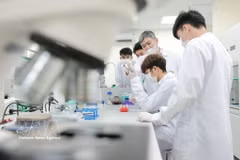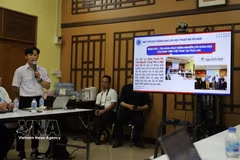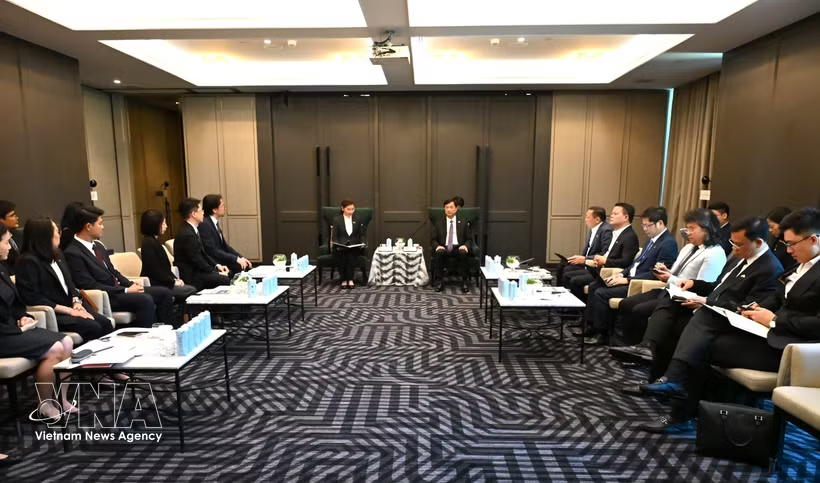
Bangkok (VNA) – A visiting delegation from Vietnam’s Central Steering Committee for the Development of Science, Technology, Innovation and Digital Transformation held talks with Thailand’s National Science and Technology Development Agency (NSTDA) on May 28, opening up prospects for deeper cooperation and greater exchanges of experience in institutional development and sci-tech governance.
The Vietnamese delegation was led by Nguyen Duy Ngoc, Politburo member, Secretary of the Party Central Committee, Head of the Party Central Committee’s Organisation Commission and standing deputy head of the Steering Committee.
At the meeting, Assoc. Prof. Dr. Chaowaree Adthalungrong, Executive Director of the NSTDA’s National Centre for Genetic Engineering and Biotechnology (BIOTEC), said the two countries share many similarities in climate, natural conditions, crops and challenges relating to disease management in plants and livestock. Given these similarities, she said, strengthening the partnership was essential to address common challenges.
Over recent years, NSTDA has built strong partnerships with Vietnamese research institutes and organisations in agriculture, biotechnology, energy and sustainable development. Notable examples include joint projects on cassava value chains, salt-tolerant rice, biotechnology products and an initiative on green energy cooperation and development in the Mekong basin.
Chaowaree expressed her hope that the latest discussions, focusing on salt-resistant rice, poultry vaccines and BIOTEC’s areas of expertise, would lay the groundwork for broader long-term collaboration between the two sides.
Addressing the meeting, Ngoc praised the extensive experience and longstanding cooperation between BIOTEC, NSTDA and Vietnamese agencies, expressing his hope that the discussions would soon deliver tangible outcomes across research, production and practical application.
He stressed that Vietnam has clearly defined its strategic direction through Resolution No. 57-NQ/TW, which places science and technology, innovation and digital transformation at the centre of the country’s future development strategy.
Highlighting similarities in the development orientations of the two countries, Ngoc said he believes the meeting would provide valuable lessons for Vietnam, particularly in fostering breakthroughs, encouraging innovative thinking in governance and developing practical business models.
He proposed that both sides strengthen dialogue and information-sharing in order to establish joint research and application platforms, beginning with relatively simple projects before progressing to more advanced solutions, particularly in biotechnology applications for agriculture, healthcare and medical services.
As part of the working programme, the Vietnamese delegation also conducted field studies and examined several of Thailand’s notable policy and management models currently implemented at NSTDA.
Among them was the autonomous sci-tech agency model, which allows national shared-use research centres to operate flexibly with autonomy in finance, recruitment and commercialisation outside the conventional state salary framework.
The delegation also studied Thailand’s integrated governance model under the Ministry of Higher Education, Science, Research and Innovation (MHESI), which consolidates science and technology, innovation, higher education and research within a single ministry to optimise resources.
In addition, Vietnamese officials reviewed Thailand’s science and technology cluster system, which is closely linked to special economic zones and supported by internationally standardised shared infrastructure, including a synchrotron particle accelerator. The model is expected to provide useful reference points for Vietnam as it considers restructuring its national network of high-tech parks in the coming years./.
See more
Vietnam-Asia DX Summit discusses acceleration of digital transformation to create new growth drivers
Vietnam now needs more effective digital transformation to create higher productivity, new growth models and stronger competitiveness in the AI era, said participants at the plenary session of the Vietnam-Asia DX Summit 2026.
VNeID set to become Vietnam’s all-in-one digital super app
The project aims to transform VNeID into a modern, secure and highly scalable national digital platform capable of effectively serving citizens, businesses, agencies and organisations in handling administrative procedures, accessing online public services, conducting electronic transactions and using digital utilities.
Robocon Vietnam 2026 ignites students’ passion for technological innovation
More than just a major technology competition for engineering students, this year’s event provides a platform for innovation, artificial intelligence (AI) and practical industrial applications to converge.
UNODC: Hanoi Convention should be treated as long-term commitment, not single event
Regional Representative of the UNODC for Southeast Asia and the Pacific, Delphine Schantz, recommended that countries should treat the UN Convention against Cybercrime (Hanoi Convention) as a ‘starting point,’ instead of an ‘end goal.’
Five Vietnamese scientists named among Asia’s top 100 researchers in 2026
The inclusion of Vietnamese researchers in the 2026 Asian Scientist 100 list alongside Nobel laureates highlights Vietnam’s increasing integration into the global scientific community and its expanding research capabilities.
Ho Chi Minh City views biotechnology industry as new groundbreaking growth driver
For Ho Chi Minh City, science, technology and innovation have been identified as key drivers of growth in the new development period. Biotechnology, therefore, is considered one of the sectors capable of generating high added value and promoting the transition towards a greener growth model.
Vietnamese innovation community in Singapore drives science, technology cooperation
Addressing the forum, Vietnamese Ambassador Tran Phuoc Anh expressed appreciation for the initiative to connect Vietnamese intellectuals in Singapore and make the most of the city-state’s strengths in science, technology and innovation.
Localities aim for higher growth through science, technology
Experiences from localities nationwide show that Resolution 57 is fostering a marked transformation in development mindset. Science and technology, innovation and digital transformation are increasingly becoming foundational drivers of economic growth and opening new development space for localities in the years ahead.
Experts recommend ‘five don’ts’ to protect personal data
Vietnamese authorities handled more than 30 cases involving the illegal sale and theft of personal data between 2023 and 2025, affecting over 160 million data records across sectors including health, education, finance, banking and telecommunications.
Protecting digital future in post-quantum, AI era
Participants highlighted the importance of building a proactive, synchronised and sustainable national cybersecurity ecosystem through closer cooperation among regulators, technology firms, research institutions and cybersecurity experts.
Vietnam pushes ahead with AI-powered legal infrastructure
Research by the Ministry of Justice (MoJ) shows that AI adoption in the legal sector remains constrained by fragmented, unstandardised and weakly connected legal databases. A unified national legal data ecosystem has yet to be established, while big data and AI applications are still largely confined to pilot programmes and have not been integrated across the full legislative process, including drafting, appraisal, review and inspection of legal documents.
Vietnam approves human resources development plan for atomic energy sector
The scheme aims to build a workforce with sufficient quantity, balanced structure and high-quality expertise to meet the country’s growing demand for atomic energy development and applications, while ensuring radiation safety, nuclear safety and nuclear security.
Vietnam’s startup ecosystem gains momentum on global stage
According to the Global Startup Ecosystem Index 2026 released by StartupBlink, Vietnam climbed five places to rank 50th globally, marking its highest position ever in the annual rankings.
Vietnam needs groundbreaking policies to develop major tech firms: Experts
The country is now home to around 80,000 technology firms, 1.4 times higher than the figure in 2020. Total revenue of the sector in 2025 was estimated at 198 billion USD, up nearly 26% from 2024.
Vietnam moves to build standards framework for strategic technologies, products
The strategy is designed to promote the adoption of international, regional and Vietnamese standards to serve the development of strategic technologies, strategic products and key economic sectors.
Deputy PM demands full disbursement for sci-tech in 2026
As of May 12, total disbursed capital reached 7.95 trillion VND, equivalent to 14.78% of the Prime Minister’s plan. Of this, central budget disbursement hit 4.06 trillion VND, or 14.8% of the target, while local budget disbursement exceeded 3.88 trillion VND, or 14.75%.
VinFuture 2026: Global partner network expands 14-fold after six seasons
With 17,154 nominating partners from 117 countries and territories across all five continents, the scale of the prize has grown by around 16% compared with the 2025 season and more than 14-fold compared with its inaugural year in 2021.
Da Nang exhibition showcases advanced German scientific research
The exhibition reflects the important role of science within German culture while also showcasing Germany’s broad international scientific cooperation network for students and young researchers worldwide.
Solving technology challenge through the “three-party linkage”
According to Pham Duc Nghiem, Deputy Director of the Department of Startups and Technology Enterprises under the Ministry of Science and Technology, the “three party” linkage model involving the State, research institutes/universities and enterprises is becoming essential for developing strategic technologies. Enterprises provide practical problems, universities and research institutes develop technological solutions, while the State creates support mechanisms and policies to accelerate commercialisation.
Young Vietnamese intellectuals in Thailand promote innovation cooperation
Vietnamese students and intellectuals in Thailand could contribute to promoting Vietnam’s image internationally by actively organising and participating in Vietnamese cultural festivals and exchange activities.