Vietnam seeks deeper integration into smart electronics supply chains

Vietnam's electronics industry contributed around 164 billion USD to total export turnover in 2025 and is projected to reach 200 billion USD in 2026, continuing to play a key role in driving economic growth, job creation and economic restructuring.

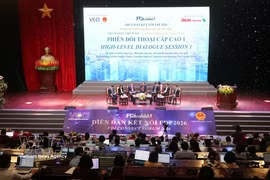
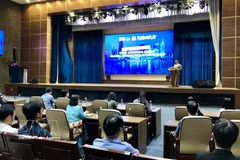
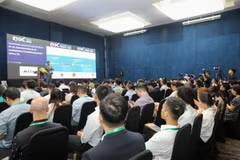
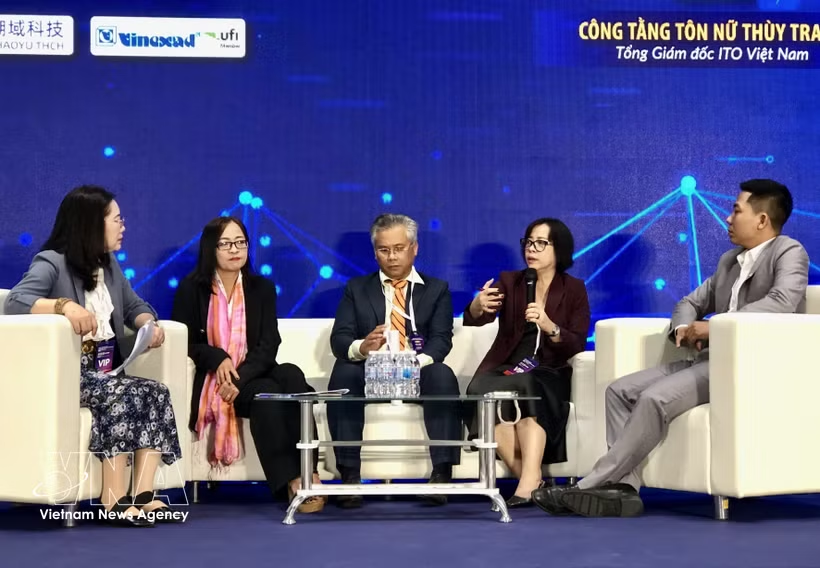
Participants in the forum in Ho Chi Minh City on May 28 (Photo: VNA)

Ho Chi Minh City (VNA) – Vietnam is facing major opportunities to integrate more deeply into global technology value chains, particularly in electronics, semiconductors, smart manufacturing and high-tech supporting industries, experts and businesses said at a smart electronics supply chain connectivity forum held in Ho Chi Minh City on May 28.

The forum, organised by the Vietnam Electronic Industries Association (VEIA), highlighted how geopolitical shifts, supply chain restructuring, technological competition among major powers, and the rapid development of artificial intelligence (AI), semiconductors and smart manufacturing are reshaping the global electronics industry.

According to Nguyen Thi Nhu Phuong, head of VEIA’s representative office in Ho Chi Minh City, smart supply chains have now become a strategic foundation of the global digital economy, with AI, big data, automation, ESG standards and technological innovation increasingly determining the competitiveness of countries and businesses.

Experts noted that Vietnam has strong potential to become a new connectivity hub for Asia’s smart electronics industry if it can effectively capitalise on investment shifts, strengthen domestic enterprises and enhance linkages between local firms and global technology corporations.

From the perspective of foreign-invested enterprises, Cong Tang Ton Nu Thuy Trang, General Director of ITO Vietnam, said the electronics industry has become a core pillar of the digital economy and the new industrial revolution.

She added that global corporations are restructuring supply chains towards greater diversification and flexibility, while prioritising countries with a stable investment environment, strong connectivity, modern technological development potential.

However, businesses are also facing growing challenges related to ESG requirements, international standards, data security, automation and innovation capacity, making the development of a highly adaptive smart electronics supply chain ecosystem increasingly important.

Vietnam's electronics industry contributed around 164 billion USD to total export turnover in 2025 and is projected to reach 200 billion USD in 2026, continuing to play a key role in driving economic growth, job creation and economic restructuring./.

VNA

See more

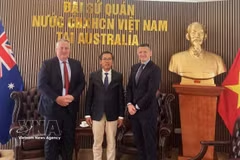
Vietnamese Consul General in Perth Pham Hai Anh (R) meets with David Morgan, Chairman of the Western Australia – Vietnam Business Council (WAVBC) on May 28. (Photo published by VNA)

Vietnam seeks stronger cooperation with Western Australia

Anh stressed that strong political relations between Vietnam and Australia should continue to be translated into practical and effective economic and investment cooperation programmes that are commensurate with the potential and needs of both sides.

Customers buy petrol at a Petrolimex station in Hanoi (Photo: VNA)

Petrol prices cut from 15:00 on May 28

From 15:00 on May 28, E5RON92 petrol is capped at 23,258 VND (0.88 USD) per litre, down 1,082 VND, while RON95-III is sold for no more than 24,154 VND per litre, down 1,395 VND.

A booth at the IEAE 2026 in Ho Chi Minh City. (Photo: VNA)

Over 300 firms join Vietnam smart electronics exhibition

Vietnamese businesses have advantages in understanding domestic consumer demand, after-sales services and the ability to quickly adapt to market changes, helping them compete not only on price but also build long-term brand trust.

The Cat Linh - Ha Dong urban railway line, which began operation on November 6, 2021, is the first of its kind in Vietnam. (Photo: VNA)

Hanoi prepares to launch 1.5-billion-USD Metro 2A extension project

The Hanoi Metropolitan Railway Management Board (MRB) announced that it will organise an Early Market Engagement (EME) event for the project on June 18-19 in Hanoi to collect feedback from domestic and international businesses and consultants before the official bidding process begins.

A Vietnamese representative introduces Vietnam International Sourcing 2026, scheduled to take place in Ho Chi Minh City from September 3-5, 2026, at the webinar. (Photo: VNA)

Vietnam, India eye win-win cooperation in fisheries sector

The recent upgrade of bilateral relations is set to open up more cooperation opportunities between Vietnamese and Indian businesses in the global fishery supply chain, said Vietnamese Trade Counsellor in India Bui Trung Thuong.

The dialogue forum held in Ho Chi Minh City on May 27 (Photo: VNA)

Forum seeks to connect Vietnamese startups with global capital

Alongside the rapid development of technology startups, the expansion of the digital workforce, and growing demand for innovation from businesses, open innovation collaboration models are becoming an important trend for connecting research, technology, markets, and investment capital flows.

VIFC-HCMC is positioned as a multi-functional international financial hub focusing on banking services, capital markets and international investment connectivity. (Photo: VNA)

Deputy PM urges strict risk control for VIFC rollout

Under the Government’s plan, VIFC-HCMC is positioned as a multi-functional international financial hub focusing on banking services, capital markets and international investment connectivity, while VIFC-DN is being developed into a specialised centre for fintech, digital finance and green finance.

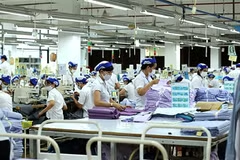
A garment and textile production line at VINATEX. (Photo: vinatex.com.vn)

Textile exports rise, but orders weaken

The latest statistics from the Vietnam Textile and Apparel Association (VITAS) show that the country’s textile and garment exports reached 14.53 billion USD in the first four months of this year, up 4.3% year-on-year.

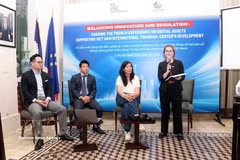
Speakers at the event. (Photo: VNA)

Vietnam, France share experience in building legal framework for digital assets

Digital assets are reshaping economic models, financial infrastructure, capital flows, investor confidence, cybersecurity frameworks and the competitiveness of existing international financial centres. These developments present common challenges for both France and Vietnam, making the exchange of practical lessons and regulatory experience increasingly important.