Digital technology helps standardise supply chains, sustain export competitiveness

Experts noted that supply chain optimisation and risk management are no longer isolated tasks for individual companies but a requirement for the entire export ecosystem. With guidance from regulators, support from industry experts and their own efforts, Vietnamese exporters are expected to enhance their competitiveness and turn technical barriers and market volatility into opportunities for sustainable growth in global markets.

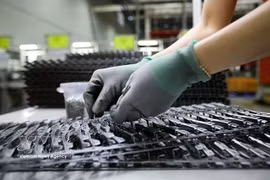
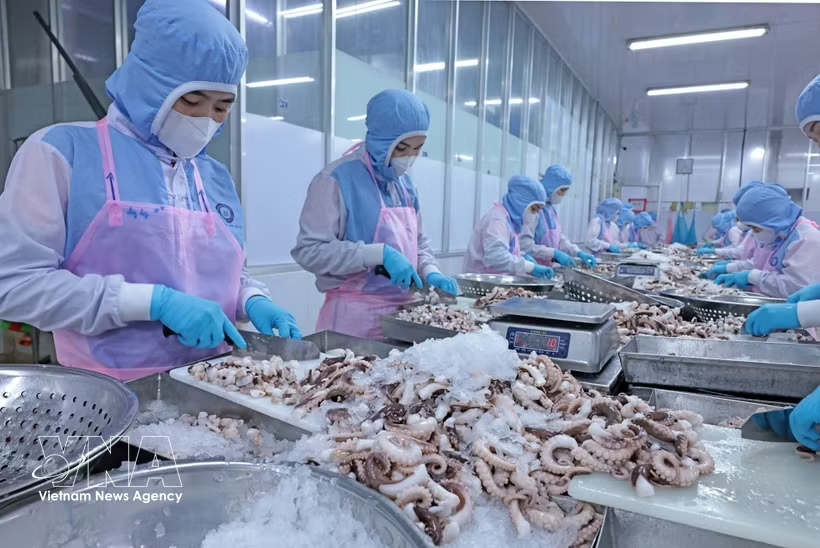
Workers process seafood for exports. (Photo: VNA)

Hanoi (VNA) – Rising logistics costs, tightening technical barriers and increasingly stringent green standards are placing growing pressure on Vietnamese exporters, making supply chain standardisation through digital technology an urgent requirement to maintain competitiveness in global markets.

As industrial production and trade showed signs of recovery in the second quarter of 2026, businesses continued to face mounting challenges from inflation, geopolitical tensions and disruptions in global logistics networks.

According to the National Statistics Office, imports of raw materials and components have been rising faster than exports, putting pressure on the trade balance. At the same time, instability in regions such as the Middle East has pushed up shipping and logistics costs, increasing the burden on enterprises’ working capital.

Beyond market volatility and geopolitical risks, sustainability standards are also reshaping global trade rules. Major export markets of Vietnam, including the EU, the US and Japan, are tightening requirements related to the Carbon Border Adjustment Mechanism (CBAM), digital product passports and supply chain traceability.

Economist Le Quoc Phuong said global supply chains are being restructured toward greater safety, transparency and environmental sustainability rather than relying solely on low-cost advantages.

Vietnamese enterprises therefore face not only risks linked to freight costs and exchange rate fluctuations, but also growing pressure to comply with new international standards, he said, warning that companies without effective risk management systems and supply chain optimisation strategies could see their profit margins eroded by rising compliance costs.

In response, many exporters have begun restructuring their operations and shifting from passive production models to proactive optimisation of the entire supply chain, from sourcing materials to manufacturing, packaging and transportation.

Nguyen Van Le, Director of Binh Minh Interior Wood Manufacturing and Export JSC, said markets such as the EU and the US are imposing increasingly strict requirements on supply chain transparency, sustainable forestry certification and intellectual property protection.

“Instead of focusing solely on delivery speed, we are now required to ensure that the entire production process complies with market standards,” he said.

The company has invested in enterprise resource planning (ERP) software to digitalise material tracking. Although the initial investment was significant, the system has helped reduce intermediate waste by around 15% while improving traceability capabilities for international partners.

Experts said the green transition and supply chain upgrading process require substantial financial and technical resources, making stronger policy support essential, particularly for small- and medium-sized enterprises.

Nguyen Cam Trang, Deputy Director of the Agency of Foreign Trade under the Ministry of Industry and Trade, said the ministry is working with Vietnam’s trade offices abroad and industry associations to develop an early warning database on trade defence measures and supply chain risks.

The ministry will also strengthen training programmes on risk management and coordinate with financial institutions to help businesses access preferential financing for production modernisation and compliance with international standards, she said.

Experts noted that supply chain optimisation and risk management are no longer isolated tasks for individual companies but a requirement for the entire export ecosystem. With guidance from regulators, support from industry experts and their own efforts, Vietnamese exporters are expected to enhance their competitiveness and turn technical barriers and market volatility into opportunities for sustainable growth in global markets./.

VNA
See more

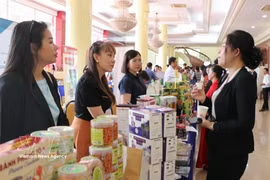
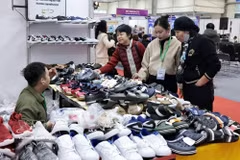
Vistors at the exxhibition (Photo: VNA)

Hanoi to host major toy and child products exhibition

According to representatives of Vinexad, the exhibition will introduce a wide range of new products, including educational toys, creative products, childcare and safety equipment, and solutions for preschool education. The event is expected to provide businesses with opportunities to secure stable supply sources, expand distribution networks and update themselves on the latest consumer and technology trends in the industry.

A Vietnamese business representative in Laos raises opinions at the forum. (Photo: VNA)

Vietnam, Laos promote trade and transport connectivity

Kingsadone Phetdaoheuang, Director General of the Foreign Trade Department under Laos’ Ministry of Industry and Commerce, Laos’ efforts to transform itself from a landlocked country into a regional connectivity hub linking the Mekong sub-region and ASEAN, creating new opportunities for industry, agriculture and cross-border trade.

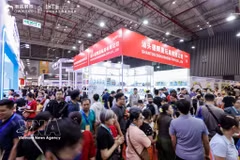
Visitors to Thailand Week 2026 in Hanoi (Photo: VNA)

Vietnam, Thailand poised to open new chapter in economic, trade cooperation

With growing two-way trade turnover, increasingly integrated supply-chain linkages, and expanding cooperation in logistics, high technology, green economy and digital transformation, Vietnam and Thailand are gradually shaping a new economic collaboration space within ASEAN that is more interconnected and complementary in nature.

Philippine experts study ways to improve rice production efficiency. (Photo: PIA.GOV.PH)

Vietnam, Philippines further boost cooperation in food security

Since establishing diplomatic relations in 1976, Vietnam and the Philippines have built a strong and substantive partnership across sectors. Despite global uncertainties, bilateral ties have continued to deepen, underpinned by mutual respect, equality, and shared interests.

Tran Duy Dong, Chairman of the Phu Tho People’s Committee, speaks at the province's investment promotion conference in Shanghai, China, in April 2026. (Photo: VNA)

Phu Tho expands strategic cooperation with Chinese enterprises

With its advantageous geographic location, ample development potential, an increasingly open investment climate, and a strong commitment to supporting businesses, Phu Tho is steadily enhancing its appeal to major Chinese corporations in high-tech industries, manufacturing and processing, logistics, energy, and strategic infrastructure.

Prime Minister Le Minh Hung chairs a working session with the Hanoi People's Committee and ministries on rental housing development in the capital on May 25, 2026. (Photo: VNA)

Rental housing a strategic segment serving public needs: PM

The PM said rental housing development must be integrated with urban planning, land-use planning, public transport, industrial zones and labour market development, with priority given to major cities, industrial parks and key economic corridors with full infrastructure.

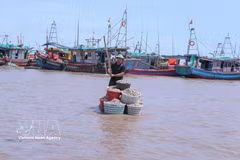
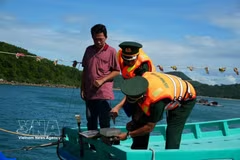
A border guard checks VMS on a fishing boat. (Photo: VNA)

An Giang subsidises VMS upgrades to fight illegal fishing

The provincial budget will cover 50% of actual invoiced costs, capped at 5 million VND (192 USD) per vessel for upgrades and 11 million VND for replacements, with vessel owners paying the remainder. The policy is framed as a shared state-citizen responsibility aimed at driving regulatory compliance. The support runs through December 31, 2026.