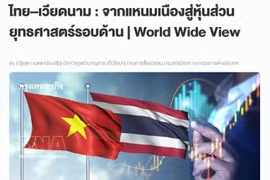
Hanoi (VNA) - As Vietnam and Thailand move toward the 50th anniversary of their diplomatic relations in 2026 and deepen ties under their newly upgraded Comprehensive Strategic Partnership, economic and trade cooperation continues to stand out as a key pillar of bilateral relations.
With growing two-way trade turnover, increasingly integrated supply-chain linkages, and expanding cooperation in logistics, high technology, green economy and digital transformation, Vietnam and Thailand are gradually shaping a new economic collaboration space within ASEAN that is more interconnected and complementary in nature.
Against this backdrop, the upcoming official visit to Thailand by General Secretary of the Communist Party of Vietnam Central Committee and State President To Lam is expected to open a new phase in bilateral trade and investment relations.
According to Vietnamese Trade Counsellor in Thailand Le Huu Phuc, economic and trade relations have achieved remarkable progress over recent years, becoming an increasingly important pillar of the Vietnam-Thailand Comprehensive Strategic Partnership.
Thailand currently remains Vietnam’s largest trading partner within ASEAN, ranking sixth among Vietnam’s global trading partners and among the country’s leading foreign investors. Bilateral trade has expanded steadily, reaching 22.1 billion USD in 2025, nearly 2.5 times higher than the level recorded in 2013 when the two countries established their Strategic Partnership.
The upward trend continued into 2026, with total bilateral trade in the first four months reaching 8.6 billion USD, up 23.9% year-on-year.
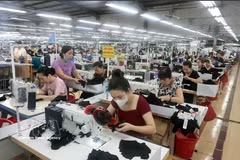
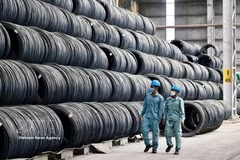
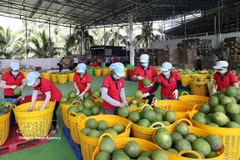
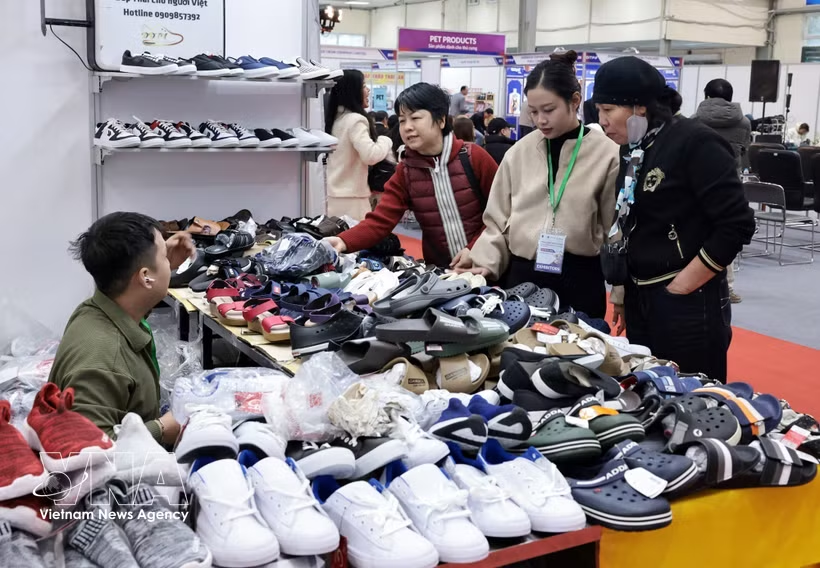
Trade structures are also evolving in a more positive direction, reflecting the improving competitiveness of Vietnamese products in the Thai market. Beyond raw materials and heavy industrial products, Vietnamese manufactured goods have increasingly secured a place in Thailand’s supply chains. Some Vietnamese digital transformation and technology products have also begun entering the Thai market alongside products from foreign-invested enterprises.
Investment cooperation is similarly identified as a major bright spot. As of April, Thailand had around 800 investment projects in Vietnam with total registered capital of 15.4 billion USD, ranking eighth among foreign investors in the country.
The presence of major Thai conglomerates in Vietnam, coupled with the growing expansion of Vietnamese enterprises into Thailand, reflects a high level of strategic confidence between the two business communities.
Supporting sectors including infrastructure, logistics, aviation, tourism and people-to-people exchanges are also experiencing rapid growth. The two countries currently operate around 400 flights per week, facilitating about 4 million passenger trips and commercial exchanges annually.
According to Phuc, both economies remain on a strong growth trajectory and are entering a new development phase focused on sustainability, modernisation, green growth and science-technology innovation, thereby creating an important foundation for new drivers of bilateral economic cooperation.
At the same time, Vietnam and Thailand are facing shared challenges related to energy security, artificial intelligence adoption and shifts in global supply chains. These challenges are also opening new opportunities for cooperation in renewable energy, green economy, circular economy and digital transformation, he added.
To Ngoc Son, deputy head of the Foreign Market Development Department under the Ministry of Industry and Trade, observed that the two economies are becoming increasingly interconnected and coordinating closely in building the ASEAN Economic Community. Beyond trade and investment, the two countries are also maintaining effective cooperation in energy, industry, culture and tourism.
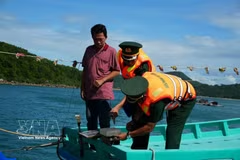
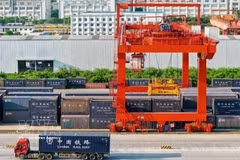
Both sides are expected to prioritise stronger business connectivity within regional supply chains, enhanced logistics and infrastructure links, and the expansion of coastal and overland transport routes connecting Vietnam, Laos and Thailand in order to reduce transportation costs and delivery times.
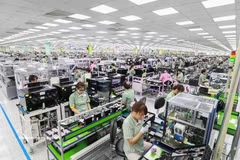
Particular attention will also be devoted to cooperation in technology-intensive sectors such as semiconductors, electronic components, printed circuit board (PCB) manufacturing and heavy industry, which are emerging as major areas of bilateral collaboration.
Phuc advised businesses to carefully study local consumer culture and distribution systems and take advantage of ASEAN trade agreements and bilateral cooperation frameworks to strengthen competitiveness.
The Trade Office of Vietnam in Thailand, he said, will continue placing businesses at the centre of efforts to achieve the bilateral trade target of 25 billion USD, while strengthening market information services, trade promotion and investment connectivity between enterprises, associations and chambers of commerce in both countries./.
VNA