Vietnam approves national strategy for modern, safe inclusive financial ecosystem

Under the national financial inclusion strategy for the 2026-2030 period, Vietnam aims for 95% of the population aged 15 and above to have transaction accounts at banks or other authorised institutions by 2030.

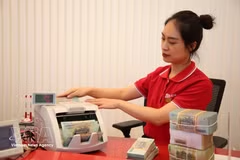
Illustrative photo (Photo: thoibaotaichinhvietnam.vn)

Hanoi (VNA) - Deputy Prime Minister Nguyen Van Thang has signed Decision No. 928/QD-TTg approving the national financial inclusion strategy for the 2026-2030 period, aiming to build a modern and safe inclusive financial ecosystem in Vietnam.

The strategy targets all citizens and businesses, with priority given to people in rural, remote, border and island areas, low-income households, students, small- and medium-sized enterprises (SMEs), cooperatives, household businesses and vulnerable groups.

​Under the strategy, Vietnam aims for 95% of the population aged 15 and above to have transaction accounts at banks or other authorised institutions by 2030.

The value of non-cash payments is expected to reach 30 times the country’s GDP, while at least 30% of adults are targeted to have savings deposits at credit institutions and foreign bank branches.

The strategy also aims for at least 300,000 SMEs to have outstanding loans at credit institutions or foreign bank branches by 2030.

Outstanding loans serving agriculture and rural development are expected to account for around 25% of total credit in the economy, while insurance sector revenue is projected to reach 3.3-3.5% of GDP.

The Government said the strategy seeks to ensure equal access to financial products and services, helping improve living standards and ensuring that no one is left behind in the development process.
vnanet-potal-giao-dich-thanh-toan-khong-dung-tien-mat-tang-4443-8087210.jpg
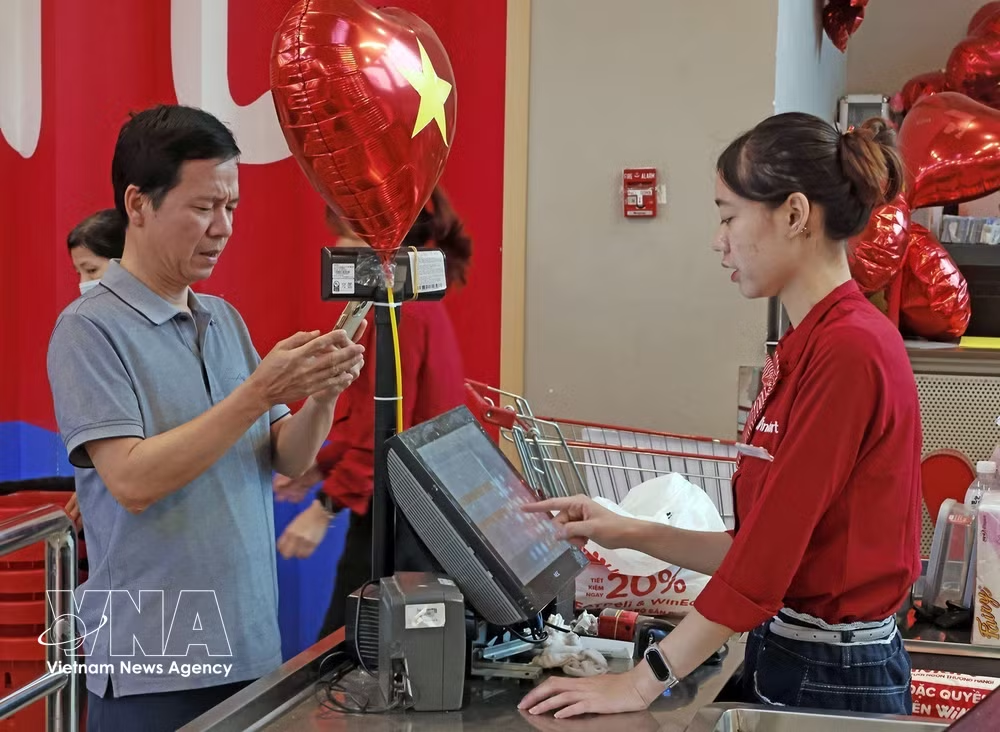
A customer uses cashless payment options at a WinMart supermarket. (Photo: VNA)

To achieve the targets, the strategy proposes a series of measures, including improving the legal framework, diversifying financial service providers and developing modern digital distribution channels at reasonable costs.

The plan also focuses on expanding access points for financial services in rural, remote and disadvantaged areas, enabling residents and businesses to access financial products more conveniently.

Authorities will promote cashless payments across the economy while encouraging the development of financial products tailored to agriculture, rural production, SMEs, cooperatives and household businesses.

The strategy also encourages cooperation between credit institutions, foreign bank branches and fintech firms to develop digital financial service models for priority groups.

A nationwide financial education programme and digital citizen programme will also be implemented to improve financial literacy and digital skills.

The Government stressed the importance of consumer protection, cybersecurity and personal data protection as financial services become increasingly digitalised.

Notably, the strategy prioritises sustainable finance and green finance development.

Credit institutions and financial service providers are encouraged to prioritise loans for green and circular economy projects and apply environmental, social and governance (ESG) standards.

The Government also plans to diversify green financial products and green credit schemes to improve access to financing for businesses and individuals pursuing green transition initiatives.

In addition, insurers are encouraged to expand microinsurance and supplementary pension products, while fintech applications are expected to help widen financial inclusion for vulnerable groups and underserved communities./.

VNA

See more

Tran Duy Dong, Chairman of the Phu Tho People’s Committee, speaks at the province's investment promotion conference in Shanghai, China, in April 2026. (Photo: VNA)

Phu Tho expands strategic cooperation with Chinese enterprises

With its advantageous geographic location, ample development potential, an increasingly open investment climate, and a strong commitment to supporting businesses, Phu Tho is steadily enhancing its appeal to major Chinese corporations in high-tech industries, manufacturing and processing, logistics, energy, and strategic infrastructure.

Prime Minister Le Minh Hung chairs a working session with the Hanoi People's Committee and ministries on rental housing development in the capital on May 25, 2026. (Photo: VNA)

Rental housing a strategic segment serving public needs: PM

The PM said rental housing development must be integrated with urban planning, land-use planning, public transport, industrial zones and labour market development, with priority given to major cities, industrial parks and key economic corridors with full infrastructure.

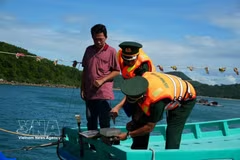
A border guard checks VMS on a fishing boat. (Photo: VNA)

An Giang subsidises VMS upgrades to fight illegal fishing

The provincial budget will cover 50% of actual invoiced costs, capped at 5 million VND (192 USD) per vessel for upgrades and 11 million VND for replacements, with vessel owners paying the remainder. The policy is framed as a shared state-citizen responsibility aimed at driving regulatory compliance. The support runs through December 31, 2026.

Cargo transit through Nanning International Railway Port before heading to Vietnam’s Yen Vien station. (Photo: VNA)

Vietnam, China add cross-border rail link in trade push

China Railway Nanning Group said a container train hauling 170 tonnes of calcium hydroxide left Guigang station in the Guangxi Zhuang Autonomous Region on May 23 afternoon. The shipment transited through Nanning International Railway Port before heading to Vietnam’s Yen Vien station. The corridor is a new cross-border logistics addition following the launch of the Liuzhou-Nanning-Vietnam rail service.

Customers conduct transactions at the head office of Bao Viet Securities Company in Hanoi. (Photo: VNA)

SOE equitisation urged to improve quality, attract foreign capital

Major policies have been introduced to strengthen the financial market and improve the role of SOEs. Notably, Politburo Resolution No.79-NQ/TW dated January 6, 2026 on State economic development requires SOEs to serve as the core force of the State economy, operate effectively under market principles and adopt modern, transparent governance standards with regional and international competitiveness.

Director of the Agency for Domestic Market Management and Development Tran Huu Linh joins celebrities during the “Vitality of Vietnamese Goods” livestream session (Photo: gdnd)

From tradition to digitalisation: Elevating Vietnamese goods

For many years, the campaign “Vietnamese people prioritise using Vietnamese goods” has played an important role in promoting domestic consumption and supporting local businesses. Today, alongside traditional trade fairs and distribution channels, digital platforms are creating new opportunities for Vietnamese products to increase their competitiveness.

Vice Chairman of the National Assembly (NA) Nguyen Hong Dien receives a delegation from the European Chamber of Commerce in Vietnam (EuroCham) in Hanoi on May 22. (Photo: VNA)

Vietnam, EU promote substantive, effective economic cooperation

The NA always attaches importance to improving institutional frameworks and building a comprehensive, transparent and development-enabling legal environment to support both domestic and foreign businesses, including European enterprises operating in Vietnam, said NA Vice Chairman Nguyen Hong Dien.