Basic science research must be reformed to meet national development requirements: top leader

Party General Secretary and State President To Lam stressed that reform in basic science research must encompass awareness, institutional frameworks, investment mechanisms, and implementation methods. He described the issue as a strategic matter directly linked to Vietnam’s development model, national self-reliance and international standing in the 21st century.

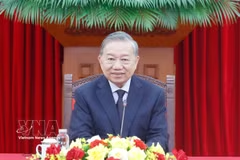
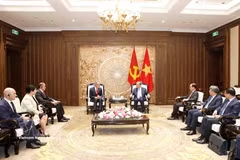
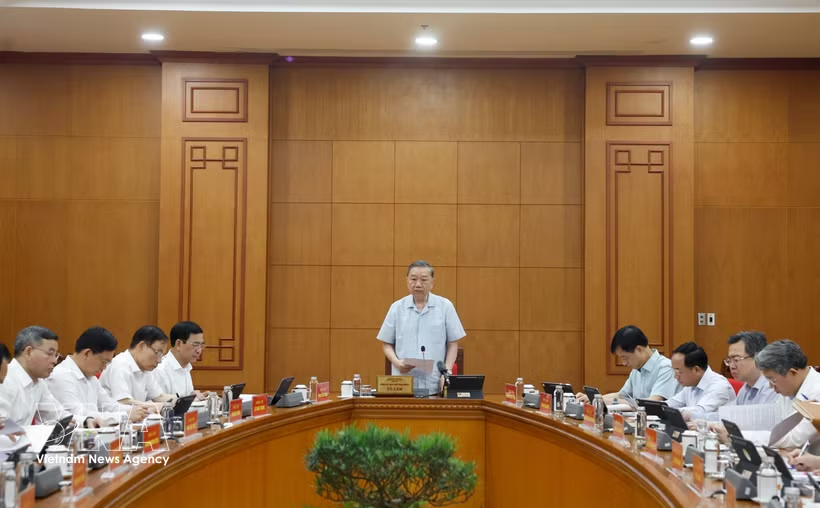
Party General Secretary and State President To Lam speaks at the meeting of standing members of the Steering Committee on science and technology development, innovation and digital transformation on May 25. (Photo: VNA)

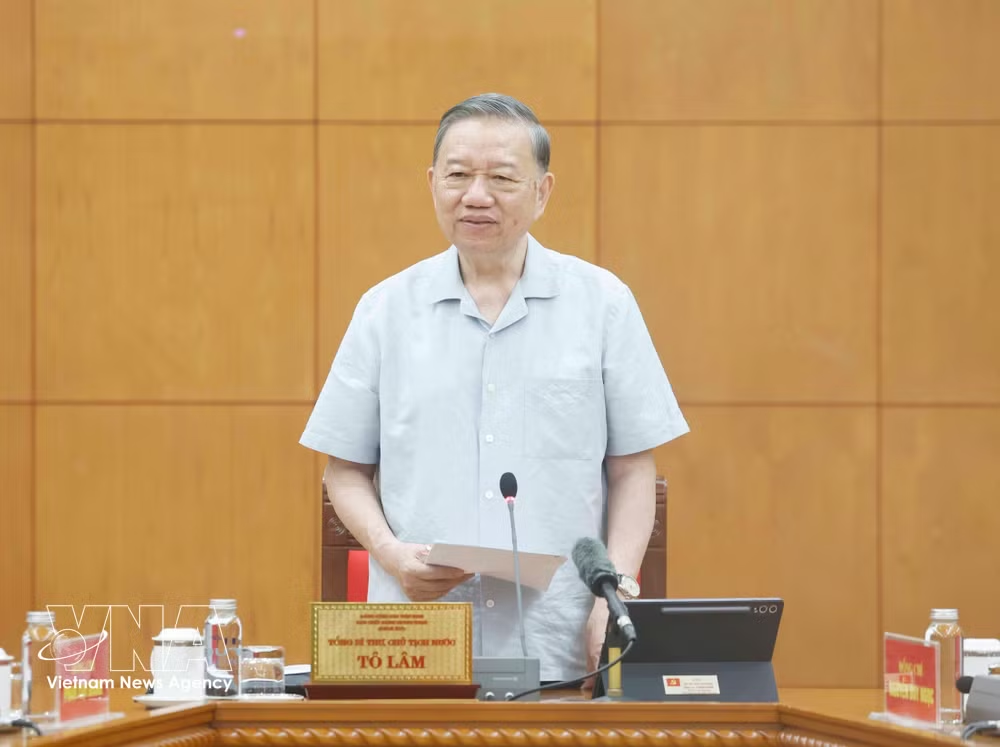
Hanoi (VNA) - Party General Secretary and State President To Lam chaired a meeting of standing members of the Steering Committee on science and technology development, innovation and digital transformation on May 25, emphasising that basic science research must undergo comprehensive reform to meet the country’s development demands in the new era.

General Secretary and President Lam stressed that reform in basic science research must encompass awareness, institutional frameworks, investment mechanisms, and implementation methods. He described the issue as a strategic matter directly linked to Vietnam’s development model, national self-reliance and international standing in the 21st century.

According to the leader, perceptions regarding the role of basic scientific research have changed significantly in recent years. While it was previously viewed mainly as a highly specialised academic activity in universities and research institutes, it is now increasingly recognised as the nation’s knowledge foundation and a basis for developing core technologies, elite human resources, strategic forecasting capacity and long-term autonomy capability.

However, he noted that the sector still faces many shortcomings and bottlenecks that are not commensurate with the country’s development requirements. Investment remains limited, while Vietnam has yet to establish a strong, stable and long-term national ecosystem for basic research. Research activities remain fragmented, lacking close coordination, strong scientific schools and internationally competitive research groups aligned with national development strategies.

He also pointed to administrative-heavy management mechanisms, the shortage of modern laboratories, shared computational infrastructure and large-scale scientific databases, as well as inadequate long-term investment mechanisms for leading research teams. Human resources, he said, remain a strategic bottleneck, with a shortage of top scientists in many fields and insufficient support for younger generations of researchers.

The top leader highlighted the strategic importance of social sciences and humanities, stressing that while natural sciences and technology form the foundation for production and technological capacity, social sciences and humanities underpin governance, institution-building, cultural development and social stability.

A country may import technology, but it cannot import a development model suited to its own history, culture and conditions, he said, emphasising the crucial role of social sciences and humanities in theoretical research, policymaking, legal development, strategic forecasting and safeguarding the Party’s ideological foundation.

The Party General Secretary and State President called for the development of a modern, autonomous and internationally integrated basic research system capable of generating new knowledge, training elite human resources and supporting strategic policymaking and technological development for rapid and sustainable national growth.

He set out major targets through 2030 and toward 2045, including the removal of institutional bottlenecks, the establishment of a relatively synchronised national research ecosystem, the development of leading research centres and internationally competitive fields of basic science.
vnanet-potal-tong-bi-thu-chu-tich-nuoc-chu-tri-cuoc-hop-thuong-truc-ban-chi-dao-ve-nghien-cuu-khoa-hoc-co-ban-8782294.jpg
Party General Secretary and State President To Lam speaks at the meeting of standing members of the Steering Committee on science and technology development, innovation and digital transformation on May 25. (Photo: VNA)

General Secretary and President Lam also underscored the need to shift scientific governance from administrative management to creative governance, emphasising post-audit mechanisms, long-term impact evaluation and protection of academic freedom alongside scientific integrity and accountability.

He further stressed that people must remain at the centre of scientific development, calling for a comprehensive ecosystem to identify, train, nurture and attract scientific talent, including overseas Vietnamese intellectuals.

He also proposed building strategic national data and knowledge infrastructure, including key laboratories, shared high-performance computing systems, digital libraries and scientific and social databases, noting that data should be regarded as a strategic infrastructure asset in the AI era.

The leader also called for stronger and more selective international cooperation, including efforts to attract foreign experts, scientists and overseas Vietnamese intellectuals; expand partnerships with leading global scientific centres to raise research standards; train the next generation of researchers; and narrow knowledge gaps. At the same time, he stressed the importance of safeguarding data, intellectual property, knowledge security and national interests./.
VNA

See more

Vice President of Lao National Assembly (NA) Sounthone Xayachak and her delegation at the site of the Dakcheung bauxite mining and alumina processing complex in Dakcheung district, Laos’ Xekong province, on May 23. (Photo: VNA)

Lao senior legislator visits major Vietnamese-invested project

A delegation of the Lao National Assembly (NA), led by its Vice President Sounthone Xayachak, on May 23 visited and inspected the progress of the Dakcheung bauxite mining and alumina processing complex, a major industrial project invested by Vietnam’s Viet Phuong group in Dakcheung district, Laos’ Xekong province.

Ambassador Do Hung Viet, in his capacity as President of the 11th NPT Review Conference, announces the conclusion of the conference. (Photo: VNA)

11th NPT Review Conference under Vietnam’s Presidency concludes

In a statement issued after the conference, UN Secretary-General Antonio Guterres particularly commended Vietnam, in its role as President of the Conference, for its tireless efforts to promote substantive outcomes aimed at strengthening the NPT and advancing the treaty’s objectives.

Deputy Foreign Minister Nguyen Manh Cuong (Photo: VNA)

Top leader’s Thailand visit expected to generate new momentum for bilateral cooperation

The upcoming official visit to Thailand by General Secretary of the Communist Party of Vietnam (CPV) and State President To Lam will also provide an opportunity for the two countries’ senior leaders to hold in-depth discussions on major orientations for effectively implementing the new cooperation framework, Deputy Foreign Minister Nguyen Manh Cuong told the press ahead of the trip.

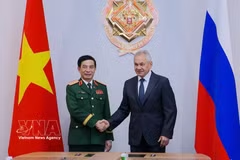
Deputy Prime Minister and Minister of National Defence General Phan Van Giang (L) meets with General Sergei Shoigu, Secretary of the Security Council of the Russian Federation (Photo: VNA)

Vietnam, Russia step up maritime cooperation

Vietnam and Russia agreed to continue coordinating the implementation of signed agreements, focusing on enhancing naval cooperation, expanding marine scientific research, developing maritime transport and strengthening specialised training programmes.

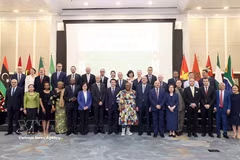
Delegates at the ceremony marking the 63rd Africa Day (May 25, 1963 – 2026) in Hanoi on May 22. (Photo: VNA)

Vietnam seeks deeper cooperation with African countries

Reviewing the historical ties between Vietnam and African countries, the deputy minister stressed that the close relationship was founded in the 1920s by President Ho Chi Minh and African revolutionary leaders. Building on that tradition of solidarity, the two sides have stood side by side throughout their struggles for national independence in the past as well as in the current cause of national construction and development.

The meeting between Party General Secretary and State President To Lam and David Zapolsky, Senior Vice President and Chief Global Affairs and Legal Officer at Amazon, in Hanoi on May 22 (Photo: VNA)

Top leader pledges favourable conditions for US tech firms to invest in Vietnam

Vietnam considers the US one of its most important partners, the top leader said, expressing his wish that the bilateral relationship will continue to grow in line with the Comprehensive Strategic Partnership, with economic, trade and investment ties as the main engine and sci-tech cooperation as a new breakthrough.

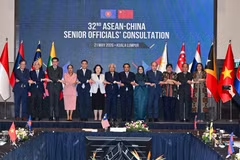
Senior Officials of ASEAN member states and China met on May 21 in Kuala Lumpur for the 32nd ASEAN-China Senior Officials’ Consultation (ACSOC) (Photo: Ministry of Foreign Affairs)

Vietnam underscores importance of international law at ASEAN-China meetings

Deputy Foreign Minister Dang Hoang Giang, head of the ASEAN Senior Officials’ Meeting (SOM) delegation of Vietnam, led a Vietnamese delegation to attend the 32nd ASEAN-China Senior Officials’ Consultation (ACSOC) and the 26th ASEAN-China Senior Officials’ Meeting on the Implementation of the Declaration on the Conduct of Parties in the East Sea (ASEAN-China SOM-DOC) in Kuala Lumpur, Malaysia, on May 21.

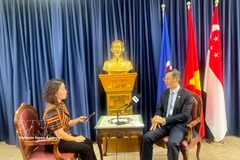
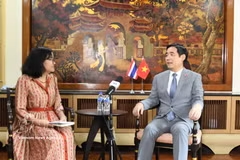
Vietnamese Ambassador to Thailand Pham Viet Hung (R) grants an interview to the Vietnam News Agency (Photo: VNA)

Vietnam–Thailand partnership set for stronger momentum: Ambassador

Vietnamese Ambassador to Thailand Pham Viet Hung said the upcoming official visit to Thailand by General Secretary of the Communist Party of Vietnam Central Committee and State President To Lam will provide an opportunity for leaders of both countries to review achievements over the past five decades while opening up new directions for cooperation, helping elevate bilateral ties to a deeper and more effective level in line with the interests of both peoples and the goals of regional peace, cooperation and development.

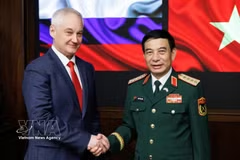
Vietnamese Deputy Prime Minister and Minister of National Defence General Phan Van Giang (right) shakes hands with Russian Defence Minister Andrey Removich Belousov on May 21 (Photo: VNA)

Vietnam, Russia seek to deepen defence cooperation

To elevate bilateral defence cooperation more substantively and effectively in line with agreements reached by senior leaders of both countries, the two sides agreed to continue implementing cooperation contents already agreed upon. Priority areas include effectively carrying out signed cooperation documents; exchanging and signing new agreements in line with the needs of both sides; sharing experience; cooperation in humanitarian mine clearance, military history education and communications; training cooperation; and promoting cooperation between the Vietnam–Russia Tropical Science and Technology Research Centre and units under the Russian Ministry of Defence.

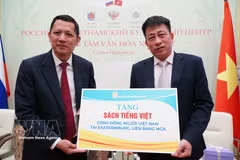
Editor-in-Chief of the Vietnam Education Publishing House Pham Vinh Thai (right) symbolically presents books to the Vietnamese community in Russia. (Photo: VNA)

Russia-Vietnam Cultural Centre opens pathways to new career opportunities

With support from the Saint Petersburg Committee for External Relations and the Russia-Vietnam “Traditions and Friendship” Cooperation Promotion Foundation, more than 500kg of books introducing Vietnamese history, culture and language were transported to Saint Petersburg for donation to the Russia-Vietnam Cultural Centre.