An Giang (VNA) – With the APEC Economic Leaders’ Week 2027 (APEC 2027) as a catalyst, Phu Quoc special zone in the Mekong Delta province of An Giang is pushing ahead with a sweeping green transition to become a benchmark eco-island for the region that meets international standards in environmental quality, green infrastructure, and urban governance.
To realise this vision, An Giang is developing a green transition plan for Phu Quoc for 2026–2035, with a vision to 2050, basing on six core pillars aimed at reducing emissions, restoring ecosystems, and ensuring sustainable growth.
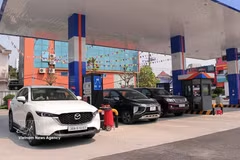
Accordingly, Phu Quoc will prioritise the development of green public transport, electrify tourism and passenger transport services, and expand charging infrastructure and battery-swapping stations, while creating pedestrian and cycling spaces.
By 2027, the share of green-powered public transport is expected to rise from 15% to 50%. Green transport corridors will connect the airport, seaports, urban centres, tourist zones, and APEC venues, while reliance on fossil-fuel vehicles will be gradually reduced to improve travel experiences for both residents and visitors.
Urban infrastructure upgrades will focus on clean water supply, waste and wastewater treatment, flood mitigation, and expanding green spaces. By 2030, all residents are expected to have access to clean water, while modern waste treatment coverage is targeted at 90%.
Tourism – Phu Quoc’s economic backbone – is being reshaped around sustainability and quality. A “Green label” certification for tourism businesses will be piloted in 2026–2027. Visitors will be able to enjoy cleaner beaches with at least 70% meeting environmental standards, and accommodation providers committed to eliminating single-use plastic products.
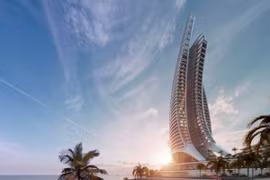
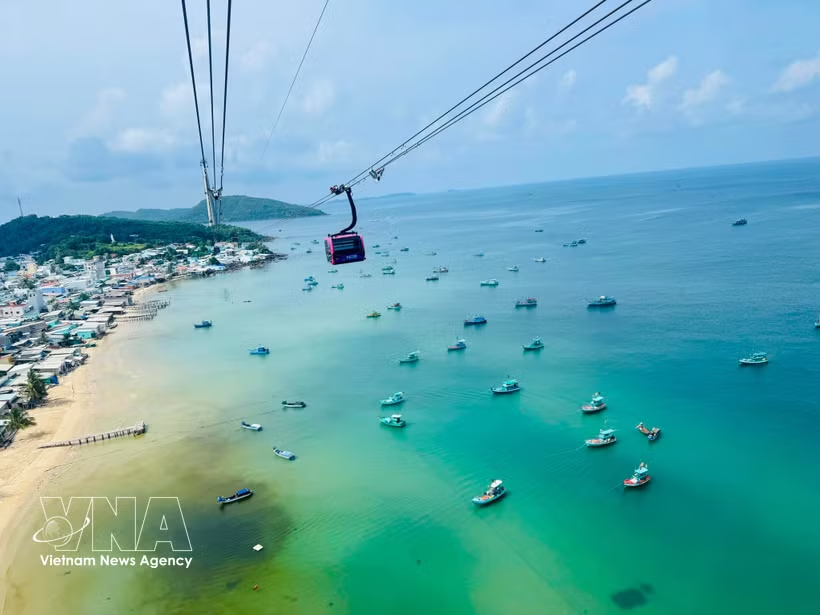
A corner of the Phu Quoc special zone, An Giang province, from the Hon Thom cable car – the world’s longest over-sea cable system. (Photo: VNA)
Protecting natural ecosystems remains central to the island’s long-term competitiveness. Local authorities are prioritising the restoration of degraded coral reefs, seagrass beds, and natural forests, alongside stricter protection of critical habitats, biodiversity monitoring, and enhanced water security.
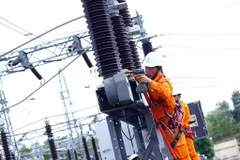
Regarding energy development, Phu Quoc aims to reduce dependence on high-emission grid power by promoting rooftop solar systems combined with storage at hotels and resorts. Renewable energy is projected to account for 35% of total electricity by 2027 and 50% by 2035.
Equally important is governance driven by data and community engagement. The success of the green transition is said to depend heavily on behavioural changes among residents, tourists, and businesses. In the short term, the island targets 100% waste sorting at source.
The 2026–2027 period is defined as an “acceleration phase”, focusing on visible and high-impact projects in preparation for APEC 2027, including island-wide EV charging infrastructure, smart lighting and intelligent transport systems, and a “plastic-free tourism” initiative at key destinations.
The local leaders have reaffirmed the province’s determination in implementing the plan, viewing it as a foundation for long-term sustainable development to create new values. Chairman of the provincial People’s Committee Ho Van Mung has urged swift finalisation of the roadmap, alongside incentives to support electric vehicle adoption and green business practices.
Urgent measures are also being rolled out, including integrating green transition criteria such as urban tree density, charging stations and EV battery-swapping points into zoning plans and adjustments to Phu Quoc’s master plan, as well as issuing architectural management regulations to ensure orderly and well-structured urban development.
Authorities plan to ban plastic bags and bottles on ferries and at markets, and pilot restrictions on gasoline vehicles on major boulevards once infrastructure is ready.
Consultants will be engaged to fast-track the issuance of green certifications for tourism businesses, while digital tools will be used to promote eco-compliant destinations to travelers.
With more than 137 trillion VND (over 5 billion) earmarked for APEC-related investments, Phu Quoc is positioning itself not only as the host of a global event, but as a pioneering net-zero island, aspiring to become a “Green lighthouse” that inspires sustainable development across the region and the world./.