Vietnam, Laos promote trade and transport connectivity

Kingsadone Phetdaoheuang, Director General of the Foreign Trade Department under Laos’ Ministry of Industry and Commerce, Laos’ efforts to transform itself from a landlocked country into a regional connectivity hub linking the Mekong sub-region and ASEAN, creating new opportunities for industry, agriculture and cross-border trade.

A Vietnamese business representative in Laos raises opinions at the forum. (Photo: VNA)

Vientiane (VNA) – Vietnam and Laos are stepping up cooperation in trade, transport and logistics connectivity as both countries seek to strengthen supply chains and facilitate cross-border commerce, officials said at the Vietnam – Laos Logistics Business Forum 2026 held in Vientiane on May 26.

The forum was jointly organised by the Lao Ministry of Industry and Commerce’s Foreign Trade Department, the Vietnamese Ministry of Industry and Trade’s Agency of Foreign Trade, and the Vietnam Trade Office in Laos. It brought together government officials, industry associations and hundreds of businesses operating in logistics, multimodal transport, warehousing, import-export and e-commerce.

Speaking at the event, Kingsadone Phetdaoheuang, Director General of the Foreign Trade Department under Laos’ Ministry of Industry and Commerce, said the forum was aimed at translating bilateral cooperation agreements into concrete action. She highlighted Laos’ efforts to transform itself from a landlocked country into a regional connectivity hub linking the Mekong sub-region and ASEAN, creating new opportunities for industry, agriculture and cross-border trade.

To realise this vision, Laos is implementing its Trade and Transport Facilitation Action Plan for 2025–2030, which targets to cut import-export licensing times by at least 40%, reduce customs clearance times at border gates by a minimum of 50%, raise the national Logistics Performance Index (LPI) by at least 40%, and eliminate at least half of unnecessary checkpoints along domestic transport routes. The country is also seeking Vietnam’s support in sharing experience and enhancing logistics infrastructure transport routes.

Laos is focusing on 12 strategic measures under the direction of the National Trade and Transport Facilitation Committee, she said, adding that the country hopes Vietnam will share its experience and strengthen connectivity in warehousing infrastructure to help ease transport cost bottlenecks and expand access to the sea through the Vung Ang Port complex in Ha Tinh, central Vietnam.

Tran Thanh Hai, Deputy Director General of Vietnam’s Agency of Foreign Trade, said logistics cooperation between the two countries should become more modern, integrated and sustainable amid global trends toward digitalisation, green development and resilient supply chains. He called for closer collaboration in logistics infrastructure, multimodal transport, digital transformation, customs modernisation and business connectivity.

Hai underlined the significant potential for logistics cooperation between Vietnam and Laos, noting that Vietnam has advantages in seaport infrastructure, logistics network and international connectivity, while Laos holds a strategic position in the Greater Mekong Sub-region as a vital link between ASEAN and inland Asia.

He said that with more effective linkages, the two economies could complement each other in developing regional supply chains, not only meeting bilateral transport and trade but also attracting transit cargo from third countries, thereby generating higher added value for both countries’ logistics sectors.

During discussions, participants identified high cross-border logistics costs, infrastructure bottlenecks, procedural issues at some border gates and incompatibility in electronic customs documentation as key challenges. They agreed that greater digitalisation and investment in multimodal transport, including road, sea and the proposed Vung Ang – Vientiane railway route, would help address these obstacles.

The forum is expected to open a new chapter in Vietnam – Laos economic cooperation, supporting the goal of raising bilateral trade turnover to more than 4 billion USD in 2026 and eventually 10 billion USD by 2030./.
VNA

See more

Visitors to Thailand Week 2026 in Hanoi (Photo: VNA)

Vietnam, Thailand poised to open new chapter in economic, trade cooperation

With growing two-way trade turnover, increasingly integrated supply-chain linkages, and expanding cooperation in logistics, high technology, green economy and digital transformation, Vietnam and Thailand are gradually shaping a new economic collaboration space within ASEAN that is more interconnected and complementary in nature.

Philippine experts study ways to improve rice production efficiency. (Photo: PIA.GOV.PH)

Vietnam, Philippines further boost cooperation in food security

Since establishing diplomatic relations in 1976, Vietnam and the Philippines have built a strong and substantive partnership across sectors. Despite global uncertainties, bilateral ties have continued to deepen, underpinned by mutual respect, equality, and shared interests.

Tran Duy Dong, Chairman of the Phu Tho People’s Committee, speaks at the province's investment promotion conference in Shanghai, China, in April 2026. (Photo: VNA)

Phu Tho expands strategic cooperation with Chinese enterprises

With its advantageous geographic location, ample development potential, an increasingly open investment climate, and a strong commitment to supporting businesses, Phu Tho is steadily enhancing its appeal to major Chinese corporations in high-tech industries, manufacturing and processing, logistics, energy, and strategic infrastructure.

Prime Minister Le Minh Hung chairs a working session with the Hanoi People's Committee and ministries on rental housing development in the capital on May 25, 2026. (Photo: VNA)

Rental housing a strategic segment serving public needs: PM

The PM said rental housing development must be integrated with urban planning, land-use planning, public transport, industrial zones and labour market development, with priority given to major cities, industrial parks and key economic corridors with full infrastructure.

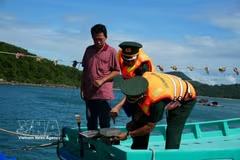
A border guard checks VMS on a fishing boat. (Photo: VNA)

An Giang subsidises VMS upgrades to fight illegal fishing

The provincial budget will cover 50% of actual invoiced costs, capped at 5 million VND (192 USD) per vessel for upgrades and 11 million VND for replacements, with vessel owners paying the remainder. The policy is framed as a shared state-citizen responsibility aimed at driving regulatory compliance. The support runs through December 31, 2026.

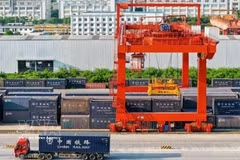
Cargo transit through Nanning International Railway Port before heading to Vietnam’s Yen Vien station. (Photo: VNA)

Vietnam, China add cross-border rail link in trade push

China Railway Nanning Group said a container train hauling 170 tonnes of calcium hydroxide left Guigang station in the Guangxi Zhuang Autonomous Region on May 23 afternoon. The shipment transited through Nanning International Railway Port before heading to Vietnam’s Yen Vien station. The corridor is a new cross-border logistics addition following the launch of the Liuzhou-Nanning-Vietnam rail service.

Customers conduct transactions at the head office of Bao Viet Securities Company in Hanoi. (Photo: VNA)

SOE equitisation urged to improve quality, attract foreign capital

Major policies have been introduced to strengthen the financial market and improve the role of SOEs. Notably, Politburo Resolution No.79-NQ/TW dated January 6, 2026 on State economic development requires SOEs to serve as the core force of the State economy, operate effectively under market principles and adopt modern, transparent governance standards with regional and international competitiveness.