ASEAN Future Forum 2026 to open on June 9 with expanded agenda: ministry

Deputy Foreign Minister Nguyen Manh Cuong told reporters that the forum, first proposed by the Vietnamese Prime Minister at the 43rd ASEAN Summit in Indonesia in September 2023, has been successfully organised in 2024 and 2025, gradually establishing itself as an open dialogue platform that effectively complements ASEAN’s formal processes.

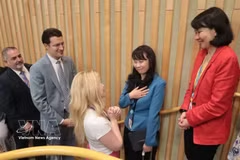
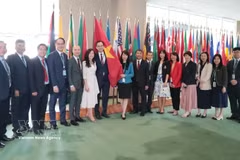
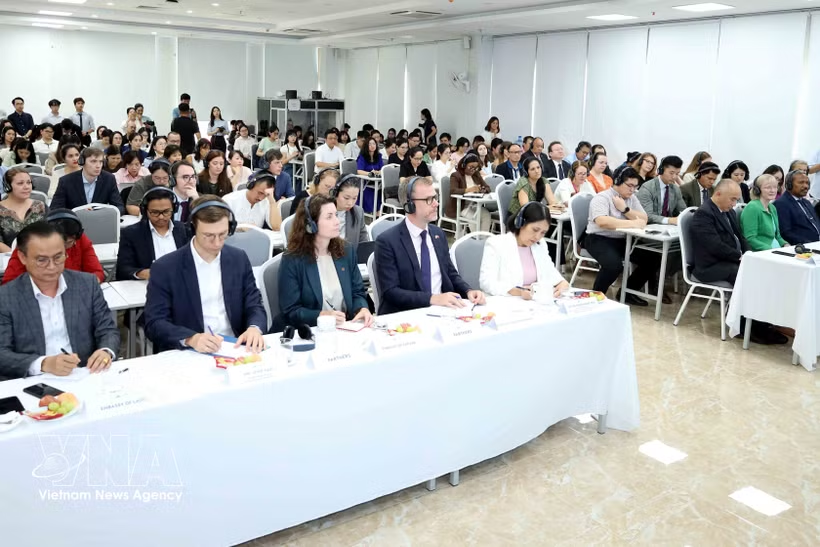
Participants in the international press briefing on May 26 (Photo: VNA)

Hanoi (VNA) – The ASEAN Future Forum 2026 (AFF 2026) will run in Hanoi on June 9-10, the Vietnamese Ministry of Foreign Affairs told an international press briefing in the capital on May 26.

Deputy Foreign Minister Nguyen Manh Cuong told reporters that the forum, first proposed by the Vietnamese Prime Minister at the 43rd ASEAN Summit in Indonesia in September 2023, has been successfully organised in 2024 and 2025, gradually establishing itself as an open dialogue platform that effectively complements ASEAN’s formal processes.

Cuong stressed that AFF 2026 carries major strategic significance for the host as it will be the first large-scale, high-level multilateral diplomatic event hosted by Vietnam following the success of the 14th National Party Congress, the 16th National Assembly election, and the consolidation of Party and State leadership positions.

A successful forum, he said, will provide a vivid proof of Vietnam’s foreign policy of independence, self-reliance, and peace, while further projecting the image of a dynamic, developing and deeply integrated Vietnam in the region and beyond.

This year’s forum is built around the theme “Shaping a Shared Future Together: Peace, Prosperity and People-Centred Development”. Cuong said the choice directly targets the most urgent demands of the current era amid increasingly complex geopolitical landscape, while also reflecting Vietnam’s strategic vision.

Placing people at the centre, he stressed, is not merely a slogan but a guiding principle for ASEAN Community building, ensuring that the interests and resilience of all people are bolstered, and nobody is left behind as the region shifts to new growth models and confronts global uncertainty.

On scale and agenda, AFF 2026 will be materially larger in both length and substance than previous editions, with more than 20 activities designed to be diverse, open, and inclusive.

Pre-forum events on June 8 include a dialogue among Southeast Asian political parties, the ASEAN Cities Leadership Conference, a Mekong sub-regional roundtable, the Southeast Asian Youth Conference, and a roundtable on artificial intelligence (AI) governance.

On June 9 morning, the official opening session will take place at the Melia Hanoi hotel, with keynote addresses expected from key Vietnamese Party and State leaders and high-ranking officials from several ASEAN member states.

Plenary sessions will follow, focused on ASEAN resilience and unity, new initiatives for conflict prevention, and the scaling of AI applications across the region. Delegates will also attend a closed-door luncheon discussion on financial technology (Fintech).

On June 10, plenary discussions on energy security and development models will precede the closing session.
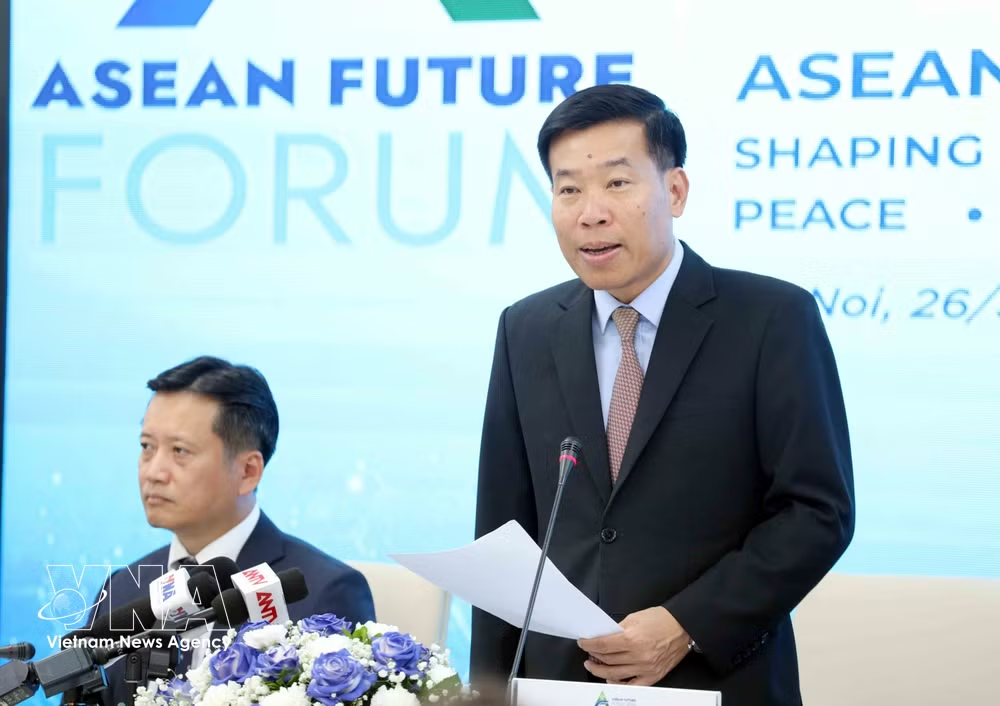
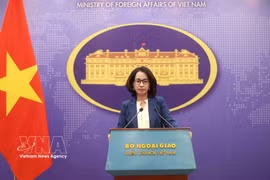
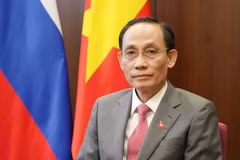
Deputy Foreign Minister Nguyen Manh Cuong speaks at the briefing. (Photo: VNA)

Deputy Foreign Minister Nguyen Manh Cuong speaks at the briefing. (Photo: VNA)

Dr. Nguyen Hung Son, Director of the Diplomatic Academy of Vietnam (DAV), affirmed that AFF 2026 will draw an unprecedented mix of participants, extending beyond government policymakers to include representatives from the business community, academia, youth, society organsations, and members of the public.

He said he expects the forum to serve as an “incubator” for innovative ideas and comprehensive solutions to shared challenges in Southeast Asia and the wider Asia-Pacific.

In a Q&A with domestic and foreign media, Son said this year’s agenda zeroes in on the issues most directly linked to people’s daily lives and safety, ensuring citizens can benefit from advances in AI and identifying ways to secure energy supplies amid global supply chain disruptions, thereby fostering societal resilience against future shocks.

Cuong described the initiative for dialogue among Southeast Asian political parties as a major breakthrough in regional diplomacy, marking the first time inter-party relations move beyond bilateral engagement into a multilateral framework. The goal, he said, is to unlock the potential and maximise the role of political parties in maintaining regional stability and shaping cooperation and development.

On the role of major ASEAN urban areas, he observed that while governments formulate policy, major cities are where those visions are translated into reality as hubs of population, economic activity, technology, and finance.

He singled out Hanoi, whose Khue Van Cac (Pavilion of Constellation Literature) symbol appears in the forum’s logo, as not just the birthplace of the event but a testament to a thousand-year-old capital committed to contributing to ASEAN’s shared peace and prosperity.

On the East Sea issue, Son reaffirmed that peace and stability in the waters remain a top priority for both Vietnam and ASEAN. Although the matter won’t have a standalone session, the principles of upholding international law and settling disputes through peaceful means will be organically woven into discussions on conflict prevention.

He added that regional energy security is inseparable from the safety and uninterrupted operation of vital maritime routes through the East Sea./.​

VNA

See more

An overview of the 36th meeting of States Parties to the United Nations Convention on the Law of the Sea (Photo: VNA))

Vietnam presides over opening session of 36th meeting of States Parties to UNCLOS

Against the backdrop of mounting challenges facing the oceans, including climate change, marine pollution, biodiversity loss, maritime security concerns, and the impacts of emerging technologies, Permanent Deputy Foreign Minister Nguyen Minh Vu called for stronger international cooperation and greater resource mobilisation to protect the oceans and ensure a peaceful, secure, and sustainable marine environment.

NA Chairman Tran Thanh Man speaks at the conference (Photo: VNA)

Conference mulls over legislative roadmap for 16th NA’s term

In his keynote speech, NA Vice Chairman Nguyen Khac Dinh presented the conclusion as a strategic vision for legal reform in the new development period. It spells out concrete goals, nine major orientations, six bundles of tasks and solutions, and assigns specific duties to the relevant bodies.

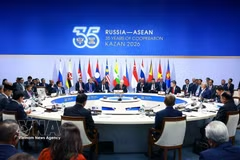
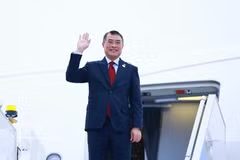
Prime Minister Le Minh Hung departs Hanoi on June 16, 2026 to attend the ASEAN–Russia Commemorative Summit and conduct bilateral activities in Kazan, Russia from June 16 to 18. (Photo: VNA)

PM departs for ASEAN – Russia Commemorative Summit

PM Hung’s participation in this summit once again reflects Vietnam’s consistent foreign policy of independence, self-reliance, resilience, peace, friendship, cooperation and development, as well as the diversification and multilateralisation of external relations in line with the spirit of the 14th National Party Congress.

Deputy Defence Minister Senior Lieutenant General Nguyen Truong Thang and the Vietnamese delegation are briefed by a French partner on a combat helicopter model at Eurosatory 2026. (Photo: VNA)

Vietnam promotes defence cooperation at Eurosatory 2026

During the event, the Vietnamese delegation met with major French defence firms, including Airbus and UNAC, to discuss technology transfer, human resource training, technical support and defence industry development. Vietnam also invited international partners to participate in the Vietnam International Defence Expo 2026, scheduled to be held in Hanoi this December.

Party General Secretary and State President To Lam receives Danish Ambassador to Vietnam Nicolai Prytz in Hanoi on June 15, 2026. (Photo: VNA)

Top Vietnamese leader receives outgoing Danish Ambassador

Party General Secretary and State President To Lam emphasised that the friendship nurtured over decades, coupled with shared development visions, particularly in the green economy, maritime economy and circular economy, as well as growing connections in culture, sports, tourism and people-to-people links, will continue to serve as a solid foundation for deeper and more productive relations between Vietnam and Denmark.

Party General Secretary and State President To Lam speaks at the working session with the education sector in Hanoi on June 15. (Photo: VNA)

Top leader urges education sector to make fundamental shift in mindset

Implementation of Resolution 71 must be carried out with strict discipline, regular inspections and continuous monitoring. The Ministry of Education and Training should establish a transparent system for tracking implementation through specific and regularly updated indicators. Each objective must be translated into concrete tasks, resources, timelines and responsible agencies.

Prime Minister Le Minh Hung (R) receives Russian Ambassador to Vietnam Gennady Bezdetko in May 2026. (Photo: VNA)

Vietnam - bridge in advancing ASEAN–Russia relations

Prime Minister Le Minh Hung’s upcoming visit to Russia from June 16–18 for the ASEAN–Russia Commemorative Summit marking 35 years of dialogue relations highlights Vietnam’s commitment to the ASEAN–Russia Strategic Partnership and its role in strengthening cooperation between the bloc and Russia.

A bird's eye view of Hanoi capital (Photo: VNA)

📝 OP-ED: Democracy and happiness – core values for building public trust

At the heart of the model is the principle that all policies must be designed for the people, rooted in the people’s aspirations and dedicated to serving their interests. Citizens will play an active role in governance through access to information, participation in decision-making, oversight of public affairs and equitable access to development outcomes. In this context, democracy and happiness of the people are not only development goals but also the most accurate benchmarks for evaluating the effectiveness of local governance and the capacity of grassroots authorities to serve their communities.