Vietnam affirms position in ASEAN, creating new growth space

Vietnam has emerged as an increasingly important driver of regional economic integration over the past three decades, with two-way trade with ASEAN soaring to approximately 91 billion USD in 2025 from only 3.26 billion USD in 1995.

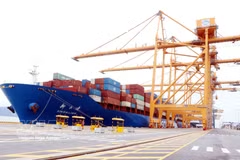
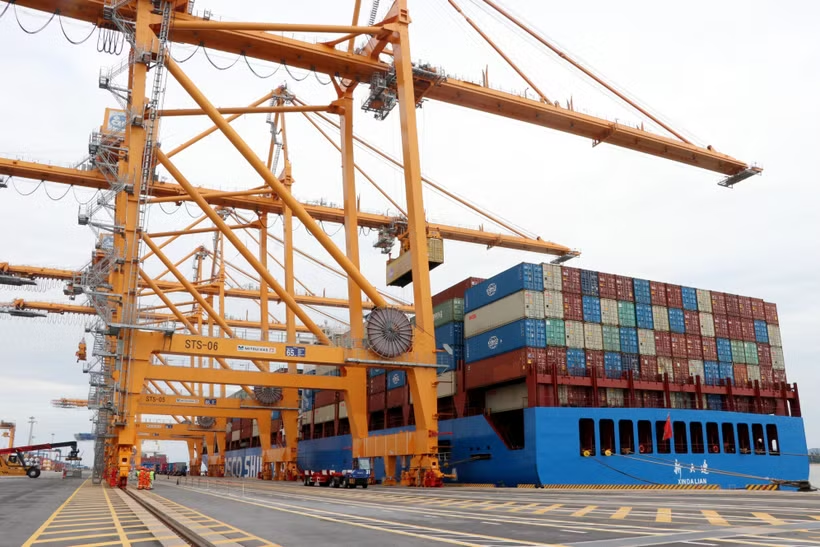
Containers are loaded at Hai Phong Port TIL International Terminal (HTIT). (Photo: VNA)

Hanoi (VNA) – Vietnam has emerged as an increasingly important driver of regional economic integration over the past three decades, with two-way trade with ASEAN soaring to approximately 91 billion USD in 2025 from only 3.26 billion USD in 1995.

As Southeast Asia accelerates economic connectivity, digital transformation and green growth, the country is strengthening its position as a key manufacturing, logistics and digital trade hub, helping to create new growth space for the region.

Le Quoc Phuong, former Deputy Director of the Industry and Trade Information Centre under the Ministry of Industry and Trade, said Vietnam’s accession to ASEAN in 1995 and participation in regional free trade agreements (FTAs), including the ASEAN Free Trade Area (AFTA), the ASEAN Trade in Goods Agreement (ATIGA) and the Regional Comprehensive Economic Partnership (RCEP), have provided a strong impetus for trade growth.

ASEAN is now one of Vietnam’s largest trading partners, behind only the US, China and the Republic of Korea. Deep tariff reductions within the bloc have facilitated Vietnamese exports while promoting the country’s deeper integration into regional production networks. The bloc is also an important source of investment.

Statistics from Vietnam Customs show that eight ASEAN member states have invested in all the 18 economic sectors in Vietnam, with manufacturing and processing industries attracting more than 1,000 projects worth about 22.2 billion USD. Vietnam has become an increasingly important link in ASEAN supply chains, importing components and materials from Thailand, Malaysia and Singapore for production, assembly and export. \

Cooperation is also expanding into the digital economy, green transition, renewable energy and logistics. One promising area is the ASEAN Power Grid (APG). With its strategic location and significant offshore wind potential, Vietnam is emerging as a key hub in the bloc’s energy security strategy.

According to the ASEAN Centre for Energy, full APG connectivity could contribute up to 3 trillion USD to regional GDP by 2040 and create around 1.45 million jobs. Le Phuong Hoa, Deputy Director of the Institute for Asia-Pacific Studies under the Vietnam Academy of Social Sciences, stressed that maintaining ASEAN centrality is essential for safeguarding the region’s development space and strengthening cooperation based on international law.

Expanding cooperation space

Beyond traditional trade, the digital economy is becoming a new growth engine for ASEAN, with Vietnam among the region’s most dynamic markets. According to the e-Conomy SEA 2025 report, ASEAN’s digital economy could reach 305 billion USD in gross merchandise value (GMV) this year, up 17% year-on-year.

E-commerce remains the key growth driver, with Vietnam among the fastest-growing markets in the region. Vietnam is also promoting cooperation in the digital sector through efforts to conclude the ASEAN Digital Economy Framework Agreement (DEFA), which is expected to facilitate cross-border data flows, digital trade and greater participation of small and medium-sized enterprises in the regional digital ecosystem.

Meanwhile, green transition is opening up new avenues for cooperation. Vietnam’s electric vehicle adoption rate has reached about 33% of total vehicle sales, significantly above the ASEAN average. Despite strong growth, experts believe there remains substantial room for deeper cooperation, as intra-ASEAN trade accounts for only about 20–22% of the bloc’s total trade.

To make better use of regional FTAs, Vietnamese enterprises need to enhance competitiveness, strengthen brands, increase technological content in exports, and meet higher standards in green transition, digitalisation and sustainable development.

At the 27th ASEAN Economic Community Council Meeting, Deputy Minister of Industry and Trade Phan Thi Thang affirmed Vietnam’s readiness to work closely with other ASEAN members to enhance the resilience of the regional economy./.

VNA

See more

An overview of the working session between the Kazakh delegation and the Can Tho City People's Committee on July 16. (Photo: VNA)

Kazakhstan explores agricultural by-product recycling project in Can Tho city

The proposed project would use rice husks as its primary feedstock, with an estimated one million tonnes processed annually using advanced technology developed in Kazakhstan. At present, the top priority is to secure a stable supply of raw materials from rice-producing provinces across the Mekong Delta.

Consumers buy fruit at a supermarket in Vietnam. (Photo: VNA)

US highlights potential in Vietnam’s fruit market

The US was Vietnam's second-largest supplier of agricultural products, with export turnover reaching 4.7 billion USD in 2025, a remarkable increase from less than 3.5 billion USD in 2024, Fruitnet said, citing a new report by the US Department of Agriculture (USDA).

Vietnamese Ambassador to Thailand Pham Viet Hung (thitd, left) attends the opening ceremony of Grand Halal Bangkok 2026 (Photo: VNA)

Vietnamese firms seek global Halal opportunities at Bangkok exhibition

Ambassador Pham Viet Hung described Grand Halal Bangkok 2026 as an important opportunity for Vietnamese businesses to connect not only with Thailand's Halal industry but also with Halal food producers worldwide, while learning from experience of Thailand and international partners.

Marnufacturing garments for export at Hung Yen Jute and Garment Joint Stock Company. (Photo: VNA)

GDP expands 8.18%, with new growth drivers taking shape

According to the National Statistics Office under the Ministry of Finance, GDP expanded by 8.39% in the second quarter, up from 8.14% a year earlier. Growth for the first six months reached 8.18%, exceeding the 7.63% recorded in the same period of 2025. The performance reflected broad-based contributions from both the supply and demand sides of the economy.

Production line at Honda Vietnam's manufacturing facility in Dong Van II Industrial Park, Ninh Binh province. (Photo: VNA)

Vietnamese economy sustains momentum on strong industrial production

The National Statistics Office (NSO) under the Ministry of Finance reported that the manufacturing and processing sector remained the principal driver of economic growth, accounting for 33.07% of the economy's total value-added growth during the first six months of the year.

Investors conduct transactions at Bao Viet Securities' headquarters in Hanoi. (Photo: VNA)

Vietnam eyes 205.6 billion USD in stock market funding for 2026–2030

Addressing a seminar on restructuring capital mobilisation channels hosted by the Finance and Investment newspaper on July 15, Bui Hoang Hai, Vice Chairman of the State Securities Commission of Vietnam (SSC), said the domestic economy continues to face considerable external challenges in 2026, including the effects from the Middle East conflict.

Workers process farm produce at the Coastal Fisheries Development Company (Cofidec) in Ho Chi Minh City. (Photo: VNA)

Vietnam remains ASEAN’s fastest-growing economy in first half of 2026: experts

Economists at United Overseas Bank (UOB), a Singapore-based multinational bank, said Vietnam’s gross domestic product (GDP) expanded by 8.39% in the second quarter of 2026, from 7.94% in the first quarter. As a result, economic growth for the first half of the year reached 8.18%, keeping Vietnam at the top among ASEAN economies.

The interface of Vietnam's foreign supplier portal for tax registration, declaration and payment by overseas suppliers. (Photo: dientuungdung.vn)

Foreign digital service providers pay nearly 480 million USD in taxes

According to the Department of Taxation, 259 overseas suppliers have registered, declared and paid taxes through the portal. Tax revenue from the group reached 78.1% of the full-year target, surging 119% from a year earlier and making foreign suppliers the fastest-growing source of tax revenue in Vietnam's digital economy.

Ca Mau companies and households use rooftop solar to cut expenses. (Photo: VNA)

Vietnam raises rooftop solar sales cap to 50%, widens direct power deals

Rooftop solar power is entering a new phase of development with a more solid foundation. When integrated with energy storage systems and direct power purchase mechanisms, it not only contributes to supplementing distributed energy sources and reducing pressure on the national power system, but also serves as a driving force for green growth, enhances the competitiveness of the economy, and ensures energy security.

Production of electrical wiring harnesses at Bandai Vietnam Co., Ltd. in the Left Bank Industrial Park, Phu Tho province. (Photo: VNA)

Record FDI Inflows signal strong investor confidence, but absorptive capacity remains key

Vietnam's competitive advantages are evolving. Rather than relying primarily on low labour costs and tax incentives, the country's future competitiveness will increasingly depend on structural and long-term factors, including transparent institutions, policy predictability and an investment environment capable of supporting long-term strategic investors.