Vietnam pushes to develop world-class technology startups

Vietnam’s startup ecosystem now comprises roughly 4,000 startups, 208 investment funds, 84 incubators and more than 20 startup support centres. With an estimated valuation of 75 billion USD, the ecosystem has established most of the key foundations needed for long-term growth.

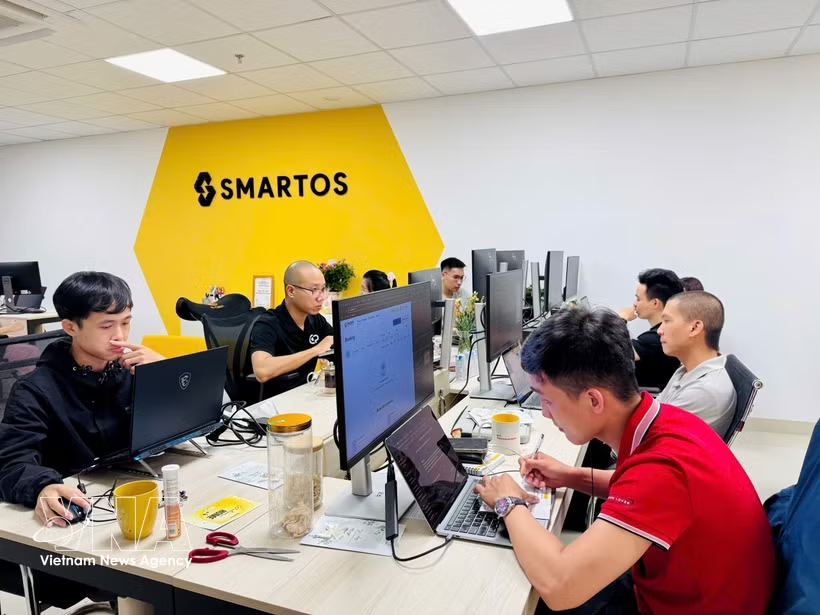
Private technology enterprises are increasingly viewed as a driving force at the heart of the innovation ecosystem. (Photo: VNA)

Hanoi (VNA) - Vietnam’s rise into the world’s top 50 startup ecosystems for the first time marks a major milestone in its innovation journey, but persistent challenges in startup quality, technology commercialisation, capital access and international competitiveness continue to constrain its global ambitions.

According to StartupBlink’s Global Startup Ecosystem Index 2026, Vietnam climbed to 50th place worldwide, achieving its highest ranking to date among more than 100 countries and 1,000 cities assessed. Ho Chi Minh City also entered the global top 100 startup cities for the first time and emerged as one of Southeast Asia’s most dynamic innovation hubs, while Hanoi, Da Nang and Hai Phong further strengthened their positions as growing centres of entrepreneurship and technology.

Vietnam’s startup ecosystem now comprises roughly 4,000 startups, 208 investment funds, 84 incubators and more than 20 startup support centres. With an estimated valuation of 75 billion USD, the ecosystem has established most of the key foundations needed for long-term growth.

Momentum is expected to accelerate as the Government rolls out new policies to advance science, technology, innovation and digital transformation. Among the most significant measures is Resolution No. 86/NQ-CP on the National Innovation Startup Strategy, adopted in April 2026, which aims to transform Vietnam into an innovation-driven startup nation by supporting startups, spin-offs from universities and research institutes, and innovation centres in Hanoi, Da Nang and Ho Chi Minh City.

The strategy also prioritises emerging sectors such as artificial intelligence, semiconductors, robotics, quantum technology, green hydrogen and core digital infrastructure, creating fresh opportunities for domestic technology enterprises.
vnanet-potal-da-nang-ngay-hoi-khoi-nghiep-doi-moi-sang-tao-8177709.jpg
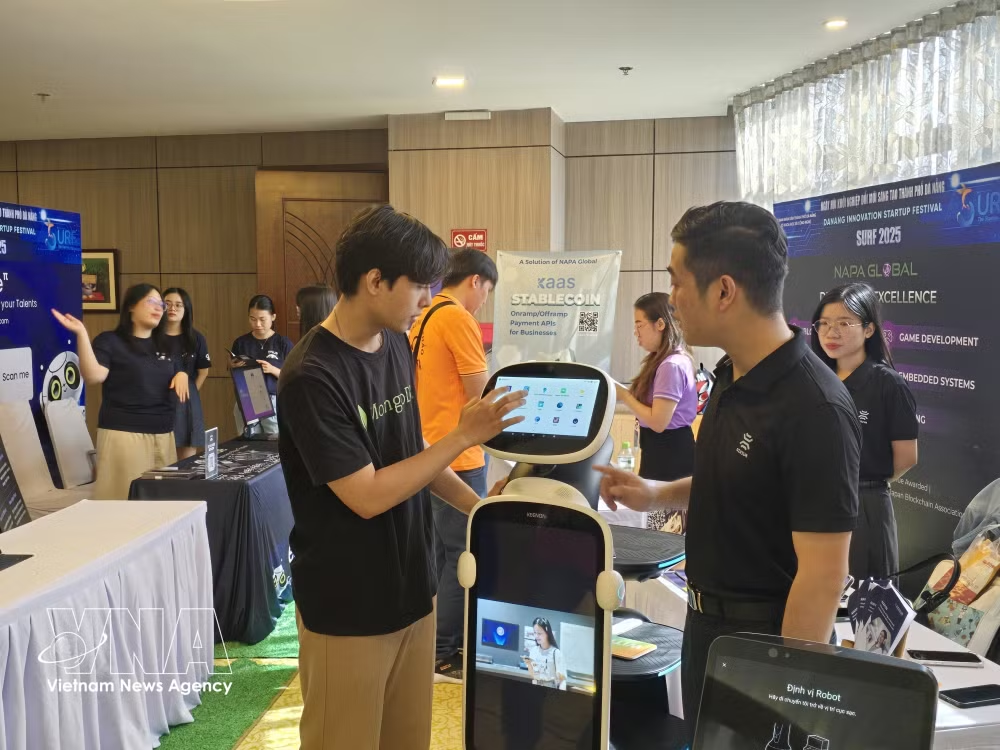
Visitors explore technology showcases at the Tech Exhibition held during Da Nang Startup and Innovation Festival (SURF) 2025. (Photo: VNA)

Despite the progress, experts caution that Vietnam still faces a long road to consistently producing technology companies capable of competing on the global stage. One of the key obstacles is the limited scope of existing support mechanisms, which often focus on startup formation and early-stage fundraising while providing insufficient support throughout the broader business lifecycle.

Trinh Minh Giang, Chairman of the Venture Management Consulting Group, noted that startup failure rates remain high, while procedures related to business restructuring, closure, bankruptcy and entrepreneurial re-entry remain complex, exposing founders to considerable legal and financial risks.

He argued that startup policies should be expanded beyond early-stage support to include areas such as corporate governance, business scaling and failure management, helping entrepreneurs navigate both growth and setbacks more effectively.

While Vietnamese startups have demonstrated strengths in idea generation and initial fundraising, many continue to struggle with scaling operations, product development and international market expansion.

Economist Nguyen Thanh Doan said that, in addition to funding challenges, regulatory constraints and weak connections between businesses, research institutions and universities remain major barriers to the ecosystem’s sustainable development.

To unlock the next phase of growth, experts say Vietnam needs stronger support mechanisms, including regulatory sandboxes, dedicated public funding programmes and a more adaptive legal framework that can keep pace with rapidly evolving technologies. Building a more supportive and interconnected innovation ecosystem will be crucial to nurturing Vietnamese technology firms capable of competing across the region and beyond./.


VNA

See more

Officials of the Vietnamese Ministry of Finance and the Japan International Cooperation Agency (JICA) at the meeting in Hanoi (Photo: Ministry of Finance)

Finance Ministry, JICA to hasten major joint projects

JICA President Tanaka Akihiko said he is pleased to return to Vietnam and see landmark projects of bilateral ties now operational and delivering clear benefits to the public, including Nhat Tan Bridge and Ho Chi Minh City’s metro line No. 1.

Customers conduct transactions at an Agribank office in Hung Yen province. (Photo: VNA)

Outstanding green credit reaches 828 trillion VND

To date, loans subject to environmental and social risk assessments have exceeded 5.1 quadrillion VND (some 193.6 billion USD), representing an almost 25-fold increase compared with the end of 2017 and accounting for 27.7% of total outstanding credit in the economy.

Metfone Express's fleet at the launch ceremony. (Photo: VNA)

Vietnamese firm expands into logistics sector in Cambodia

Cambodian Minister of Post and Telecommunications Chea Vandeth praised Metfone’s contributions to socio-economic development, job creation, technology transfer and bilateral connectivity. He described the launch of Metfone Express as evidence of the long-term commitment and innovative spirit of Viettel.

Vietnamese products at the fair (Photo: VNA)

Vietnamese food products gain prominence at RoK's leading food fair

Vietnamese exhibitors are showcasing a wide range of products, including processed foods, tropical fruit products, functional foods, spices and beverages. Major exporters such as Vinamilk, WestFood, TSFood, Nafoods Group, Bich Chi Food and DH Foods are among the participants.

At the Vietnam–Canada Business Forum 2026 (Photo: VNA)

Green transition creates fresh opportunities for Vietnam–Canada partnership

Rahul Malhotra, owner of RM Venturex, said the forum provided businesses with valuable insights into opportunities for deeper Vietnam–Canada cooperation. He noted that support from diplomatic channels and the engagement of both public and private sectors are helping create favourable conditions for stronger economic ties among Canada, Vietnam and ASEAN.

At the working session between Can Tho leaders and representatives of Singaporean businesses. (Photo: VNA)

Can Tho invites Singaporean firms to invest in industry, energy, logistics

Singapore is currently the Mekong Delta city’s largest source of foreign direct investment (FDI), with 12 active projects totalling nearly 320 million USD in registered capital. A flagship project is the Vietnam-Singapore Industrial Park (VSIP) Can Tho, launched in 2022 with an investment of over 3.7 trillion VND (140 million USD) and covering nearly 294 hectares.

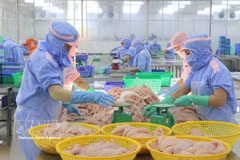
Workers process tra fish for exports. (Photo: VNA)

Sustainable transformation needed for Vietnam’s strategic pangasius sector

With continued policy support, technological innovation and close coordination among authorities, businesses and farmers, Vietnam’s pangasius industry is expected to make a strong and sustainable breakthrough during the 2026–2030 period, reinforcing its position as the world’s leading exporter of the fish.

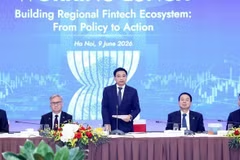
Deputy Prime Minister Nguyen Van Thang speaks at the event. (Photo: baochinhphu.vn)

Deputy PM calls for integrated ASEAN fintech ecosystem

Deputy PM Nguyen Van Thang proposed a shared vision for an ASEAN fintech ecosystem that is open, secure, transparent, inclusive, and sustainable: “Open” to foster connectivity, “Secure” to enable growth, “Transparent” to build trust, “Inclusive” to ensure that no one is left behind, and “Sustainable” to strengthen resilience and support long-term progress.

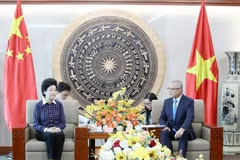
Vice Chairperson of the National Committee of the Chinese People's Political Consultative Conference (CPPCC) Xian Hui (left) meets with Secretary of Phu Tho provincial Party Commitee Pham Dai Duong on comprehensive cooperation (Photo: VNA)

Phu Tho expands cooperation with Chinese localities

A high-level delegation of the National Committee of the Chinese People's Political Consultative Conference (CPPCC), led by its Vice Chairperson Xian Hui, visited the production facility of BYD Vietnam Co., Ltd. at Phu Ha Industrial Park and held a working session with leaders of Phu Tho province on June 9.