Vietnam issues new rules on issuance and management of APEC Business Travel Cards

The ABTC is a travel document issued to eligible businesspersons, enabling visa-free entry into participating APEC member economies. The card is available in both physical and electronic formats, which carry equal legal validity.

An APEC Business Travel Card (Illustrative image: VNA)

Hanoi (VNA) – Permanent Deputy Prime Minister Pham Gia Tuc has signed the Prime Minister’s Decision No. 28/2026/QD-TTg, promulgating regulations on the procedures, authority and management of APEC Business Travel Cards (ABTC).

The decision sets out the categories of individuals eligible for an ABTC, procedures and authority for issuing and managing the card for Vietnamese businesspeople, personnel approval and temporary residence certification for foreign ABTC holders, as well as the responsibilities of relevant agencies, organisations, enterprises and individuals.

The ABTC is a travel document issued to eligible businesspersons, enabling visa-free entry into participating APEC member economies. The card is available in both physical and electronic formats, which carry equal legal validity.

An ABTC is valid for a maximum of five years from the date of approval by APEC member economies, provided that its validity does not exceed that of the holder’s passport. The card is non-renewable and may be used for entry and exit in the member economies indicated on the card. Temporary residence periods are granted in accordance with the regulations of each host economy.

The decision also specifies conditions for consideration of ABTC issuance. Organisations and enterprises must demonstrate a need to send businesspersons on short-term visits to APEC economies for business activities or participation in conferences, seminars and meetings.

Enterprises applying for ABTC privileges must have operated continuously for at least 24 months and be in compliance with regulations governing trade, taxation, customs, labour and social insurance. Applicants must be at least 18 years old, possess full civil legal capacity, have worked for the sponsoring organisation or enterprise for at least 12 months, and meet social insurance requirements where applicable. They must not be subject to any temporary exit suspension under Vietnamese law.

The decision identifies a broad range of eligible applicants, including executives and chief accountants of enterprises, financial institutions, securities and insurance firms, cooperatives and business associations. Eligibility criteria vary depending on whether the State holds a controlling stake in the organisation. Certain public officials participating in APEC-related meetings and economic cooperation activities, as well as heads and deputy heads of Vietnam’s trade representative offices in APEC economies, may also be considered for ABTC issuance.

Vietnamese ABTC holders are required to use the card solely for legitimate business-related travel, safeguard the document and comply with immigration, residence and other relevant regulations of APEC economies. Individuals who no longer hold the position under which the card was granted must return it to their organisation within five working days.

The decision will take effect on July 1, 2026, replacing Decision No. 09/2023/QD-TTg. ABTCs issued before the effective date will remain valid until their expiry, except in cases otherwise stipulated by the new regulations. Pending applications submitted before July 1 will continue to be processed under the provisions of the 2023 decision./.

VNA

See more

Children experience virtual reality technology at Nha Trang Centre shopping mall in Khanh Hoa province. (Photo: VNA)

Vietnam’s digital economy surpasses 72 billion USD in 2025: press briefing

The ministry reported that hi-tech exports accounted for 50.76% of the country’s total merchandise exports in the first quarter of 2026. Notably, Vietnam rose to 50th place in the 2026 Global Startup Ecosystem Index published by StartupBlink, climbing five positions from the previous year and achieving its highest ranking to date.

The core are of the site for the Ninh Thuan 2 nuclear power plant in Thai An hamlet of Vinh Hai commune, Khanh Hoa province (Photo: VNA)

Khanh Hoa sees active disbursement for nuclear site clearance

At a meeting on June 1, the People’s Committee of Phuoc Dinh commune, host to the Ninh Thuan 1 plant, reported that compensation plans had been prepared for 852 of the 1,129 affected households and individuals, or more than 75% of the total.

Aircraft operate at Cat Bi International Airport in Hai Phong. (Photo: VNA)

New incentives introduced for airlines opening routes

Domestic carriers participating in the air transport market for the first time will be eligible for a 50% reduction in take-off and landing charges, as well as air navigation service fees, under a new incentive scheme that took effect on May 15.

Electric vehicles produced at VinFast’s manufacturing plant in India. (Photo: VNA)

VinFast, NVIDIA, Autobrains join forces on Level-4 robotaxi project

According to a press release by VinFast, the collaboration marks a new step in VinFast's roadmap to make advanced autonomous driving technology more accessible at a reasonable cost, while opening a more practical approach to autonomous mobility solutions in the region's highly complex traffic environments.

At the Vietnam–Italy Technology Connectivity Seminar. (Photo: VNA)

Vietnam seeks stronger links with businesses in northern Italy

Representatives of many businesses in Turin and the Piemonte region said that Vietnam has been emerging as one of Asia’s most dynamic markets and a promising gateway for Italian companies seeking to expand their presence in Southeast Asia and the wider Asia-Pacific region.

Illustrative photo (Photo: VNA)

Smart payments drive digital finance development

With a young population, a high smartphone penetration rate, and steadily improving digital data infrastructure, Vietnam is well positioned to move beyond the goal of a cashless society toward the development of an inclusive digital finance ecosystem.

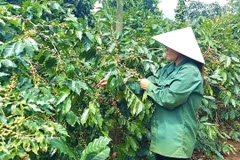
A farmer is harvesting coffee in Quang Tri province. Vietnam is speeding up the development of a 2020 forest boundary map to help exporters comply with the European Union Deforestation Regulation. (Photo: VNA)

Vietnam speeds up 2020 forest map to support compliance with EUDR

If Vietnam does not establish its own forest reference dataset, European importers will continue relying on global forest-cover databases to assess compliance for Vietnamese exports, which might result in inaccuracies when applied to local production conditions.