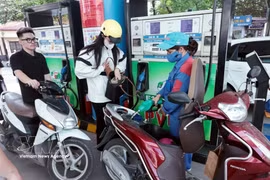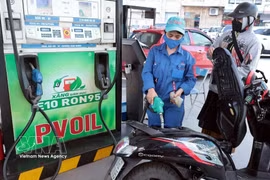
Hanoi (VNA) – In the course of safeguarding and developing the nation, challenges arise not only from hostile ideological forces but also from individuals and groups who can be described as “social disruptors” – those who take pleasure in sowing doubt, stirring controversy, and creating public anxiety whenever a new policy is introduced and implemented. Their criticism of the nationwide adoption of E10 biofuel (E10RON95) is another manifestation of such counterproductive behaviour.
The “social disruptor” mentality refers to deliberate actions aimed at obstructing, undermining, or disrupting collective activities, established regulations, or public policies under the guise of “offering opinions” or “social criticism.” Many individuals exhibiting such behaviour are not necessarily driven by opposition to the political system; rather, their actions often stem from rebellious tendencies, chronic dissatisfaction, a desire to criticise virtually everything, or a need to attract attention.
Nevertheless, it should be noted that this mentality can create fertile ground for hostile elements seeking to exploit. When the line between constructive opinion and outright opposition becomes blurred, it can hinder the country's development efforts.
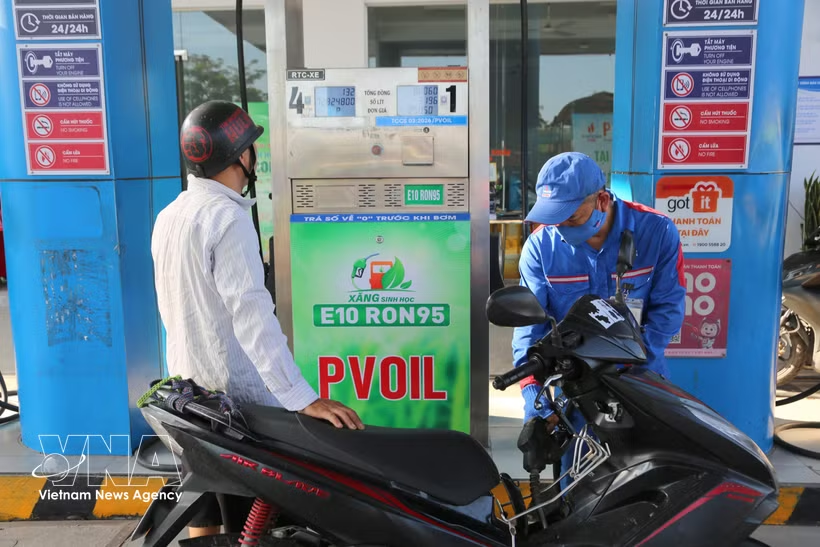
As widely known, the Ministry of Industry and Trade issued Circular No. 50/2025/TT-BCT on November 7, 2025, outlining the roadmap for blending biofuels with conventional fuels in Vietnam. Under the regulation, beginning June 1, 2026, E10 biofuel, containing a 10% ethanol blend, is to be made available nationwide, replacing RON95 petrol.
This roadmap is implemented in accordance with the Party’s and the State’s policies, including Politburo Resolution No. 55-NQ/TW on the orientation of Vietnam’s National Energy Development Strategy through 2030 with a vision to 2045, and Politburo Resolution No. 70-NQ/TW dated August 20, 2025, on ensuring national energy security through 2030 with a vision to 2045. These policy documents call for the effective implementation of measures to reduce dependence on fossil fuels, lower emissions, and protect the environment.
Almost immediately, those opposed to E10 biofuel made their presence felt across social media platforms.
Numerous posts on Facebook, TikTok, YouTube and other online platforms have claimed that E10 fuel damages engines, reduces vehicle performance, increases fuel consumption, poses safety risks, is unsuitable for Vietnam’s climate, and could even contribute to a rise in traffic accidents nationwide. Some individuals have gone further by producing staged or selectively edited videos accompanied by inflammatory commentary aimed at creating public anxiety and confusion.
Such unfounded claims continue to circulate despite repeated clarifications from experts. According to specialists, ethanol has a lower energy density than conventional petrol. As a result, some tests have shown that fuel consumption when using E10 may be slightly higher than with mineral gasoline, typically by only around 2–3%.
However, other studies have found no significant difference. This is because ethanol promotes more complete combustion of the fuel mixture, helping to offset part of the energy deficit associated with its lower calorific value. Some tests have even indicated that vehicles using E10 can achieve travel distances comparable to, or in certain cases greater than those powered by conventional gasoline.
For most motorists, the difference between using E10 and conventional gasoline is barely noticeable in everyday driving conditions. While some users have reported that their vehicles feel less responsive after switching to E10, experts note that such issues may stem from pre-existing fuel-system deposits, corrosion, or other maintenance-related factors rather than from the fuel itself.
Despite the widespread circulation of such claims, E5 and E10 have been used on a trial basis in Vietnam for many years, and no scientific evidence has demonstrated that biofuels cause damage to vehicles or adversely affect spark plugs, engine sensors, electronic fuel-injection systems, starting performance, electrical systems, or air-conditioning systems.
Globally, biofuel-blended gasoline is currently used in around 60 countries, and regulatory authorities in these countries have not reported complaints of the nature being circulated by critics of E10.
Do Van Tuan, Chairman of the Vietnam Biofuels Association and a long-time researcher of biofuels, has rejected a number of fabricated claims regarding E10.
According to him, assertions that E10 absorbs moisture from the air when left unused in a fuel tank, leading to phase separation and water accumulation at the bottom of the tank, are unfounded. He explained that gasoline naturally tends to evaporate, and when stored in a sealed fuel tank, the vapour pressure inside the tank remains higher than the pressure outside. As a result, moisture from the surrounding environment cannot be drawn into the tank as claimed.
Tuan also dismissed allegations that E10 can clog fuel lines and fuel injectors. He stressed that if such problems occur, they are not caused by the biofuel itself. In vehicles that have remained unused for extended periods while containing conventional gasoline, deposits and contaminants may accumulate in fuel lines and injectors. When E10 is introduced, its solvent properties can help clean these components, potentially dislodging accumulated residues and causing temporary blockages during initial use.
He noted that the issue can be resolved simply by cleaning the fuel lines and injectors. Once the accumulated deposits are removed, the problem does not recur in subsequent uses of E10.
The expert also advised consumers not to add fuel additives to E10 based on recommendations from self-proclaimed “online experts.” According to him, such additives are entirely unnecessary and, in some cases, may even cause damage to vehicle engines.
Critics of E10 biofuel have further argued that the policy is being “imposed” on consumers, that authorities have failed to provide a sufficiently transparent and gradual roadmap, and that inadequate consideration has been given to consumer habits and interests.
The Ministry of Industry and Trade, however, noted that Decision No. 53/2012/QD-TTg, issued by the Prime Minister on November 22, 2012, established a clear roadmap for the blending of biofuels with conventional fuels. Under the decision, following a trial period, E5 was designated as the fuel to be produced, blended, distributed, and used nationwide for road motor vehicles from December 1, 2015. The decision also stipulated that E10 will become the nationwide standard fuel for road vehicles from December 1, 2017.
Implementing Decision No. 53/2012/QD-TTg, and following extensive testing and evaluation, E5 was officially introduced nationwide on January 1, 2018. However, the transition to E10 could not be carried out as originally scheduled.
As a result, the ministry reported to the Prime Minister and sought approval to continue implementing the roadmap in line with the objectives and spirit of Decision No. 53, thereby advancing the gradual adoption of E10 nationwide.
The nationwide transition to E10 biofuel from June 1, 2026, marks the next step in implementing the biofuel roadmap set out in Decision No. 53. The move is fully consistent with practical requirements, grounded in a clear legal framework, and aligned with the Party’s and Government’s policies on energy transition, green economic development, and carbon-emissions reduction.
Nguyen Sinh Nhat Tan, Deputy Minister of Industry and Trade, emphasised that The implementation of the biofuel roadmap is neither a coercive measure nor an attempt to limit consumers' freedom of choice. Rather, it stems from the need to promote sustainable development, ensure energy security, protect the environment, and fulfill Vietnam’s international commitments to reducing greenhouse-gas emissions.
For many years, the country has maintained the parallel use of conventional gasoline and biofuel-blended gasoline, allowing consumers sufficient time to familiarise themselves with the products, enabling the market to adapt, and providing businesses with the opportunity to gradually improve distribution infrastructure, technical capacity, and supply chains. The transition roadmap has been designed as a phased process, supported by thorough impact assessments.
There is therefore nothing “sudden” or “unexpected” about the policy, contrary to claims circulated by those seeking to undermine or misrepresent the transition.
In the coming period, the Ministry of Industry and Trade will continue to coordinate closely with relevant ministries, agencies, and enterprises to ensure a stable fuel supply, maintain quality, safeguard consumer interests, and provide transparent information to help the public confidently use E10 biofuel.
It should also be noted that from June 1, two types of biofuels are available on the market: E5 (E5RON92) and E10 (E10RON95), allowing consumers to select the fuel most suitable for their vehicles. E5, which is compatible with older-generation gasoline engines, will remain available until December 31, 2030.
The biofuel roadmap in Vietnam is therefore aimed at achieving a balanced approach that advances the goals of green energy transition, environmental protection, and stability in the fuel market, while safeguarding the legitimate interests of both consumers and businesses./.
VNA