Hanoi (VNS/VNA) – Vietnam is rapidly emerging as one of the world’s leading mobile game production hubs, but analysts say the gaming industry still lacks the professional ecosystem to build global competitiveness.
According to the Vietnam Mobile Game Industry Report 2025 released by GameGeek, Vietnamese developers launched 27,388 new mobile games in 2025, up 13% from a year earlier, ranking 33rd.
Vietnamese-made games also recorded 4.9 billion global downloads last year, making Vietnam the world’s second-largest market by mobile game downloads, equivalent to around 9,300 downloads per minute.
The report also showed the sector was shifting toward more sustainable monetisation models. In-app purchase (IAP) revenues rose around 83% from 2024, while many studios began moving away from advertising-only models toward hybrid monetisation strategies combining ads and direct purchases.
Casual, puzzle and arcade games remained the dominant segments, accounting for roughly 66% of total downloads.
But despite the strong headline growth, industry experts say Vietnam’s gaming sector still faces structural weaknesses, particularly the lack of international networking platforms, specialised mentoring systems and long-term support mechanisms for developers.
Vu Minh Hanh, director of GameGeek, said Vietnam is transitioning from large-scale production toward deeper and more sustainable products.
The next opportunity lies in attracting international investment and benefiting from stronger government support policies, she added.
New growth engine
The sector is attracting increasing attention from the Government in the context that Vietnam is promoting the development of the digital economy.
At the recent Vietnam GameVerse 2026, industry experts estimated Vietnam’s gaming industry generated around 1.66 billion USD in revenue in 2025, with annual growth projected at nearly 10% through 2029, when the market could reach 2.42 billion USD.
Vietnamese titles such as Flappy Bird, Axie Infinity and Magic Tiles have already demonstrated the country’s ability to create globally successful intellectual property.
Le Quang Tu Do, Director of the Authority of Broadcasting and Electronic Information under the Ministry of Culture, Sports and Tourism, said the current period offered favourable conditions for Vietnamese gaming companies to expand partnerships, attract investment and target international markets.
Vietnam has identified gaming as one of six priority cultural industries eligible for state support and investment incentives, he said. Companies investing in games that incorporate Vietnamese historical and cultural content would also qualify for preferential corporate tax policies.
Statistics showed that the global gaming industry currently generates around 200 billion USD in annual revenue, making it one of the world’s largest entertainment sectors.
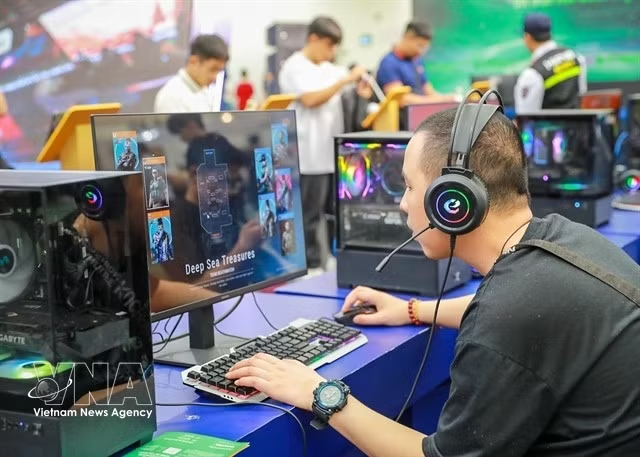
Esports, one of the fastest-growing segments of the industry, is also generating expanding economic value globally through streaming, marketing, advertising, event organisation and cultural promotion.
According to Business Research Company, the global esports market was estimated to generate around 3 billion USD in revenue in 2025 with a compound annual growth rate of 19%.
In Vietnam, around 28.2 million people currently participate in gaming and esports-related entertainment, equivalent to nearly 30% of the population, according to Statista. Domestic esports revenue is expected to reach 10 million USD by 2030.
While the industry is becoming an increasingly important pillar of Vietnam’s digital economy, policymakers and legal experts caution that rapid expansion also raises regulatory challenges, particularly around data protection and content governance.
Nguyen Huyen Minh, senior lawyer at BMVN International LLC, said gaming companies would need clearer legal frameworks for collecting, processing and sharing user data, especially as personalised advertising and behavioural analytics become more widespread.
Workforce development would also remain critical as Vietnam seeks to move beyond outsourcing toward building globally recognised game studios and long-term intellectual property, according to La Xuan Thang, publishing director at VNGGames, a subsidiary of VNG.
Deputy Minister of Culture, Sports and Tourism Ho An Phong recently said that Vietnam needs to strengthen control over content creation and establish clearer regulatory direction to prevent negative consequences to ensure the right-track development of the gaming industry.
He said that alongside opening the market to international developers, Vietnam would need stronger state support policies and closer coordination between businesses, regulators and media organisations to build a healthy and professional esports ecosystem./.

Vietnam GameVerse 2026 aims to elevate local gaming industry globally
Carrying the theme “Do local, go global”, this year’s event promotes a development approach rooted in Vietnamese creativity and innovation as the foundation for expanding local gaming products into international markets. Organisers expect the event to draw around 60,000 participants.