SSIT welcomes LNG-powered mega container ship on new trans-Pacific route

The event marks an important milestone affirming the SSIT’s capability to handle ultra-large container ships as well as its commitment to promoting green maritime development in the Cai Mep-Thi Vai port cluster.

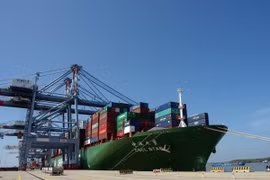
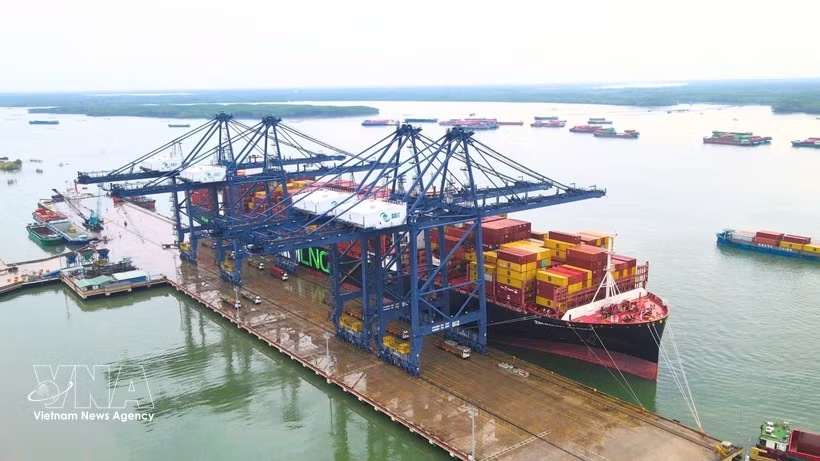
LNG-powered container vessel Zim Mount Rainier docks at SP-SSA International Terminal in Tan Phuoc ward, Ho Chi Minh City (Photo: VNA)

Ho Chi Minh Ciy (VNA) – The SP-SSA International Container Services Joint Venture Company (SSIT) has successfully received the LNG-powered container vessel Zim Mount Rainier operating on the new ZXB trans-Pacific service route run by Israel’s ZIM shipping line, directly linking Vietnam with the US East Coast.

The event marks an important milestone affirming the SSIT’s capability to handle ultra-large container ships as well as its commitment to promoting green maritime development in the Cai Mep-Thi Vai port cluster.

The ZIM Mount Rainier, measures 366m in length and has a carrying up to 15,124 TEUs, placing it among the world’s largest container vessels currently operating on key international trade routes. Notably, the ship is powered by liquefied natural gas (LNG), considered one of the most advanced green energy solutions in the global shipping industry today, helping significantly reduce greenhouse gas emissions and protect the environment.

The newly launched ZXB service directly connects cargo flows among strategic destinations including Singapore, Cai Mep, Hai Phong, Yantian and Xiamen in China, Kingston in Jamaica, and Charleston, Savannah, New York and Boston in the US.

The introduction of the route is expected to strengthen Vietnam’s trade connectivity with major economic and logistics hubs in Asia and along the US East Coast.
vnanet-sai-gon2.jpg
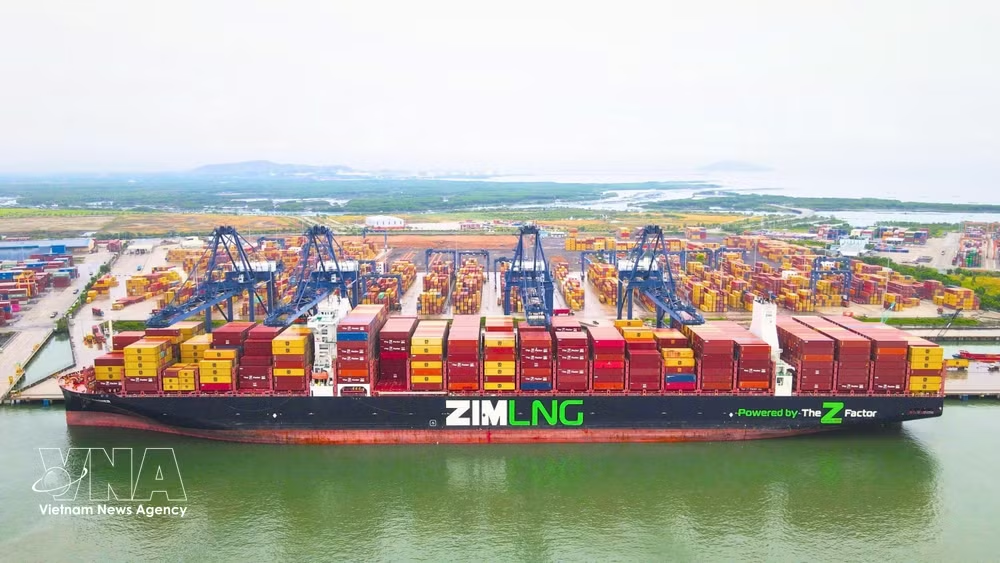
A panoramic view of SP-SSA International Terminal in Tan Phuoc ward, Ho Chi Minh City (Photo: VNA )

The SSIT’s inclusion as one of the ports of call on the route further underscores the terminal’s operational capability, strategic position and capacity to accommodate mega container vessels within the international maritime network.

SSIT General Director Phan Hoang Vu said that cooperation between SSIT and ZIM, which began in 2025, has continued to grow stronger.
The launch of the ZXB service with regular calls at the SSIT marks a new milestone in bilateral cooperation amid strong transformation in the maritime industry, particularly on trade routes between Vietnam and the US, he said.

The successful handling of LNG-powered mega container ships also demonstrates the shared commitment of both sides to promoting green and sustainable maritime development in Vietnam.

On May 29, the vessel left the SSIT to continue its voyage on the ZXB route.

Established in 2006, the SSIT is a joint venture between SSA Marine of the US, the Vietnam Maritime Corporation (VIMC) and Saigon Port. Located downstream of the Cai Mep-Thi Vai port complex in Ho Chi Minh City, the terminal features a 60ha container yard, a 655m main berth, a 435m barge berth and Vietnam’s largest STS crane system./.
VNA

See more

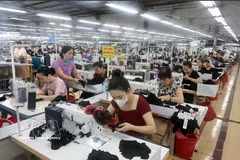
Workers at TNG Thai Nguyen Garment Company in the northern province of Thai Nguyen. (Photo: VNA)

Vietnam takes major step toward sustainable business development: ILO

The national programme aimed at promoting sustainable business practices across the country’s private sector during the 2026–2030 period sets out a comprehensive framework to promote the development of a responsible and sustainable private sector – one that balances economic performance, social responsibility and environmental protection.

A view of a container port in Singapore. (File photo: Xinhua/VNA)

Vietnam-Singapore trade cooperation gains fresh momentum

Analysts noted that Vietnam-Singapore ties are increasingly moving beyond traditional goods trade towards green growth, innovation and high-quality supply chains, laying a stronger foundation for more substantive and sustainable cooperation in the years ahead.

Fishing vessels anchored at Vam Lang Fishing Port, Dong Thap province (Photo: VNA)

Dong Thap tightens control of fishing fleet to combat IUU fishing

Dong Thap province currently manages 1,477 registered and licensed fishing vessels, with all eligible boats equipped with voyage monitoring systems (VMS). About 60% of the fleet consists of large-capacity vessels operating in offshore fishing grounds including Con Dao, Truong Sa and the DK1 platform area.

Dr Vu Thanh Tu Anh, head of the research team, provides information on the Mekong Delta Economic Report 2025. (Photo: VNA)

Mekong Delta Economic Report 2025 calls for institutional breakthroughs to empower private enterprises

According to Dr Vu Thanh Tu Anh, head of the research team, the report presents a comprehensive assessment of the Mekong Delta’s economic landscape, emphasising that future breakthroughs will not come from simply producing more rice, aquatic products, or fruit. Instead, the region must transition toward an innovation-driven agricultural economy built on climate adaptation and nature-based development principles.

General Secretary of the Communist Party of Vietnam Central Committee and State President To Lam and Thai Prime Minister Anutin Charnvirakul witness the exchange of cooperation agreements between businesses from the two countries. (Photo: VNA)

Top leader attends Vietnam-Thailand business forum in Bangkok

Addressing the forum, Party General Secretary and State President To Lam described the event as a key highlight of his official visit to Thailand, reflecting the determination of both countries to deepen and substantively advance their comprehensive strategic partnership.

Vietnamese Consul General in Perth Pham Hai Anh (R) meets with David Morgan, Chairman of the Western Australia – Vietnam Business Council (WAVBC) on May 28. (Photo published by VNA)

Vietnam seeks stronger cooperation with Western Australia

Anh stressed that strong political relations between Vietnam and Australia should continue to be translated into practical and effective economic and investment cooperation programmes that are commensurate with the potential and needs of both sides.