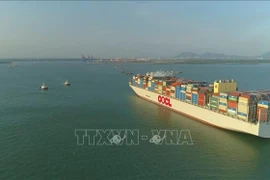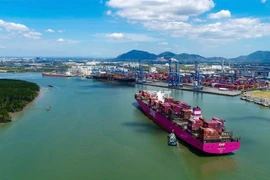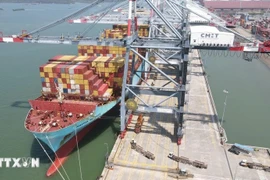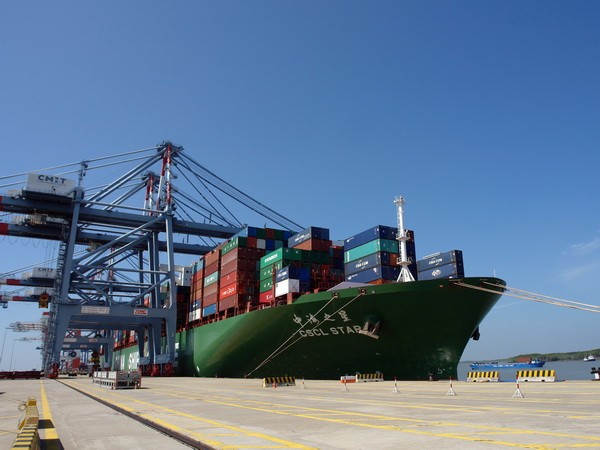
Hanoi (VNA) – Promoting the Cai Mep-Thi Vai deep-water port complex into an Asia-level international transshipment hub is not only a goal for Ho Chi Minh City’s marine economy development, but also a strategic task to enhance national competitiveness amid deep international integration.
By 2030, the seaport system of HCM City (after the administrative merger with Binh Duong and Ba Ria-Vung Tau) will need to handle between 440.8 million and 531.8 million tonnes of cargo, according to forecasts.
As the Government is adjusting the national master plan for 2021–2030 with a vision to 2050, which sets a target of sustained double-digit economic growth (over 10%) during 2026–2030, cargo volumes passing through the city’s seaports are expected to rise even further.
Mai Trung Hung, Deputy Director of the municipal Department of Construction, said the Cai Mep-Thi Vai port area now mainly operates as a gateway port. Nearly 96% of container throughput is Vietnam’s import-export cargo, while just over 4% is international transshipment cargo, mostly destined for Cambodia via the Tien and Hau rivers.
The port complex has seen its navigation channel from Buoy No.0 to the Cai Mep container terminals upgraded to a depth of 15.5 metres, the deepest in the country, allowing vessels of 160,000–200,000 DWT to operate safely without dependence on tides.
In 2024, total cargo throughput at the port cluster reached 152 million tonnes, accounting for about 34% of the nation’s total container volume.
With these advantages, HCM City has been striving to raise the share of international transshipment cargo there. The target is to reach 10% by 2030, and 2025% during the 2030–2050 period.
In reality, most cargo handled at Cai Mep-Thi Vai originates from the city and the southern key economic region. Local industrial parks, export processing zones and distribution centres are the decisive “input” sources underpinning the vitality of the port cluster.
Given this, the city has outlined a series of major plans and orientations, including developing regional-level logistics centres, forming networks of warehouses and satellite inland container depots, accelerating supply-chain digitalisation, and reforming customs procedures.
At the same time, it is investing in transport infrastructure connecting to the port complex to maximise the efficiency of multimodal transport by sea, road and rail, thereby generating higher added value for the logistics system. Currently, the inter-port road and direct road connections from Cai Mep-Thi Vai to National Highway 51 are in operation, alongside other routes linking with other localities in the region under investment.
In addition, an inland waterway transport and logistics corridor in southern Vietnam linking the Mekong Delta with Cai Mep, funded by the World Bank, is being implemented.
According to the municipal Department of Construction, investment in the Can Gio international transshipment port project has been approved in principle by the Prime Minister. Once constructed and put into operation, together with the completion of the Cai Mep Ha terminals, the two port areas will complement each other in forming a gateway port system capable of competing with major seaports in Asia and worldwide.
Assoc. Prof. Dr. Nguyen Ngoc Vinh, Deputy Director of the Institute for Regional Development Research and Consulting under the University of Economics Ho Chi Minh City, noted that connectivity among Can Gio, Cai Mep-Thi Vai and Vung Tau will create an integrated coastal economic corridor combining production, logistics, services, tourism and energy.
As global trade undergoes strong restructuring, this opportunity needs to be seized and fully leveraged, with top priority given to turning Cai Mep-Thi Vai into a regional transshipment hub. This is not only a comprehensive challenge for the southeastern region but also for Vietnam’s entire economy within the global maritime value chain, he opined./.
See more
HCM City eyes 8-10 million USD per hectare in industrial park investment
The city aims to lift average investment intensity to 8–10 million USD per hectare, with a focus on high-tech, high-value-added and environmentally friendly industries.
Vietnam's retail sales, service revenue up 9.2% in 2025
Fresh data from the Ministry of Finance’s NSO shows the tourism industry taking the lead, with travel earnings soaring by 20.2%.
International financial institutions optimistic about Vietnam’s 2026 growth
As Vietnam enters 2026 - the first year of the 2026–2030 socio-economic development plan, international organisations stress that maintaining macroeconomic stability, improving growth quality and staying the course on fundamental reforms will be crucial in turning positive assessments into tangible outcomes and shaping a more sustainable development cycle ahead.
VIFTA provides impetus for Vietnamese exports to Israel
The greatest benefit generated by the VIFTA lies in the immediate removal or phased deep reduction of many tariffs, significantly improving the price competitiveness of Vietnamese goods. At the same time, clearer provisions on rules of origin, customs procedures and trade remedies are helping foster long-term business partnerships.
Hanoi targets over 11% GRDP growth in 2026 with thrift drive
Hanoi aims for average per capita income of 198 million VND (7,600 USD) a year and state budget revenue of around 546.93 trillion VND.
Resolution No. 57: Vietnam eyes comprehensive, unified tourism data system
Information consistency will help improve national tourism brand recognition among travellers, laying a stepping stone for positioning Vietnam as a green, safe and friendly destination, according to an insider.
“Green tick” products ready for Tet holiday
Products bearing the city’s “green tick of responsibility” label, which indicates clear origin and verified quality, are increasingly visible on shelves and drawing strong consumer attention.
Viet Industry 2026 to connect Vietnam’s industrial supply chain
Covering over 10,000 sq.m, the exhibition is expected to host around 500 domestic and foreign booths representing companies from over 20 countries, showcasing advancements in industrial manufacturing technologies and equipment.
2026 Economic Census kicks off on January 7
The 2026 census aims to fully, comprehensively and objectively assess the current situation of economic establishments nationwide, including enterprises, public service units, associations, religious institutions and individual business households.
Reference exchange rate kept unchanged on January 7
With the current trading band of +/- 5%, the ceiling rate applicable for commercial banks during the day is 26,378 VND/USD, and the floor rate 23,866 VND/USD.
Vietnam’s trade in services surpasses 70 billion USD in 2025
For the whole of 2025, service export turnover was estimated at 30.31 billion USD, up 18.9% year on year.
Record 1.15 quadrillion VND allocated for development investment in 2025
Last year, central budget funds were prioritised for nationally significant projects, expressways, inter-regional links and other key infrastructure works, thereby creating new growth drivers, expanding development space and strengthening national competitiveness.
HCM City sets ambitious growth target of over 10% in 2026
HCM City posted GRDP growth of 7.53%, GRDP per capita of 8,755 USD, total retail sales and consumer service revenue increasing 15.5%, and tourism revenue surging 36.1% in 2025.
Property to be granted e-identification codes from March 1
According to the decree, the information system and database on housing and the real estate market will be built and managed uniformly from the central to local levels.
Vietnam targets 74 billion USD in agro-forestry-aquatic export earnings in 2026
Despite global uncertainty in 2025, the agriculture and environment sector fulfilled and exceeded all nine targets assigned by the Government. Overall growth reached 3.78%, while agro-forestry-fishery export turnover totalled 70.09 billion USD, up 12% year-on-year.
Int’l agricultural, environmental technology fair set for Can Tho
The organisers aim to strengthen links between suppliers of modern agricultural inputs and machinery and farmers, thereby helping producers access technologies in crop cultivation, livestock farming and aquaculture, adopt sustainable production processes and reduce greenhouse gas emissions.
National retail strategy lays foundation for new growth phase
A key focus of the strategy is encouraging enterprises from all economic sectors to participate in retail development in forms and at scales suited to their capacity. It highlights the formation of a strong domestic distribution backbone through initial incentives in mechanisms, financial policies and land access, while gradually fostering large corporations and enterprises in the distribution sector.
Vietnam, ASEAN emerge as major export markets for RoK
ASEAN, particularly Vietnam and Thailand, has also stood out. The RoK’s exports to ASEAN rose 12.5% over the period, reaching 122.4 billion USD in 2025, while exports to Vietnam climbed 10.8% to 62.8 billion USD.
PM calls for concentrated leadership, resources for railway projects
Prime Minister Pham Minh Chinh on January 6 stressed the need to focus leadership, manpower and resources on key railway projects, so that they can be put into operation soon, thereby contributing to socio-economic development and better living standards for the people.
Ministry completes IUU fishing report for submission to EC
Over the past week, no Vietnamese fishing vessels were detained by foreign authorities. However, 24 vessels that violated foreign waters have yet to be fully handled.