Hanoi (VNA) – More than 50 years after establishing diplomatic ties and over a decade since launching their Strategic Partnership, Vietnam and Singapore are entering a new phase of cooperation with growing opportunities in trade, investment and emerging industries.
The two economies are highly complementary and both participate in major new-generation free trade agreements, including the Comprehensive and Progressive Agreement for Trans-Pacific Partnership (CPTPP) and the Regional Comprehensive Economic Partnership (RCEP). Against this backdrop, economic, trade and investment cooperation continues to form a central pillar of bilateral relations.
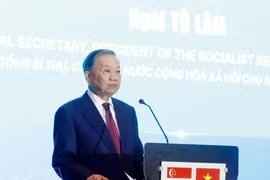
The elevation of ties to a Comprehensive Strategic Partnership in 2025, together with the upcoming state visit to Singapore by General Secretary of the Communist Party of Vietnam Central Committee and State President To Lam, is expected to inject fresh momentum into bilateral cooperation.
Experts said Singapore remains one of Vietnam’s most important economic partners in trade, investment and connectivity, as well as in workforce training and cooperation in emerging areas such as innovation, science-technology, digital transformation and green growth.
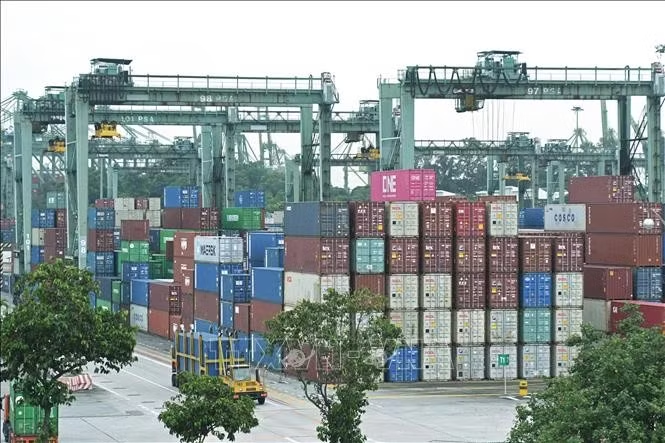
Bilateral trade has expanded steadily in recent years, rising from 8.3 billion USD in 2021 to 10.3 billion USD in 2024, and over 31.3 billion USD. The figure for the first four months of 2026 reached around 4.5 billion USD.
Singapore is currently Vietnam’s second-largest foreign investor with more than 4,500 valid projects worth nearly 97 billion USD in registered capital. Singaporean investment spans manufacturing, infrastructure, logistics, finance, real estate, high technology and modern services, contributing to Vietnam’s growth, employment and economic restructuring.
A flagship symbol of bilateral cooperation is the Vietnam-Singapore Industrial Park (VSIP) network. Since the first VSIP was launched in 1996, the model has expanded to 22 industrial parks nationwide.
The VSIP system is now shifting towards greener, smarter and more technology-driven model aligned with sustainable development goals. Singaporean Ambassador to Vietnam Rajpal Singh said the two countries signed an implementation agreement on carbon credits in 2025 and are expected to launch related projects by late 2026.
Trade flows have also recorded impressive growth. According to Vietnam’s Trade Office in Singapore, citing Enterprise Singapore, Singapore’s total trade with Vietnam reached nearly 5.3 billion SGD in April 2026, up 62.4% year-on-year. Singapore’s exports to Vietnam rose 20.9% to 2.5 billion SGD, while imports from Vietnam surged 143% to 2.7 billion SGD.
During the first four months of 2026, Vietnam remained Singapore’s 10th-largest trading partner, with bilateral trade reaching 18.8 billion SGD, up 43.7% from the same period last year. Machinery, electrical equipment and components continued to dominate trade in both directions.
Vietnamese Trade Counsellor in Singapore Cao Xuan Thang noted that although Singapore is not a large consumer market, it serves as a major regional logistics, finance and transshipment hub. Expanding the presence of Vietnamese goods there would therefore help enterprises access wider ASEAN and global markets, he said.
Economic cooperation between the two countries is increasingly shifting from traditional sectors towards technology, innovation and green development. New areas such as artificial intelligence (AI), big data, semiconductor technology, digital transformation, clean energy and carbon credits are emerging as key growth drivers.
Ambassador Rajpal Singh said Singapore hopes to deepen cooperation with Vietnam in the digital economy and sustainable development while strengthening links between technology enterprises from both countries.
Singaporean businesses and experts continue to view Vietnam as an attractive destination thanks to its political stability, strategic location, extensive FTA network and market of nearly 100 million people. In return, Singapore’s strengths in finance, logistics, innovation and governance can support Vietnamese firms in integrating more deeply into global value chains.
In the coming period, Vietnam’s Ministry of Industry and Trade and the Vietnamese Trade Office in Singapore will continue promoting trade activities and business connectivity, particularly for agricultural products, processed foods, technology and green goods.
Digital trade platforms are also gaining momentum. Most recently, the “Vietnam Online Agricultural Wholesale Market” platform was launched in Singapore to connect Vietnamese producers with importers and distributors in Singapore and the wider region. The platform is expected to improve traceability, reduce intermediary costs and enhance cross-border trade efficiency.
Experts said sustainable exports to Singapore will require Vietnamese enterprises to better understand market demand, strengthen branding, meet green standards and make greater use of e-commerce platforms and Vietnamese distribution networks in Singapore.
They added that sectors such as high technology, renewable energy, logistics, data centres, carbon credits and supporting industries are opening up substantial opportunities for bilateral cooperation.
Analysts noted that Vietnam-Singapore ties are increasingly moving beyond traditional goods trade towards green growth, innovation and high-quality supply chains, laying a stronger foundation for more substantive and sustainable cooperation in the years ahead./.
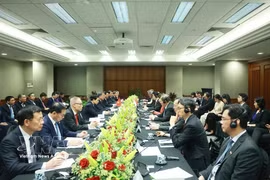
Top Vietnamese leader’s visit to Singapore to advance comprehensive strategic partnership
General Secretary of the Communist Party of Vietnam (CPV) Central Committee and State President To Lam’s state visit to Singapore from May 29–31 is expected to inject fresh momentum into the newly-established Comprehensive Strategic Partnership between the two countries while further highlighting Vietnam’s rising role and position in the region and the world.