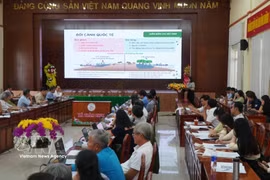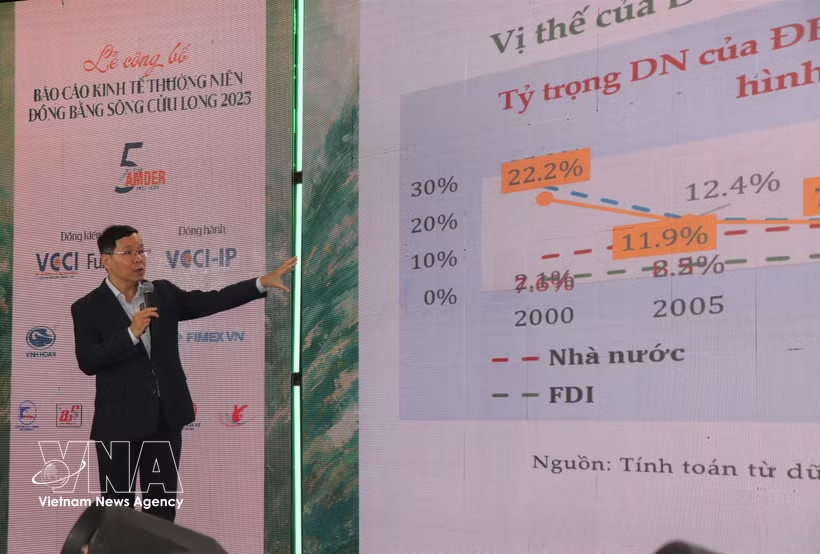
Can Tho (VNA) – The Vietnam Chamber of Commerce and Industry (VCCI), in coordination with the Fulbright School of Public Policy and Management (FSPPM), on May 28 officially released the Mekong Delta Economic Report 2025, outlining strategic solutions to unlock the region’s long-term growth potential and position the private sector at the centre of sustainable development.
According to Dr Vu Thanh Tu Anh, head of the research team, the report presents a comprehensive assessment of the Mekong Delta’s economic landscape, emphasising that future breakthroughs will not come from simply producing more rice, aquatic products, or fruit. Instead, the region must transition toward an innovation-driven agricultural economy built on climate adaptation and nature-based development principles.
In the coming decade, prosperity in the region will depend on the ability to develop an integrated ecosystem linking agriculture, processing industries, logistics, finance, and technology. Such a transformation, he noted, will create high-standard products with stronger branding, traceability, and competitiveness in increasingly green and digitalised global markets.
Experts at the event stressed that the Mekong Delta can no longer rely on a growth model based on raw resource extraction, low-cost labour, and fragmented household production. Instead, local enterprises must become the driving force behind economic restructuring and productivity growth.
VCCI Chairman Ho Sy Hung stated that domestic private enterprises already account for 45% of the 357 sectors in which the region holds competitive advantages. He emphasised that all regional development strategies should place the domestic private sector at the core while redefining the role of foreign direct investment (FDI) to promote stronger linkages, technology transfer, and value-chain spillovers.
Economist Pham Chi Lan called for deeper institutional reforms to create a more enabling business environment. She urged authorities to move away from short-term stimulus policies and administrative “ask-and-give” mechanisms, replacing them with transparent and automatic incentive systems that businesses can access once eligibility conditions are met.
Deputy Minister of Finance Le Tan Can stressed the need for local authorities to shift from an administrative mindset toward a development-oriented governance model that prioritises business growth, investment facilitation, and simplifying administrative procedures.
The report also highlighted persistent structural bottlenecks facing the Mekong Delta economy. Although the region remains strategically important for Vietnam’s food security and agricultural exports, its enterprise ecosystem remains weak and fragmented.
In 2025, its Gross Regional Domestic Product (GRDP) was estimated to grow by 7.24%, contributing 8.39% to national economic growth and accounting for 12.2% of Vietnam’s GDP. Agriculture, forestry, and fisheries continued to serve as the economic backbone, while industry and services posted stronger growth rates of 9.6% and 8.8%, respectively.
However, researchers warned that the Mekong Delta has become the region with the lowest enterprise density nationwide since 2023. While the region accounted for 22% of all Vietnamese enterprises in 2000, the figure fell sharply to approximately 7% by 2024.
The absence of medium-sized and leading enterprises remains a major challenge. As of 2024, micro-enterprises represented 87.8% of businesses by labour scale and 42% by capital scale - the highest proportion in the country. Meanwhile, agricultural enterprises accounted for less than 5% of total enterprises despite agriculture contributing more than 30% of regional GRDP.
Weak logistics infrastructure continues to undermine competitiveness. Due to limited logistics capacity and fragmented markets, most exports must be transshipped through Ho Chi Minh City and the southeastern region, pushing logistics costs to 20%–25% of product prices.
Experts warned that without comprehensive reforms in institutions, infrastructure, human resources, and enterprise development, the Mekong Delta risks falling deeper into a cycle of low productivity, labour outmigration, and limited investment attraction./.

Mekong Delta eyes stronger foothold in global tourism
Enriched by the alluvial deposits of the Mekong River, the region stands out for its dense canal network, year-round fruit orchards, biodiversity-rich national parks, and vibrant folk festivals – invaluable assets for developing diverse tourism offerings, from orchard-based eco-tourism and river experiences to cultural, festival, resort and nature conservation tourism.