New Delhi (VNA) – Vietnam and India are promoting stronger cooperation in the fisheries sector through expanded trade, investment and supply chain connectivity amid global market restructuring.
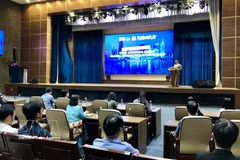
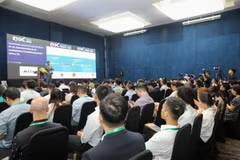
At a webinar held on May 27, Vietnamese Trade Counsellor in India Bui Trung Thuong said bilateral relations have gained fresh momentum following Party General Secretary and State President To Lam’s visit to India in early May and the elevation of ties to an Enhanced Comprehensive Strategic Partnership. Both countries also reaffirmed the goal of raising bilateral trade turnover to 25 billion USD by 2030, with fisheries considered a highly potential area thanks to the two economies' strong complementarity in terms of materials, processing, technology and export markets.
He noted India is currently one of the fastest-growing markets for fishery products in the world, with a population of over 1.4 billion, and is also a globally leading producer and exporter of these products. Its fishery processing industry is valued at approximately 12 billion USD in 2024 and is expected to exceed 20 billion USD by 2026 thanks to strong export demand, supportive government policies, and increasing investment in modern processing technology, cold chain logistics, and traceability.
The recent upgrade of bilateral relations is set to open up more cooperation opportunities between Vietnamese and Indian businesses in the global fishery supply chain, Thuong added.
To Thi Tuong Lan, Deputy Secretary General of the Vietnam Association of Seafood Exporters and Producers (VASEP), said Vietnam's fisheries sector is maintaining positive recovery momentum in 2026, with export turnover in the first four months exceeding 3.6 billion USD.
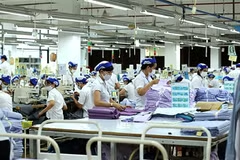
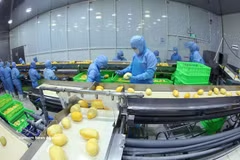
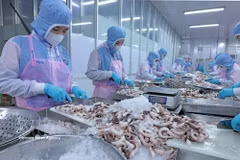
The country currently holds significant advantages in deep processing, value-added products, an extensive network of free trade agreements (FTAs), and the adaptability to various market segments. These are crucial stepping stones that enable Vietnam to continue sustaining its role as a reputable fishery processing and export hub in the global supply chain.
She held that while Vietnam has strengths in deep processing and value-added products, India has advantages in shrimp farming and raw materials. She suggested the two sides expand cooperation in raw material supply, export processing, traceability, antibiotic control, sustainability certification, and digital transformation in the fisheries industry.
Lan also proposed strengthening business connectivity through specialised trade fairs such as Vietfish in Vietnam and Seafood Expo Bharat in India to promote investment, trade, and technology transfer between their businesses.
K.N. Raghavan, Secretary General of the Seafood Exporters Association of India (SEAI), perceived that Vietnam and India should not view each other as competitors but rather aim for a "win-win" cooperation model, especially in the areas of deep processing, traceability, combating illegal, unreported, and unregulated (IUU) fishing, and developing an electronic certification system for exports to the US and the EU.
He said Vietnam is currently India's fourth largest fishery export market, with growth of nearly 70% over the past year.
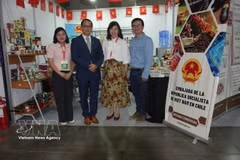
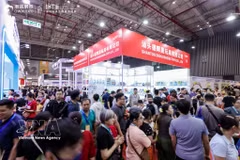
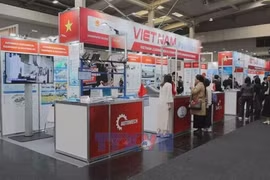
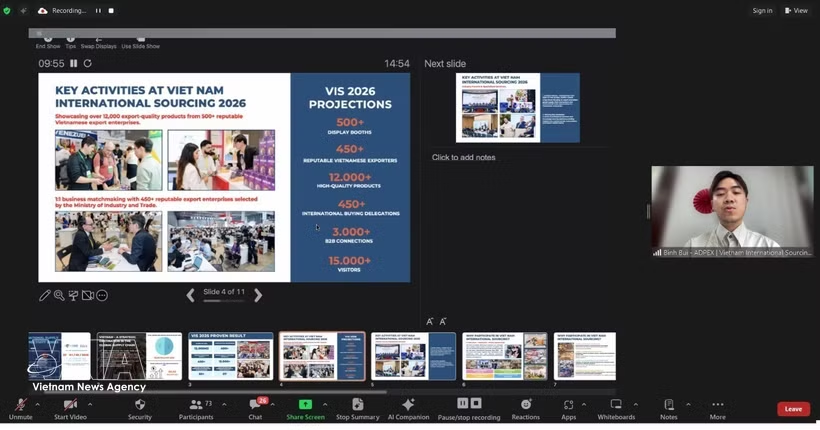
The two sides also introduced upcoming trade promotion events, including Vietnam International Sourcing 2026 in Ho Chi Minh City this September and Seafood Expo Bharat 2026 in Chennai in July, aimed at strengthening business connectivity and investment cooperation./.