Textile exports rise, but orders weaken

The latest statistics from the Vietnam Textile and Apparel Association (VITAS) show that the country’s textile and garment exports reached 14.53 billion USD in the first four months of this year, up 4.3% year-on-year.

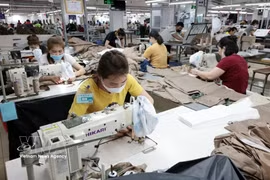
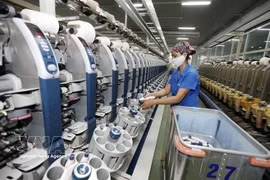
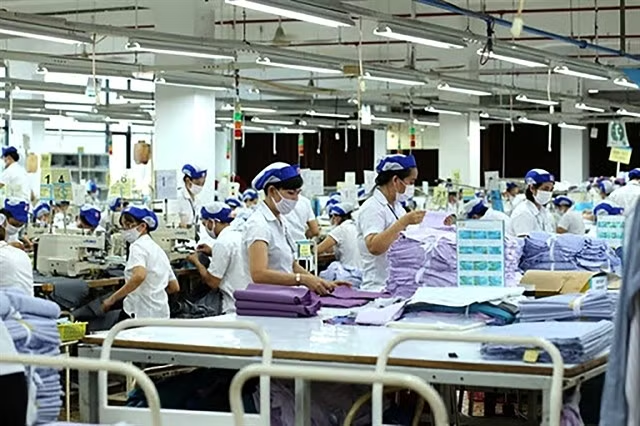
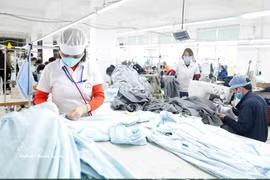
A garment and textile production line at VINATEX. (Photo: vinatex.com.vn)

Hanoi (VNS/VNA) – Despite continued export growth, the textile and garment industry is facing the risk of a downturn as second-quarter orders are forecast to fall sharply by 20–25%.

The latest statistics from the Vietnam Textile and Apparel Association (VITAS) show that the country’s textile and garment exports reached 14.53 billion USD in the first four months of this year, up 4.3% year-on-year.

The yarn and fibre segment posted strong growth with export revenue of 2.62 billion USD, an increase of 20.1%, while garment exports reached 11.9 billion USD, up slightly by 1.3%.

In the US market, Vietnam continued to maintain its leading position with a 21.4% market share.

These figures indicate that the textile and garment industry has maintained growth momentum despite ongoing volatility in the global economy. However, in reality, the sector is facing numerous challenges.

The Dai doan ket (Great Unity) newspapers quoted Nguyen Hung Quy, general director of Vinatex Textile and Garment Southern Corporation Limited Liability Company, as saying that weakening global demand has caused new orders to come in very slowly, while some buyers had even reduced or cancelled orders.

Order volumes in the second quarter are expected to decline sharply by 20–25% compared to the same period last year, he said.

In addition, imported raw material supply chains from China have faced repeated delays. As a result, manufacturers had to ramp up overtime shifts to meet increasingly tight delivery schedules.

Le Tien Truong, chairman of the Vietnam National Textile and Garment Group (VINATEX), noted that the industry is currently facing a paradox, with business performance in the first four months of the year remaining positive even as macroeconomic indicators and consumer demand in key import markets became increasingly unstable.

Even orders already secured through the third quarter remain uncertain, according to Truong. This warning highlights that the textile and garment industry’s biggest challenge lies not only in finding orders but also in managing volatility in a rapidly changing and unpredictable market.

Speaking about the remaining months of 2026, Cao Huu Hieu, VINATEX general director, said that significant uncertainties remain and could materially affect business and production results.

Therefore, enterprises need to develop production plans focused on maximising productivity and efficiency during the second quarter to create growth momentum for the final months of the year, while closely monitoring market developments to promptly implement response measures, he said.

Hieu also emphasised that companies should continue maximising profits while they still benefit from relatively low raw material prices, and maintain close market surveillance to achieve better business outcomes.

Meanwhile, VITAS Chairman Vu Duc Giang said that to achieve the target of approximately 50 billion USD in export turnover this year, the remaining months of the year could not simply be viewed as a period for “maintaining orders”.

Instead, they must serve as a pivotal phase for the textile and garment industry to undertake deeper restructuring in terms of markets, products, and technology, he said.

At the same time, diversifying export markets and customer bases must be placed at the centre of the industry’s long-term development strategy, he added./.

VNA
See more

Speakers at the event. (Photo: VNA)

Vietnam, France share experience in building legal framework for digital assets

Digital assets are reshaping economic models, financial infrastructure, capital flows, investor confidence, cybersecurity frameworks and the competitiveness of existing international financial centres. These developments present common challenges for both France and Vietnam, making the exchange of practical lessons and regulatory experience increasingly important.

International customers are impressed by Vietnamese products for natural flavours and attractive packaging. (Photo: VNA)

Vietnamese products make strong impression at Foodservice Australia 2026

International visitors expressed positive impressions of Vietnamese products displayed at the fair. Nelma Sanjines, senior supervisor at ESP Catering in Sydney, praised the flavour of Vietnamese chilli sauce and soy sauce as well as the attractive packaging of confectionery products.

Workers process seafood for exports. (Photo: VNA)

Digital technology helps standardise supply chains, sustain export competitiveness

Experts noted that supply chain optimisation and risk management are no longer isolated tasks for individual companies but a requirement for the entire export ecosystem. With guidance from regulators, support from industry experts and their own efforts, Vietnamese exporters are expected to enhance their competitiveness and turn technical barriers and market volatility into opportunities for sustainable growth in global markets.

Vistors at the exxhibition (Photo: VNA)

Hanoi to host major toy and child products exhibition

According to representatives of Vinexad, the exhibition will introduce a wide range of new products, including educational toys, creative products, childcare and safety equipment, and solutions for preschool education. The event is expected to provide businesses with opportunities to secure stable supply sources, expand distribution networks and update themselves on the latest consumer and technology trends in the industry.

A Vietnamese business representative in Laos raises opinions at the forum. (Photo: VNA)

Vietnam, Laos promote trade and transport connectivity

Kingsadone Phetdaoheuang, Director General of the Foreign Trade Department under Laos’ Ministry of Industry and Commerce, Laos’ efforts to transform itself from a landlocked country into a regional connectivity hub linking the Mekong sub-region and ASEAN, creating new opportunities for industry, agriculture and cross-border trade.

Visitors to Thailand Week 2026 in Hanoi (Photo: VNA)

Vietnam, Thailand poised to open new chapter in economic, trade cooperation

With growing two-way trade turnover, increasingly integrated supply-chain linkages, and expanding cooperation in logistics, high technology, green economy and digital transformation, Vietnam and Thailand are gradually shaping a new economic collaboration space within ASEAN that is more interconnected and complementary in nature.

Philippine experts study ways to improve rice production efficiency. (Photo: PIA.GOV.PH)

Vietnam, Philippines further boost cooperation in food security

Since establishing diplomatic relations in 1976, Vietnam and the Philippines have built a strong and substantive partnership across sectors. Despite global uncertainties, bilateral ties have continued to deepen, underpinned by mutual respect, equality, and shared interests.