Ninh Binh eliminates all 'three-no' fishing vessels

At present, 608 of Ninh Binh's 611 active fishing vessels measuring 15 metres or more in length have installed VMS, representing 99.51% compliance.

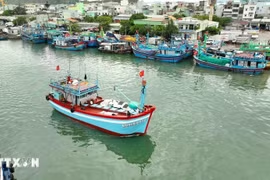
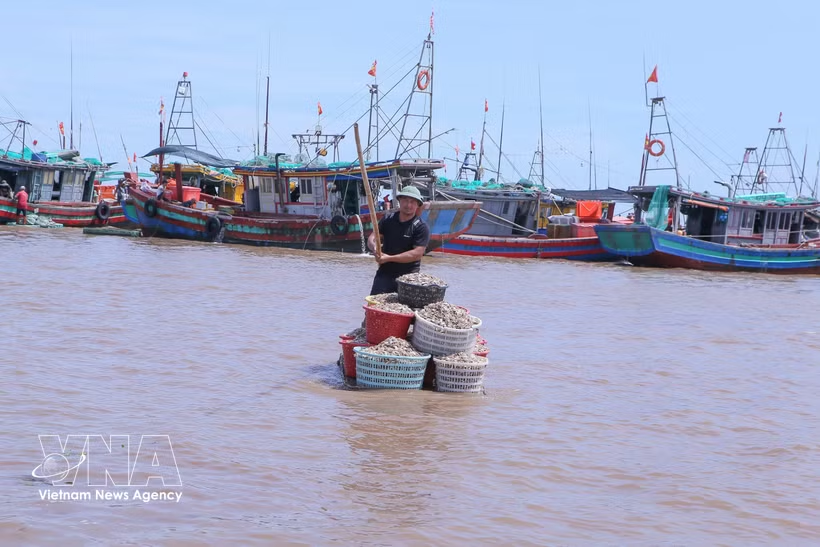
A fisherman use rafts to transport seafood from fishing boats to shore for sale at Giao Hai fish market in Giao Phuc commune, Ninh Binh province. (Photo: VNA)

Ninh Binh (VNA) – As of April 30, all fishing vessels in the northern province of Ninh Binh have been fully registered, inspected and marked, while also obtaining food safety certificates, fishing licences and having their details updated in the national fisheries database (Vnfishbase), meaning the province no longer has any so-called "three-no" fishing vessels.

The term "three-no" refers to fishing vessels operating without registration, inspection certificate and fishing licence.

To date, Ninh Binh has completed the review, verification and updating of information relating to fishing vessels and vessel owners in Vnfishbase. All 1,388 fishing vessels measuring six metres or longer have been registered, with vessel and ownership information fully integrated into both the Vnfishbase and the national population database VNeID.

The achievement follows a series of measures introduced after the merger with Ha Nam and Nam Dinh provinces. On July 28, 2025, the Ninh Binh People's Committee issued a decision establishing a steering committee tasked with combating illegal, unreported and unregulated (IUU) fishing.

The province has also organised training courses and awareness campaigns on the 2017 fisheries law and related regulations, including provisions on IUU fishing prevention. Vessel owners and captains have been required to sign commitments not to engage in IUU fishing activities, particularly incursions into foreign waters. Authorities have also conducted a comprehensive census of fishing vessels by length category and compiled lists of vessels failing to meet regulatory requirements, including those lacking registration, inspection certificates, fishing licences or food safety certification.

Despite the progress, several shortcomings remain. Authorities continue to record cases of vessels losing vessel monitoring system (VMS) connectivity for more than six hours while operating at sea. Controls over vessels entering and leaving ports and anchorage areas have yet to be fully tightened, while monitoring and statistical reporting of catches landed through private and traditional fishing ports remain limited and inconsistent. There have also been instances of fishing vessels failing to dock at their designated ports as required.

According to provincial authorities, these challenges stem partly from infrastructure constraints. Ninh Binh currently has only two fishing ports, while numerous private and traditional landing sites and beach landing areas are scattered across coastal communes, stretching already limited enforcement resources.

According to Vice Chairman of the provincial People's Committee Tran Anh Dung, the province will continue to diversify public awareness efforts and organise inspection teams to monitor anti-IUU fishing measures in coastal communes and wards.

It will also regularly review and publicise lists of vessels deemed at high risk of committing IUU fishing violations. At the same time, authorities will continue identifying those that have yet to install voyage monitoring system (VMS) and require owners to comply with installation regulations.

Ninh Binh has pledged to put an end to vessels operating without licences, failing to maintain VMS signals or sailing without registration numbers, and to impose strict penalties on those found deliberately violating regulations.

Particular emphasis is being placed on the deployment of electronic fisheries management systems, including the electronic catch documentation and traceability system (eCDT) and the electronic fishing and transhipment logbook system (Elogbook). These systems support the monitoring of vessel movements through ports, the collection of fishing logs and catch reports, oversight of landings. Authorities are also strengthening catch monitoring and traceability measures at ports, fishing wharves and vessel anchorage areas throughout the province.

At present, 608 of the province's 611 active fishing vessels measuring 15 metres or more in length have installed VMS, representing 99.51% compliance. The remaining three vessels have not yet installed the devices because they are newly registered and not yet operational, have remained inactive ashore for extended periods, or have recently undergone ownership transfers and are awaiting updates from equipment suppliers.

Meanwhile, 604 of the 611 vessels currently hold valid food safety certification, equivalent to 98.85% compliance. The remaining seven have not been certified because they are not currently operating and remain ashore. Authorities have also issued fishing licences to 1,383 of the province's 1,388 fishing vessels, representing 99.64% of the fleet./.

VNA

See more

According to Fortune’s latest list, Vinachem ranks 148th among Southeast Asia’s top 500 companies in 2026. (Photo: vinachem.com.vn)

Vinachem makes Fortune Southeast Asia 500 for the first time

According to Fortune’s latest list, Vinachem ranked 148th among Southeast Asia’s top 500 companies in 2026. The ranking is compiled using key financial indicators including revenue, profit and total assets, and covers enterprises from seven regional economies, namely Vietnam, Indonesia, Thailand, Malaysia, Singapore, Philippines and Cambodia.

Lien Khuong International Airport in the central province of Lam Dong (Photo: VNA)

Lien Khuong Airport expected to reopen in August

The project is invested by ACV, with a total investment of over 1 trillion VND (38 million USD), including the repair of the entire runway, taxiways, safety strips, and technical infrastructure and equipment to ensure flight operations.

Representatives of Ho Chi Minh City's tax agency address concerns and clarify tax-related issues raised by the FDI business community. (Photo: VNA)

Ho Chi Minh City moves to ease tax hurdles for FDI firms

The Ho Chi Minh City tax agency said it will maintain regular dialogue with businesses, push ahead with administrative reform and digital transformation, and identify implementation bottlenecks to recommend policy adjustments, facilitating investment and business activities for FDI enterprises.

A workshop on the Halal market is held in Ho Chi Minh City on June 16, 2026. (Photo: VNA)

Growing Halal market offers opportunities for Vietnamese businesses

The Halal market is becoming a promising avenue for businesses in Ho Chi Minh City. With its well-developed manufacturing, trade and service ecosystem and dynamic business community, the city is well positioned to strengthen its role in regional and global Halal supply chains.

Wistron Infocomm Vietnam Co., Ltd, an FDI enterprise, has invested in Dong Van III Industrial Park of Ninh Binh province since 2021, creating jobs for more than 12,800 workers. (Photo: VNA)

Vietnam seeks to position itself as leading destination for foreign investment

A significant shift in the recently issued Resolution 10 is the move from a strategy of attracting “more capital” towards attracting “higher-quality FDI”. The objective is no longer limited to investment volume but extends to absorbing advanced technologies, increasing domestic value creation, strengthening innovation capacity and accelerating modernisation in the economy.

Enterprises must disclose to investors the issuance plan, legal and investment risks and the rights and obligations of issuers and bondholders. (Photo: VNA)

Vietnam tightens rules on corporate bond issuance

Under Decree No 200/2026/ND-CP, enterprises issuing bonds will continue to operate under the principle of self-borrowing, self-repayment and self-responsibility, meaning issuers are fully accountable for the efficiency of capital use, debt repayment capacity and any disputes arising from bond issuance, use of funds, and payment of principal and interest.

A performance on The Huc bridge of the temple as part of a nighttime tourism programme to discover the Ngoc Son temple on Hoan Kiem Lake, downtown Hanoi. (Photo: VNA)

Hanoi adopts framework to boost night-time economy development

The resolution encourages a wide range of cultural, artistic and tourism activities, including performances, exhibitions, film screenings, presentations of traditional and intangible cultural heritage, and other programmes held in public spaces, pedestrian streets, heritage sites, theatres, cinemas and cultural venues.

A cargo port in Thiruvananthapuram city, India (Photo: ANI/VNA)

Ample room remains for Vietnam–India logistics cooperation

The GTTCI expert noted that alongside logistics and integrated warehousing, e-commerce is expected to be a particularly high-growth sector in the coming years. He described it as a multi-billion-dollar market with significant untapped opportunities for cooperation between Vietnam and India.

The meeting between Minister of Finance Ngo Van Tuan and Ambassador Julien Guerrier, head of the EU Delegation to Vietnam, on June 15. (Photo: thoibaotaichinhvietnam.vn)

Vietnam, EU enhance cooperation in green finance

Minister of Finance Ngo Van Tuan called on the EU to help facilitate Vietnamese firms' access to green finance, expand technical and financial assistance for green transition, and enhance cooperation in strategic technologies, innovation, digital finance and high-tech human resources development.

An overview of the working session between Deputy Finance Minister Tran Quoc Phuong and Kim Dongil, Director of ADB representing the Republic of Korea, Papua New Guinea, Sri Lanka, Taipei (China), Uzbekistan, Vanuatu and Vietnam. (Photo: Ministry of Finance)

Vietnam, ADB to advance strategic projects with strong economic impact

ADB has identified a pipeline of 27 projects for Vietnam through 2029, with total planned financing of approximately 4.6 billion USD. The projects focus on sectors that are among Vietnam’s priorities, including infrastructure, energy, urban development, agriculture and public sector management.