Vietnam–Canada judicial capacity development project launched

The Vietnam–Canada judicial capacity development project will focus on strengthening the capacity of judges and court personnel, improving equal access to justice, particularly for women and juveniles, enhancing the quality of judicial training, and promoting the leadership role and participation of female judges within Vietnam's judicial system.

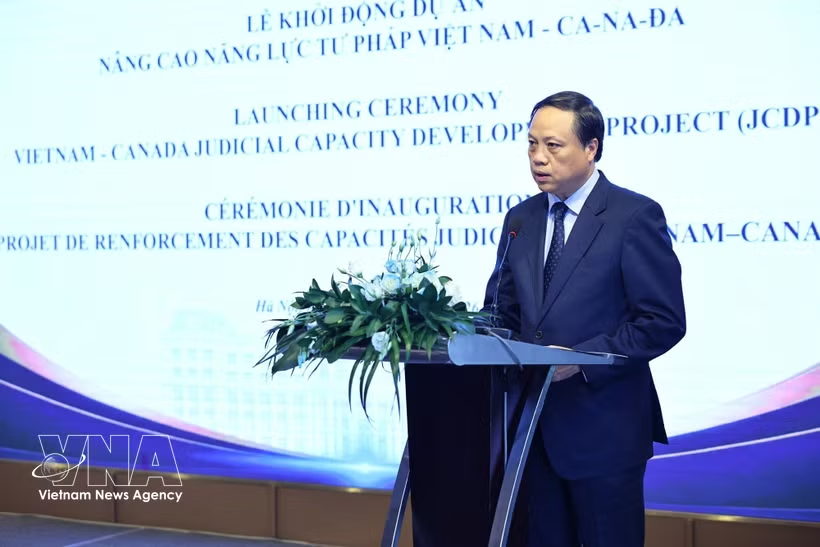
Deputy Chief Justice of the Supreme People's Court Le Tien speaks at the launch ceremony of the Vietnam–Canada judicial capacity development project in Hanoi on May 26, 2026. (Photo: VNA)

Hanoi (VNA) – The Supreme People's Court of Vietnam launched the Vietnam–Canada judicial capacity development project at a ceremony in Hanoi on May 26.

The project will focus on strengthening the capacity of judges and court personnel, improving equal access to justice, particularly for women and juveniles, enhancing the quality of judicial training, and promoting the leadership role and participation of female judges within Vietnam's judicial system.

Speaking at the launching ceremony, Deputy Chief Justice of the Supreme People's Court Le Tien described the initiative as an important milestone marking a new stage in cooperation between the judicial institutions of Vietnam and Canada.

The two countries enjoy friendly relations and broad-based cooperation across a range of sectors. Since establishing a comprehensive partnership in 2017, bilateral ties have continued to deepen, with legal and judicial cooperation emerging as an increasingly significant area of collaboration. In recent years, the Supreme People's Court of Vietnam has expanded cooperation with Canadian judicial institutions and organisations, particularly the National Judicial Institute. Through delegation exchanges, professional knowledge-sharing, workshops, training programmes and project development activities, both sides have strengthened mutual understanding and trust while advancing shared values relating to the rule of law, respect for law, and judicial reform.

Tien noted that Vietnam is actively implementing major Party policies aimed at building and refining a socialist rule-of-law state, advancing judicial reform and deepening international integration. He highlighted that Resolution No. 27-NQ/TW, adopted by the 13th Communist Party of Vietnam Central Committee, sets out the objective of developing a professional, modern, fair, rigorous and upright judiciary dedicated to serving the nation and its people, with the protection of justice, human rights and citizens' rights placed at its core.

At the same time, a number of recent resolutions issued by the Politburo on legislative reform, science and technology development, national digital transformation and international integration are creating new demands on the judicial system and the operation of the courts, he added.

Particularly significant, Tien said, is the implementation of a restructured court system under the amended law on the organisation of people's courts, which introduces several major reforms. These include the establishment of regional people's courts and specialised courts within the international financial centre, alongside the enforcement of new legislation related to judicial affairs. Such developments have created a pressing need for enhanced training and professional development for judges and court officials.

Against this backdrop, the Vietnam–Canada judicial capacity development project is both timely and highly practical, the deputy chief justice said. He expressed confidence that with the support of the Canadian Government and the expertise and partnership of Canada’s National Judicial Institute and other relevant bodies, the project would be implemented effectively, achieve its objectives and deliver lasting, tangible benefits.

He also hoped that the initiative would become a model of judicial cooperation between the two nations.

Addressing the ceremony, Leigh McCumber, Chargé d'Affaires at the Embassy of Canada in Vietnam, highlighted the longstanding friendship and extensive cooperation between the two countries, including the important role played by judicial cooperation. She noted that this joint work has been built on solid foundations and has produced concrete and sustainable results.

McCumber described the project as a significant milestone in efforts to develop a modern judiciary and broaden bilateral cooperation in areas including trade, intellectual property and cybersecurity./.

VNA
See more

President of the Vietnam Fatherland Front Central Committee Bui Thi Minh Hoai. (Photo: VNA)

VFF leader sends Vesak greetings to Buddhist community

Vietnamese Buddhism has consistently upheld the spirit of “protecting the nation and serving the people” while accompanying the nation in promoting social ethics, strengthening great national unity, and advancing national development.

Large areas of crops are flattened and damaged following heavy rain from the night of May 18 into the early hours of May 19, 2026. (Photo published by VNA)

PM orders stronger disaster prevention, response efforts

Under recently-issued Directive No. 23/CT-TTg on implementing Conclusion No. 213-KL/TW dated November 21, 2025 of the Party Central Committee’s Secretariat, provincial and municipal Party secretaries and chairpersons are required to take direct responsibility for disaster prevention and recovery work in their localities.

Police in Bo Trach commune of Quang Tri province use an AI-generated propaganda clip to raise awareness and warn against crime. (Photo: VNA)

📝OP-ED: Building “digital ideological ecosystem”: shifting from reactive thinking to early guidance

Building a digital ideological ecosystem also means changing communication thinking — not only being correct, but also being fast; not only accurate, but also relatable, accessible and aligned with the information consumption habits of digital society. More importantly, the ecosystem must create connectivity and coordination instead of the current fragmented situation in which different agencies operate separately.

The National Centre for Hydro-Meteorological Forecasting reports that since May 23, many northern localities have recorded temperatures of 37–39°C, with some areas exceeding 39°C. (Illustrative photo: VNA)

Northern power firm urges energy saving as demand nears record highs

EVNNPC reported that peak demand (Pmax) across 17 northern provinces and cities under its management (excluding Hanoi) remained elevated over the past weekend, reaching 18,666 MW on May 23 and 18,387 MW on May 24—significantly higher than the Pmax of 15,940 MW seen in May 2025.

The Hon Thom cable car, the world’s longest over-sea cable system, in Phu Quoc special zone, An Giang province (Photo: VNA)

An Giang pushes green overhaul of Phu Quoc for APEC 2027

With more than 137 trillion VND (over 5 billion) earmarked for APEC-related investments, Phu Quoc is positioning itself not only as the host of a global event, but as a pioneering net-zero island, aspiring to become a “Green lighthouse” that inspires sustainable development across the region and the world.

Permanent Member of the Party Central Committee Secretariat Tran Cam Tu pays solemn tribute to the nation's fallen heroes who fought bravely and sacrificed their lives in the fulfilment of their noble international duty at the ceremony in Ha Tinh province on May 25. (Photo: VNA)

Senior Party official attends reburial ceremony for Vietnamese martyrs in Ha Tinh

A memorial and reburial ceremony for the remains of nine Vietnamese volunteer soldiers and experts who died in Laos during wartime was held on the morning of May 25 at the Nam Martyrs’ Cemetery in Tu My commune, Ha Tinh province, with the attendance of Politburo member and Permanent Member of the Party Central Committee’s Secretariat Tran Cam Tu.

Students at Ho Chi Minh City University of Technology practice advanced technologies (Photo: VNA)

Vietnam rolls out scholarships to fuel sci-tech workforce

Spanning five chapters and 17 articles, the decree specifies eligible recipients, qualifying courses, selection criteria and principles, scholarship amounts and duration, authority for approval and disbursement, fund allocation and settlement, and the obligations of all entities and individuals involved.

The highest allowance level of 80% will apply to teachers and managers at ethnic minority boarding schools, specialised high schools, pre-university schools, schools for persons with disabilities (Illustrative photo: VNA)

Teachers to receive occupational allowances of up to 80%

The policy aims to improve policies for teachers, education managers and support staff, while encouraging them to continue working in disadvantaged, remote, border and island areas, as well as at specialised educational institutions.