Hanoi (VNA) — Every day, millions of pieces of information, videos, images and social media posts appear online, directly influencing public perception. While much positive content spreads rapidly, there is also no shortage of misleading information, historical distortions and manipulated narratives designed to sow doubt among public in ways that are increasingly difficult to detect.
Meanwhile, information security in many places still largely follows a reactive approach, only responding when incidents occur. Data remain fragmented, and reactions are often slower than the speed at which information spreads on social media. This reality shows that building a “digital ideological ecosystem” has become an urgent requirement today.
The biggest bottleneck facing the Party’s ideological work in the context of digital transformation is not a lack of personnel or determination, but rather a lack of connectivity. Different agencies and localities operate separate databases and platforms. Many still process information manually without integrated systems.
In some cases, when a “hot” issue erupts on social media, information may already have spread for hours or even days while authorities are still compiling reports through traditional procedures.
In the digital environment, even a delay of a few hours can mean losing the initiative.
Cyberspace today is no longer merely a space for communication, entertainment or business. It has also become a highly direct ideological front. False and distorted information is growing increasingly sophisticated and harder to identify, often disguised as “alternative perspectives,” “multi-dimensional analysis,” or “humanitarian” and “historical understanding” content.
Particularly concerning is the trend of “soft historical revisionism,” which quietly seeks to influence public perception through short videos, films, podcasts and audiovisual products on social media.
The danger lies in the fact that many narratives do not directly deny history, but instead target emotions in order to guide and shape perception. For example, regarding the April 30, 1975 Victory – a brilliant milestone in Vietnam’s history of national construction and defence, marking the complete liberation of the country and the reunification of the North and the South after years of division, hostile actors have attempted to separate individual pain from the broader national historical context, deliberately blurring the line between justice and wrongdoing.
Many pieces of content distort facts, manipulate archives and use AI and deepfake technologies to falsify historical information. Without a solid foundation of awareness, audiences can easily be influenced little by little without realising it.
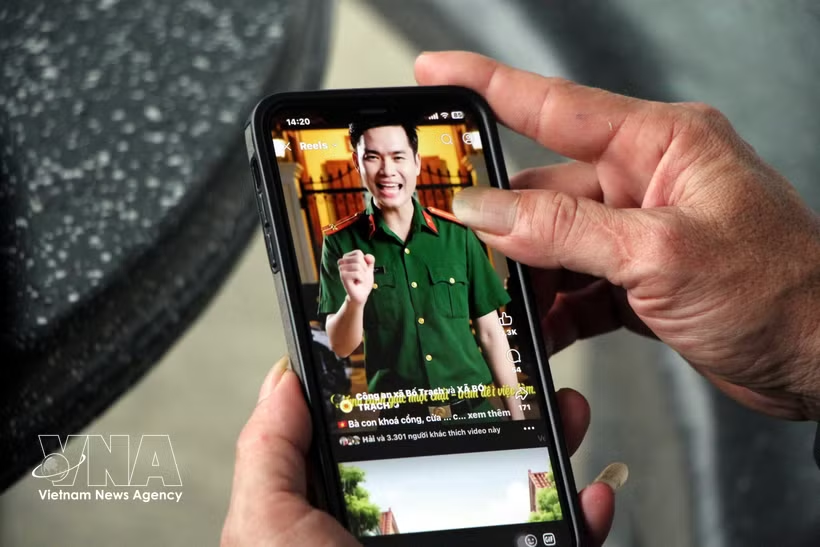
In the past, misleading information often appeared only on small websites. Today, however, just a few dozen seconds of video on TikTok, Facebook or YouTube can spread information to millions of people.
At the same time, traditional approaches still focus mainly on late detection, delayed responses and rebuttals only after information has already spread widely. This has left many agencies in a passive position, constantly chasing events instead of shaping narratives proactively.
Recent information from the Party Central Committee’s Commission for Information, Education, and Mass Mobilisation highlighted the “explosion” of harmful online content. During the 2025-2026 period alone, incidents involving toxic and harmful information on cyberspace increased by more than 300%, with over 70% directly targeting the Party’s ideological foundation.

The World Economic Forum, in its Global Risks Report 2026, continued to rank misinformation and information manipulation among the world’s leading short-term risks. In particular, generative AI and deepfake technologies are making the “battle for perception” more sophisticated than ever before.
This reality demonstrates that ideological work must not lag behind social media any more.
The requirement now is to shift decisively from “reactive thinking” to “early detection – early analysis – early guidance.” By 2030, the goal is to ensure that “100% of major policies are identified early, explained early, guided early and handled early.” Response times to serious harmful information across the information, education and mass mobilisation system are expected to be reduced to under two hours.
To achieve this, the first priority is to establish a unified digital ideological ecosystem with interconnected data throughout the system. Once data are synchronised, operation centres will be able to monitor public opinion trends in real time, detect unusual developments early and identify media campaigns showing signs of manipulation or distortion in order to provide timely guidance.
This is also why Vietnam aims to fundamentally complete a unified digital ideological work ecosystem across the Party by 2030 and establish a central-level ideological information operation centre before 2028.
Within this ecosystem, AI is not intended to replace humans in ideological work, but to support the processing of enormous volumes of data that humans cannot handle manually.
Without technological support, it would be extremely difficult to detect dangerous trends quietly spreading online. Using “AI to fight AI” and mastering at least five “Make in Vietnam” AI platforms and tools serving ideological work by 2030 therefore become essential requirements.
However, this ecosystem is not only meant for “defence” but also for “construction.” In reality, many historical stories presented through modern, accessible and emotional formats have generated strong public engagement. Numerous films, animation projects and digital historical products have attracted widespread public interest and sharing online.
This shows that if technology and digital platforms are used effectively, ideological work can come much closer to social media users.
Therefore, building a digital ideological ecosystem is not simply about investing in more software or equipment. The core issue is creating a communication environment that is fast enough, attractive enough and competitive enough to stand out amid today’s overwhelming flow of information on social media.
A good article appearing too late may lose its impact. Accurate information presented in a rigid manner is unlikely to spread widely. In contrast, distorted videos designed to trigger emotions can spread extremely quickly.
For that reason, building a digital ideological ecosystem also means changing communication thinking — not only being correct, but also being fast; not only accurate, but also relatable, accessible and aligned with the information consumption habits of digital society. More importantly, the ecosystem must create connectivity and coordination instead of the current fragmented situation in which different agencies operate separately.
Cyberspace operates in real time. Ideological work must adapt to that reality as well. Safeguarding the ideological foundation today depends not only on correct affirmations, but also on the ability to maintain a timely, persuasive and proactive presence in cyberspace.
To achieve that, ideological work can no longer afford to remain behind social media./.