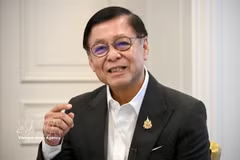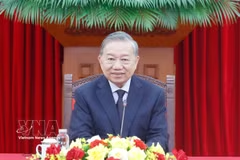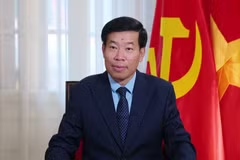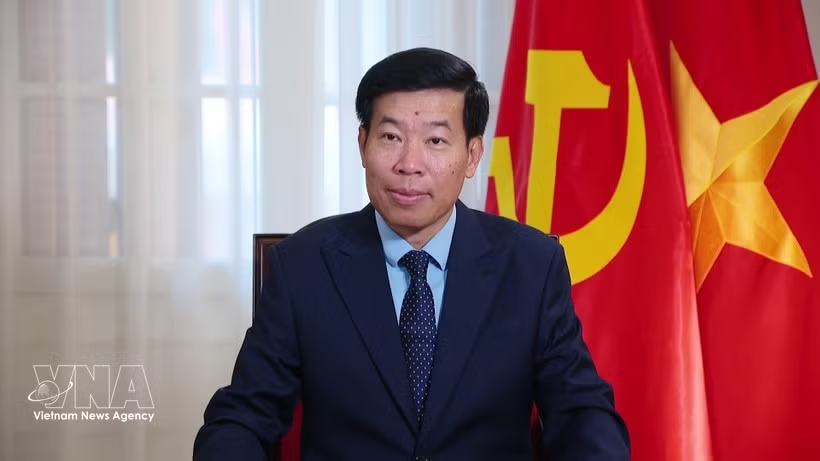
Hanoi (VNA) – The relations between Vietnam and Singapore have evolved well beyond traditional economic cooperation and are increasingly taking on a deeper strategic dimension, with a growing focus on future-oriented sectors that contribute to the sustainable development of both countries and strengthen regional integration within ASEAN, Deputy Minister of Foreign Affairs Nguyen Manh Cuong said.
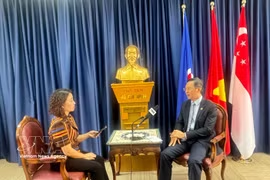
The official made the remarks in an interview with the press ahead of the State visit to Singapore by General Secretary of the Communist Party of Vietnam Central Committee and State President To Lam from May 29–31.
According to Cuong, the establishment of a strategic partnership in 2013 and its elevation to a comprehensive strategic partnership in 2025 marked a highly significant milestone in bilateral ties. The move reflects a high degree of political trust, increasingly intertwined interests and a shared strategic vision in response to a changing international environment.
Singapore is currently one of Vietnam's most important economic partners and its second-largest foreign investor, with more than 4,500 active projects and nearly 97 billion USD in registered capital. Singaporean investments span a wide range of sectors, including manufacturing, infrastructure, logistics, real estate, finance, high technology and modern services, making substantial contributions to economic growth, job creation and Vietnam's economic restructuring.
One of the most visible symbols of bilateral cooperation is the network of Vietnam–Singapore Industrial Parks (VSIP). Since the establishment of the first VSIP, the model has expanded across numerous Vietnamese provinces and cities. In its next phase of development, the network is moving towards greener, smarter and more technology-intensive models aligned with sustainable development objectives.
Vietnam and Singapore are also advancing extensive cooperation in areas such as artificial intelligence, big data, semiconductor technology, clean energy, green transition and financial centre development. In particular, both countries are promoting initiatives designed to strengthen technological connectivity and innovation by linking their respective technology ecosystems, innovation hubs, technology enterprises and pools of highly skilled talent. This represents a strategically important area of long-term cooperation that aligns closely with Vietnam's development needs and Singapore's comparative strengths.
Singapore has also, for many years, supported Vietnam in training senior officials, managers and highly qualified personnel through a range of practical cooperation programmes.
The two countries maintain regular exchanges of delegations and high-level contacts, while coordinating closely at regional and international forums, particularly within the Association of Southeast Asian Nations (ASEAN). They share common interests in maintaining peace and stability, promoting open trade, safeguarding freedom of navigation and preserving ASEAN's centrality in the evolving regional architecture.
Cuong stressed that Party General Secretary and President Lam's visit carries particular significance in advancing and operationalising the bilateral comprehensive strategic partnership framework.
The visit takes place at a time when relations are developing fruitfully and when both nations face the need to modernise their growth models, enhance competitiveness and adapt to rapid changes in the global economy.
First and foremost, it is expected to further strengthen political trust and elevate strategic coordination between the two sides. At a time of growing uncertainty and volatility in regional and global affairs, the continuation of regular high-level exchanges, the sharing of development visions and closer coordination at multilateral forums are of importance.
Economically, both countries are seeking to deepen cooperation in investment, trade, finance and supply-chain connectivity. Singapore possesses significant strengths in technology, finance, logistics and modern governance, while Vietnam offers a dynamic market, a large workforce and strong economic growth. This complementarity provides substantial scope for expanded cooperation in the new period.
A key focus of the visit will be the promotion of deeper and more substantive collaboration in science and technology, innovation and digital transformation. Both nations are expected to broaden cooperation in artificial intelligence, big data, semiconductor technology, smart cities, digital economy, digital government and green transition initiatives. These sectors are regarded as strategically important to Vietnam's long-term development.
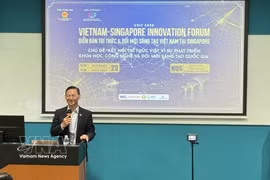
Technology and innovation initiatives such as "Tech Connect" are also expected to provide a new platform for cooperation among the three key pillars of both countries – government, academia and business. This includes regulatory agencies, research institutes, universities, technology enterprises and innovation centres. Such cooperation is expected to foster a more integrated technological ecosystem in areas including artificial intelligence, semiconductors, big data, green technologies and high-quality workforce development, in line with current trends in digital economy development and green transition.
The visit is also expected to inject fresh momentum into the development of new-generation VSIPs that are greener, smarter and more sustainable, keeping with global development trends and the sustainable development goals of both countries.
Turning to this year’s Shangri-La Dialogue, the diplomat noted that the forum, organised annually in Singapore by the International Institute for Strategic Studies, is a premier security conference in the Asia-Pacific region, bringing together heads of government, defence ministers, scholars and leading strategic experts from around the world. He described it as a highly influential platform for discussions on peace, security and the regional order.
The Deputy FM underlined that the invitation extended to Party General Secretary and President Lam to deliver the keynote address – the most prominent speech of the dialogue – reflects the international community's recognition of Vietnam's growing role, standing and influence, as well as the stature and leadership of the Vietnamese leader. It also underscores the strong interest of other countries in Vietnam's foreign policy of independence, self-reliance, peace, cooperation and development.
Vietnam is increasingly viewed as a deeply integrated economy that nevertheless maintains strategic autonomy; a dynamic developing nation with strong aspirations for advancement; and an active, responsible member of both the regional and international communities, Cuong said.
The keynote address is expected to convey the country’s perspectives and proposals on addressing the strategic challenges facing the region, with a view to promoting peace, stability and sustainable development within an evolving regional architecture.
He concluded that in this regard, Party General Secretary and President Lam's keynote appearance at the Shangri-La Dialogue serves as further recognition of Vietnam's growing role, stature and contribution to peace, cooperation and development in the region and beyond./.