Hanoi (VNA) – However sophistical or contrived they may be, distorted narratives ultimately fall silent in the face of realities on the ground in Vietnam and its continued efforts to build a clean, upright and people-centred leadership apparatus. Vietnam's anti-corruption and anti-negative phenomena campaign in 2026 has been directed to become "more resolute, more effective and more sustainable", in line with instructions from Party General Secretary To Lam.
Whenever the Party and the State introduce policies, strategies and measures aimed at advancing national development and improving the lives of citizens, hostile elements both at home and abroad are quick to launch attacks.
Vietnam's campaign against corruption, wastefulness and negative phenomena has been no exception. Critics have sought to portray it as mere political theatre, a populist exercise, or an effort that "talks tough but acts softly".
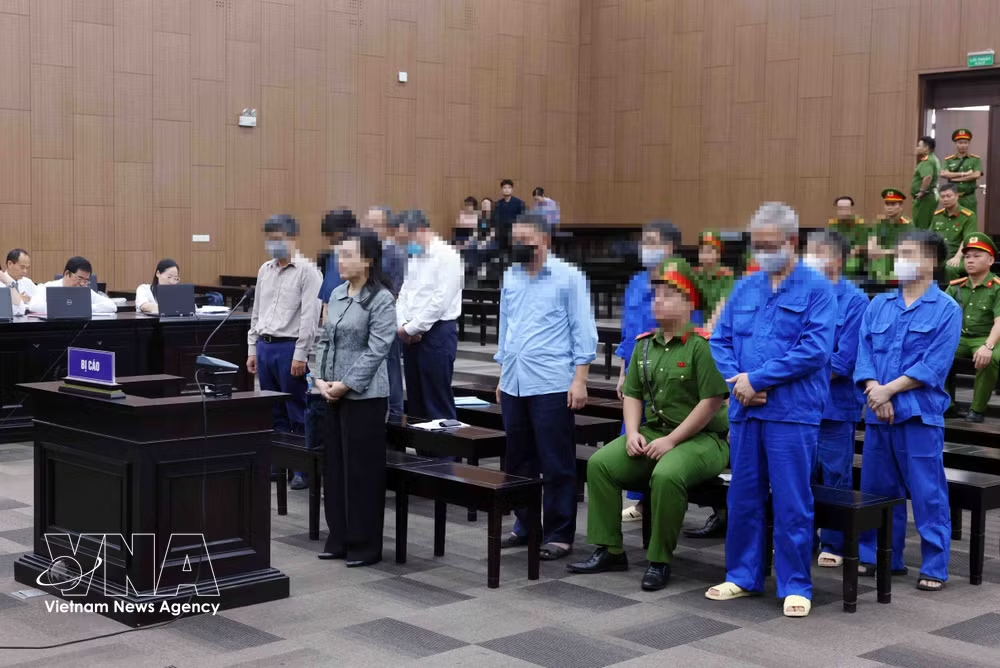
Yet in May this year, that line of attack began to lose momentum. The turning point came when the People's Court of Hanoi tried former Minister of Health Nguyen Thi Kim Tien and nine other defendants in connection with irregularities involving the second campuses of Bach Mai and Viet Duc hospitals.
Once regarded as a formidable figure at the helm of Vietnam's healthcare sector, Tien nevertheless faced a recommendation from prosecutors that the court impose a prison sentence of 5 - 6 years for "violating regulations on the management and use of State assets, causing losses and waste".
In such circumstances, continued claims that anti-corruption efforts only target lower-level figures while protecting senior officials, or that enforcement is selective, carry little credibility. Hostile commentators have therefore shifted their rhetoric, recasting the campaign as a "factional struggle", a hunt for "scapegoats", or something less substantive than it was before 2025.
So what do the facts show?
At its 29th session on December 25, 2025, the Central Steering Committee for Prevention and Control of Corruption, Wastefulness and Negative Phenomena presented figures that are difficult to dismiss.
Accordingly, 2025 marked the final year of implementation of the Resolution of the 13th National Party Congress amid significant challenges, including unprecedentedly complex natural disasters, storms and flooding. The steering committee focused on intensifying the fight against corruption, wastefulness and negative phenomena while simultaneously supporting socio-economic development, the operation of the two-tier local administration system and preparations for Party congresses at all levels. The campaign produced tangible results and strengthened consensus among officials, Party members and the public.
During 2025, Party committees and inspection commissions at all levels took disciplinary measures against more than 330 Party organisations and 9,600 Party members. The Party Central Committee as well as its Politburo, Secretariat and Inspection Commission disciplined 23 officials under the Party Central Committee's management, six of whom faced criminal prosecution. Authorities recommended the recovery or financial handling of over 75.13 trillion VND (2.85 billion USD) and 633 hectares of land, while also recommending administrative measures against 928 organisations and 3,058 individuals.
Across the country, prosecutorial bodies initiated 3,325 new cases involving 8,516 defendants for corruption, economic and abuse-of-position offences. Of these, 585 cases involving 1,585 defendants related specifically to corruption offences. Regarding cases under the direct supervision of the steering committee, authorities launched six new criminal cases involving 104 defendants from four incidents; added 172 defendants to 16 existing cases; concluded investigations into 14 cases involving 323 defendants; filed indictments in 14 cases involving 251 defendants; conducted first-instance trials of 10 cases involving 167 defendants; and heard appeals in 14 cases involving 253 defendants.
In 2026, the Central Steering Committee for Prevention and Control of Corruption, Wastefulness and Negative Phenomena is set to focus on inspections, supervision, audits, investigations and the comprehensive resolution of serious and complex corruption, wastefulness and misconduct cases that have attracted public attention. It is necessary to prevent the recurrence of past violations and ensure that corruption, wastefulness and negative phenomena do not arise in the implementation of major national and local projects. Under current plans, relevant authorities are expected to complete investigations and proceedings in 21 cases and five matters under the committee's supervision.
Unable to challenge these figures directly, hostile commentators have once again changed tack, stubbornly dismissing the Party’s and State's determination to "see the job through" with a new argument: "Even if anti-corruption efforts are genuine, the fact that so many cases are prosecuted and punished simply proves that corruption and wrongdoings are rampant."
Global experience suggests otherwise. Anti-corruption campaigns, wherever and whenever they take place, are inherently difficult and demand time, effort and sacrifice. Corruption itself is a historical phenomenon, closely associated with the exercise of state power in class-based societies.
Corruption and anti-corruption efforts coexist in every country and touch every sphere of social life, regardless of political system or level of development.
Indeed, the more advanced a society becomes, the more sophisticated illicit profiteering tends to be. Rather than appearing as petty corruption, it often evolves into "policy corruption" – far more difficult to expose because it is concealed beneath a veneer of legality.
This can create the impression of a highly transparent political system, one that may even appear "crystal clear", because the existing metrics used to assess corruption often prove inadequate and fail to detect such practices.
Lobbying is one means of influencing decision-making on issues that affect society as a whole. In developed economies such as the US and Europe, it is recognised and regulated by law.
In these jurisdictions, lobbying has become highly professionalised, encompassing both public-facing communications strategies and targeted campaigns directed at policymakers.
However, lobbying activities can also be distorted through indirect forms of bribery, including donations and financial contributions to election campaigns run by politicians and legislators.
Another manifestation is crony capitalism and interest groups, in which officials maintain close ties with financial elites and facilitate private gain through macroeconomic and financial policy decisions.
By contrast, developing countries often contend more visibly with so-called "petty corruption", and the higher number of detected cases can create the impression that corruption is especially pervasive.
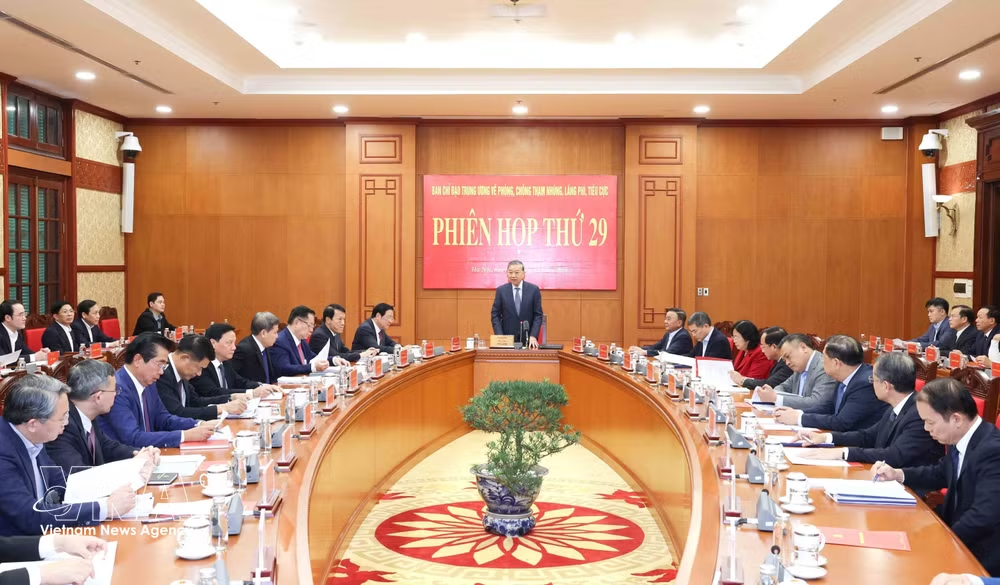
In Vietnam, the Party and State consider the fight against corruption as a long-term and arduous struggle against an "internal enemy", encompassing economic, organisational, ideological and cultural dimensions.
The prevention and control of corruption, wastefulness and negative phenomena remain among the country's foremost political priorities. The campaign is being pursued vigorously under the principle of "no forbidden zones, no exceptions, no pauses and no let-up", with the participation of the entire political system.
The legal framework underpinning this effort includes the 2025 law on amendments and supplements to a number of articles of the Law on Anti-Corruption, together with mechanisms for asset control and stringent penalties ranging from criminal prosecution and dismissal from office to asset recovery.
The fight against corruption is conducted under the direct leadership of the steering committee and implemented through close coordination among agencies, including the Government Inspectorate, the Ministry of Public Security, the Supreme People's Procuracy, the Supreme People's Court, and the Ministry of Justice.
Unaffected by the constant background noise of social media commentary, the strict handling of officials found guilty of wrongdoing, including senior officials, has contributed to cleansing the Party and State apparatus and restoring public confidence.
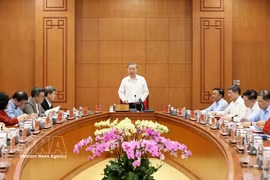
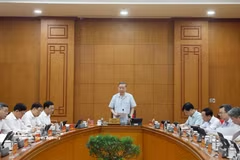
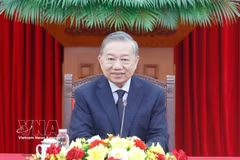
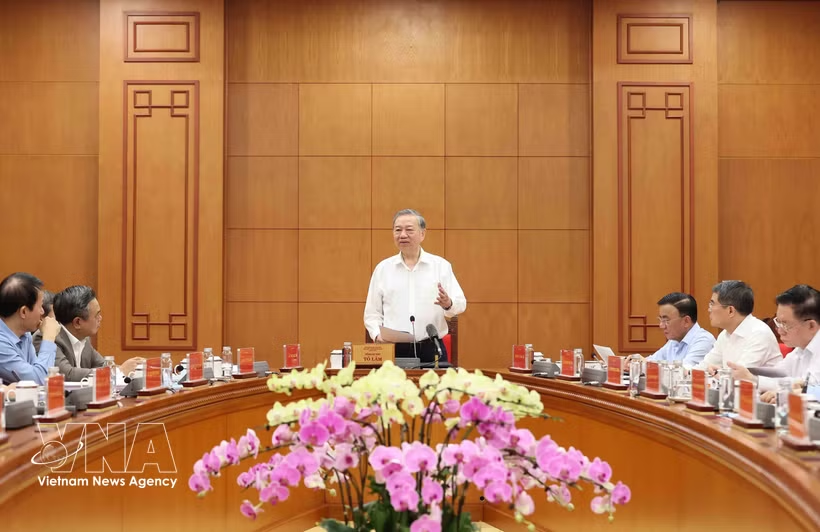
On March 18, standing members of the Central Steering Committee for Prevention and Control of Corruption, Wastefulness and Negative Phenomena, convened to discuss key priorities for the first six months of 2026. Addressing the event, Party General Secretary To Lam, who also serves as head of the committee, stressed: “Talk less and do more, see every task through to the end; each undertaking must produce concrete results.” The leader noted that after every session and meeting of the steering committee, there must be clear and substantive progress./.