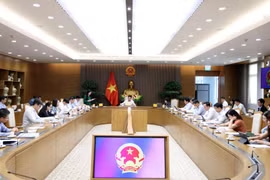
Hanoi (VNA) – Rapid rollout of the Vietnam International Financial Centre (VIFC) must go hand in hand with close supervision and effective control of risks to ensure the safety and stability of the national financial system, Deputy Prime Minister Nguyen Van Thang has said.
He stressed that there is “no reason for delay” in putting the VIFC in Da Nang and Ho Chi Minh City into operation.
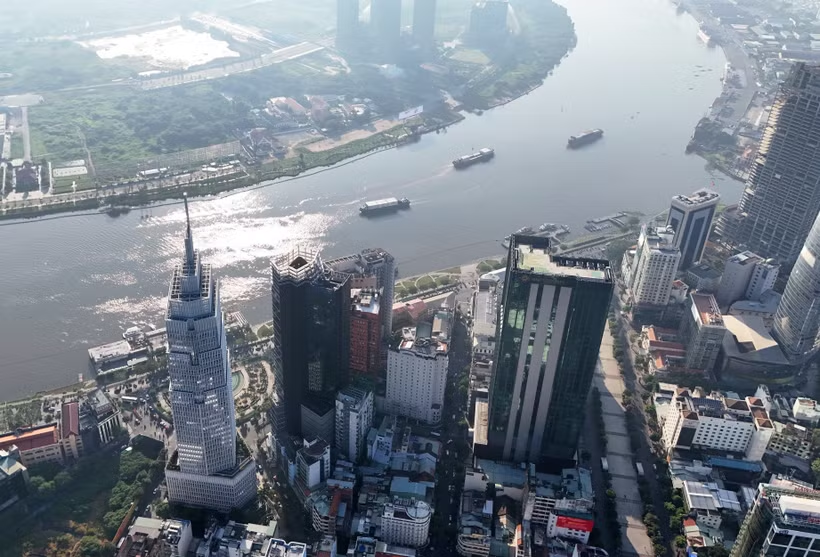
Vietnam officially established the VIFC on December 21, 2025, marking a major milestone in the country’s economic and financial development strategy. The VIFC in Da Nang city (VIFC-DN) and the other in Ho Chi Minh City (VIFC-HCMC) were subsequently launched in January and February 2026.
Under the Government’s plan, VIFC-HCMC is positioned as a multi-functional international financial hub focusing on banking services, capital markets and international investment connectivity, while VIFC-DN is being developed into a specialised centre for fintech, digital finance and green finance.
The strategy for the VIFC system is built around five pillars, including comprehensive development of capital markets and financial services, establishment of an asset management hub, promotion of fintech through regulatory sandbox mechanisms, development of specialised exchanges and modern financial instruments, and expansion of green finance to support sustainable growth.
According to Director of the International Law Department under the Ministry of Justice Bach Quoc An, Vietnam has introduced several breakthrough institutional reforms to support the VIFC model.
The National Assembly has adopted special mechanisms for the centre, while the Government has issued Decree No. 328/2025/NĐ-CP on the International Arbitration Centre operating within the VIFC framework.
One notable provision allows disputing parties to agree to waive or forgo the right to request court annulment of arbitral awards, demonstrating that Vietnam is gradually embracing the mindset of modern international financial centres. This opens up significant opportunities for the country to attract international investment flows, especially amid increasingly intense competition for foreign direct investment.
Despite operating for a short period, the VIFC has already attracted considerable interest from investors and international financial institutions.
VIFC-HCMC has granted membership commitment certificates to 15 investors after more than three months of operation. It is also working with strategic partners on projects such as a centralised commodity exchange, aviation and maritime finance centres, venture capital funds, green finance programmes, international payment switching systems and pilot models for real-world asset tokenisation.
Meanwhile, VIFC-DN has signed 20 memoranda of understanding with investors, businesses and organisations, while continuing negotiations on four additional agreements with international partners.
The city has also issued membership registration certificates to 12 investors, granted letters of acknowledgment of interest to 11 investors, while nine others are in the process of completing their membership registration applications.
International experts have also spoken positively about Vietnam’s “two centres, one structure” model.
Indian corporate finance expert Kishore Nuthalapati described the approach as one of the most effective IFC models currently being implemented, as the two geographically separate centres operate under a unified structure that enables flexible allocation of financial products and capital flows.
Dr. Luong Thanh Ha from the Banking Academy of Vietnam said the VIFC-HCMC plays a leading role in large-scale banking and capital markets, while VIFC-DN is positioned as a specialised center for fintech, digital technology, and green finance. Despite being geographically separate, these two centres are connected within a common coordination mechanism to flexibly allocate financial products and activities.
Experts also highlighted several attractive policy mechanisms, including fintech sandbox regulations, specialised dispute settlement mechanisms aligned with international standards, long-term visas of up to 10 years for foreign experts and their families, and foreign ownership policies with appropriate capital controls.
These factors are expected to help the VIFC attract stable capital inflows, reduce borrowing costs, strengthen the domestic currency and create high-value jobs in knowledge-intensive sectors.
However, experts noted that the VIFC operation still requires continuous improvement of the legal framework and policy mechanisms.
Deputy Minister of Finance Nguyen Thi Bich Ngoc said the core legal framework for the VIFC system has largely been completed, while detailed operational regulations are in the final stages of development.
At the same time, some foreign financial institutions are still facing legal barriers to market entry. According to Associate Professor Dr. Nguyen Huu Huan, Vice Chairman of the Executive Agency of VIFC-HCMC, major banks such as JPMorgan, Bank of America, Bank of China and Mitsubishi UFJ Financial Group have prepared plans to establish a presence at the centre but remain unable to participate due to certain legal requirements, particularly credit rating criteria.
Experts suggested that adjusting some entry conditions during the initial stage could help increase market liquidity, expand participation and enhance the international profile of VIFC while maintaining effective risk control mechanisms./.
VNA