VNeID set to become Vietnam’s all-in-one digital super app

The project aims to transform VNeID into a modern, secure and highly scalable national digital platform capable of effectively serving citizens, businesses, agencies and organisations in handling administrative procedures, accessing online public services, conducting electronic transactions and using digital utilities.

Targeting full integration of all individual and organisational documents on VNeID by 2028 in accordance with regulations on electronic identification and authentication. (Photo: VNA)

Hanoi (VNA) - Deputy Prime Minister Ho Quoc Dung has approved a project to develop national digital identification application VNeID for the 2026-2030 period, with a vision to 2045, positioning the platform as a “super app” at the centre of Vietnam’s national digital ecosystem.

​Under Decision No. 940/QD-TTg dated May 26, 2026, the project aims to transform VNeID into a modern, secure and highly scalable national digital platform capable of effectively serving citizens, businesses, agencies and organisations in handling administrative procedures, accessing online public services, conducting electronic transactions and using digital utilities.

The platform is also expected to function as a trusted digital infrastructure for connecting, sharing and authenticating information among national databases, specialised databases and information systems operated by ministries, sectors, local authorities, organisations and enterprises, contributing to national digital transformation and the development of digital government, digital economy and digital society.

By 2028, Vietnam aims to complete the legal framework, policies and technical infrastructure needed to develop VNeID into a comprehensive super app serving citizens, businesses and public agencies.​

Under the roadmap, 100% of beneficiaries receiving social welfare payments, pensions and social assistance are expected to have payment accounts and e-wallets integrated into VNeID. Electronic identification accounts will also be issued to all eligible individuals and organisations with demand for the service.

By the end of 2028, around 50% of essential digital utilities are expected to be integrated into VNeID, while all individual and organisational documents, along with mobile subscriptions, will be authenticated on the platform. Artificial intelligence will also be gradually integrated to enhance user experiences.

In addition, 80% of eligible citizens are expected to receive digital signature certificates for use in online public services, alongside expanded trusted services supporting civil and digital commercial transactions.​

By 2030, Vietnam plans to complete the VNeID digital ecosystem with a full range of utilities serving citizens, businesses, household enterprises and public services provided by ministries, sectors and local authorities.

​According to the plan, all citizens will have level-2 VNeID accounts integrated with payment accounts and e-wallets when needed, while all eligible citizens will be issued digital signature certificates for online public services and civil transactions.

Around 70% of utilities and services on VNeID are expected to incorporate artificial intelligence by 2030 to personalise and improve user experiences. The Government also targets 70% of users adopting cashless payment and essential bill payment services via the platform.​

In addition, 70% of users are expected to regularly access and use services and utilities within the VNeID ecosystem.

Looking ahead to 2045, Vietnam aims to further expand the VNeID digital ecosystem while continuing to upgrade technical and technological infrastructure to ensure stable, secure and seamless operations.

​Under the long-term vision, 100% of services and utilities on VNeID will integrate artificial intelligence to optimise and personalise user experiences across various digital skills and applications.​

The plan also targets universal access to cashless payment and essential bill payment services on VNeID, while 90% of users are expected to regularly access and use services within the platform’s ecosystem./.


VNA

See more

Thai Binh Seed Group Joint Stock Company has applied science and technology in research and production to develop numerous high-yield, high-quality crop varieties. (Photo: VNA)

Localities aim for higher growth through science, technology

Experiences from localities nationwide show that Resolution 57 is fostering a marked transformation in development mindset. Science and technology, innovation and digital transformation are increasingly becoming foundational drivers of economic growth and opening new development space for localities in the years ahead.

Lieutenant Colonel Nguyen Dinh Do Thi of the Department of Cybersecurity and High-Tech Crime Prevention under the Ministry of Public Security speaks at a discussion session. (Photo: VNA)

Experts recommend ‘five don’ts’ to protect personal data

Vietnamese authorities handled more than 30 cases involving the illegal sale and theft of personal data between 2023 and 2025, affecting over 160 million data records across sectors including health, education, finance, banking and telecommunications.

Major General Nguyen Tung Hung, deputy commander of the Cyber Warfare Command under the Ministry of National Defence, addresses the event (Photo: VNA)

Protecting digital future in post-quantum, AI era

Participants highlighted the importance of building a proactive, synchronised and sustainable national cybersecurity ecosystem through closer cooperation among regulators, technology firms, research institutions and cybersecurity experts.

An engineer from the Digital Transformation Centre under the Khanh Hoa provincial Department of Science and Technology carry out equipment maintenance work. (Photo: VNA)

Vietnam pushes ahead with AI-powered legal infrastructure

Research by the Ministry of Justice (MoJ) shows that AI adoption in the legal sector remains constrained by fragmented, unstandardised and weakly connected legal databases. A unified national legal data ecosystem has yet to be established, while big data and AI applications are still largely confined to pilot programmes and have not been integrated across the full legislative process, including drafting, appraisal, review and inspection of legal documents.

Deputy Prime Minister Ho Quoc Dung speaks at the meeting. (Photo: VNA)

Deputy PM demands full disbursement for sci-tech in 2026

As of May 12, total disbursed capital reached 7.95 trillion VND, equivalent to 14.78% of the Prime Minister’s plan. Of this, central budget disbursement hit 4.06 trillion VND, or 14.8% of the target, while local budget disbursement exceeded 3.88 trillion VND, or 14.75%.

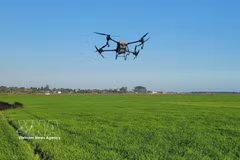
Using drones to spray pesticides in the An Nhut rice fields in Long Dien commune of Ho Chi Minh City. (Photo: VNA)

Solving technology challenge through the “three-party linkage”

According to Pham Duc Nghiem, Deputy Director of the Department of Startups and Technology Enterprises under the Ministry of Science and Technology, the “three party” linkage model involving the State, research institutes/universities and enterprises is becoming essential for developing strategic technologies. Enterprises provide practical problems, universities and research institutes develop technological solutions, while the State creates support mechanisms and policies to accelerate commercialisation.

Da Nang city's leaders present flowers to congratulate the Union of Science and Technology Associations in Da Nang on Vietnam Science and Technology Day (May 18). (Photo: VNA)

Human capital key to Da Nang’s digital economy ambitions: experts

Vo Cong Tri, Chairman of the Union of Science and Technology Associations (VUSTA) in Da Nang, described high-quality human resources as a “key driver” in the city’s transformation. Da Nang is already regarded as one of Vietnam’s leading “university cities,” with 19 higher education institutions and a high concentration of students and skilled workers. The city is also home to a growing network of science and technology organisations that are helping to foster an innovation ecosystem.

Delegates at the publication launching ceremony. (Photo: VNA)

Vietnam News Agency debuts monthly technology publication

Each 40-page issue is expected to pack 3-5 chapters, delivering a panoramic view of the global sci-tech landscape alongside in-depth analyses of emerging technology trends. The publication aims to explain strategic shifts that will shape the country’s development and examine the sci-tech, innovation and digital transformation policies of other nations.