Ho Chi Minh City (VNA) – Vietnamese startups are encouraged to strengthen connections with international investment networks and global innovation ecosystems as the country enters a new growth phase driven by technology, innovation, digital transformation, and private sector development.
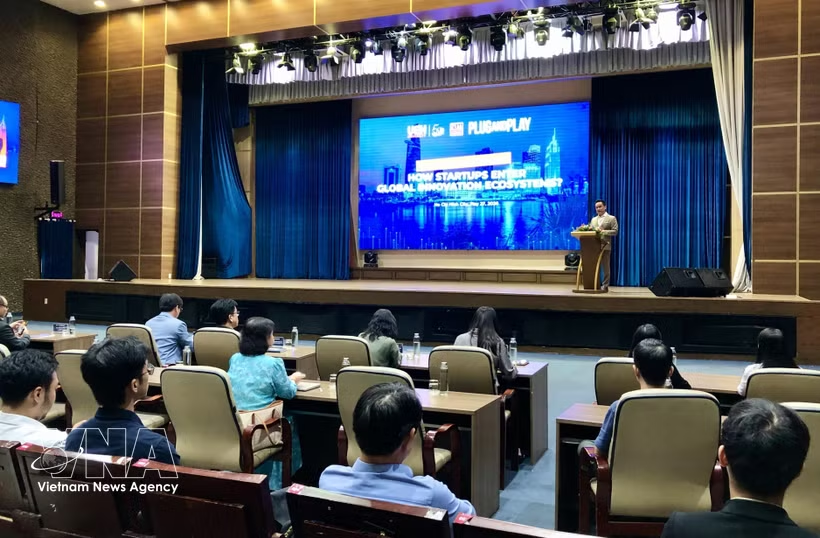
The message was highlighted at a dialogue forum titled “From Vietnam to Silicon Valley: How startups enter global innovation ecosystems?,” held in Ho Chi Minh City on May 27 by Plug and Play Tech Centre, Saigon Asset Management (SAM) and the University of Economics Ho Chi Minh City (UEH).
The event brought together startups, universities, businesses, investment funds and innovation organisations to discuss ways to foster Vietnam’s innovation ecosystem and improve access to global capital flows.
According to participants, alongside the rapid development of technology startups, the expansion of the digital workforce, and growing demand for innovation from businesses, open innovation collaboration models are becoming an important trend for connecting research, technology, markets, and investment capital flows.
However, in preparation for an era in which artificial intelligence (AI) becomes the new normal, businesses in general and the startup community in particular will need to cultivate values and capabilities that are difficult for AI to replace. In addition, global investors always prioritise startups that demonstrate the potential to emerge as leading companies or key players within their respective industries and sectors.
Although Vietnam’s startup community has continued to grow rapidly in recent years, experts said transforming university-based startups into investable businesses remains a major challenge requiring closer cooperation among universities, international investors and global innovation networks.
Associate Professor Dr. Bui Quang Hung, Director of UEH, said collaboration among startups, universities, enterprises, investment funds and innovation organisations would enable Vietnam not only to participate more deeply in the global innovation economy, but also to contribute meaningfully to shaping the global economy.
He highlighted the partnership between UEH, Plug and Play and SAM as an example of how academic research capabilities can be combined with international investment and innovation networks to support the development of globally competitive Vietnamese enterprises, technologies and human resources.
According to Hung, UEH provides an academic foundation, research capabilities, integrated technological infrastructure, an alumni network, a team of scientists and talented students, as well as strong connections with local and national authorities. Meanwhile, international partners contribute global networks, market insights, investment capacity, experience in open innovation, and the ability to transform research and experimental ideas into scalable practical solutions.
Jojo Flores, co-founder of Plug and Play, said the organisation has worked with some of the world’s most promising startups and has played a key role in connecting emerging technologies with major corporations and industries worldwide.
Plug and Play currently cooperates with more than 550 leading global brands and over 50 government organisations, while connecting with more than 100,000 startups globally. The company makes more than 250 startup investments annually and manages a global portfolio worth over 1 billion USD in assets.
It is also working to make innovation more open and accessible by supporting universities in commercialising scientific and technological research projects into market-ready solutions.
In Vietnam, the organisation has launched support programmes for university startups and innovation centres.
Louis Nguyen, Chairman and CEO of SAM, said the firm serves as a bridge linking international capital with high-growth businesses in Vietnam and Southeast Asia through its cross-border network of investors, enterprises and strategic partners.
He noted that SAM combines deep local market understanding with relationships with international investors to identify and scale businesses operating in sectors driven by long-term global demand, supply chain restructuring and regional economic transformation.
Investor interest in Vietnam has been rising rapidly, as reflected in the country’s share of startup investment within the Asia-Pacific (APAC) region increasing from 6% to 12%. At the same time, Vietnam’s highly skilled technical workforce, together with steadily growing investment inflows, is making the country an attractive market for AI investment and development both now and in the years ahead.
Representatives from several investment funds noted that innovative startups, including those in Vietnam, need to clearly understand the perspective of international investors and stay updated on AI and technology trends that are directly shaping the global market in order to succeed. On that basis, startups can better seize opportunities to engage directly in discussions on fundraising, growth, market expansion, and initiate their first connections with the innovation ecosystem in Silicon Valley.
They also emphasised that not every startup needs to expand globally. Many can still capitalise on opportunities to build profitable, fully owned businesses within the domestic market. At the same time, international expansion and external fundraising only become truly necessary once the domestic market has been fully leveraged./.