Vietnamese firms seek to tap South American market’s untapped potential

South America is increasingly viewed as a market with huge potential thanks to its large population, diverse consumer demand, abundant natural resources, and growing interest in strengthening economic cooperation with the Asia-Pacific region.

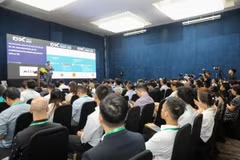
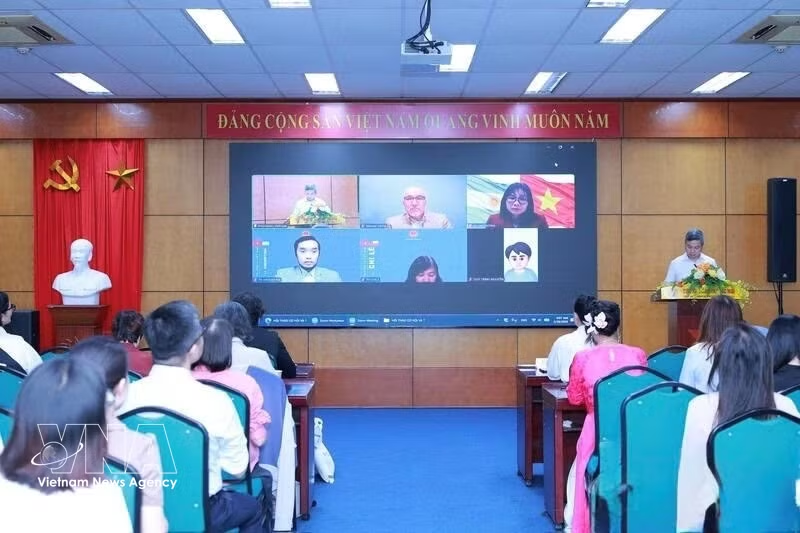
Delegates at the seminar (Photo: VNA)

Hanoi (VNA) – A hybrid seminar held by the Vietnam Trade Promotion Agency (Vietrade) under the Ministry of Industry and Trade (MoIT) on May 28, sought to equip Vietnamese enterprises with knowledge and measures needed to tap into emerging opportunities of the South American market, and addressing barriers related to geographical distance, business culture, and logistics.

Addressing the event, Nguyen Thi Thu Thuy, Deputy Director of the Vietrade’s Trade and Investment Promotion Support Centre, said export market diversification has become a strategic necessity for Vietnamese enterprises amid growing global economic uncertainties.

South America is increasingly viewed as a market with huge potential thanks to its large population, diverse consumer demand, abundant natural resources, and growing interest in strengthening economic cooperation with the Asia-Pacific region, she noted, adding that trade between Vietnam and South American countries has maintained positive growth in recent years, although its scale remains modest.

According to Thuy, two-way trade between Vietnam and South American nations has reached tens of billions of USD annually, growing at a steady pace.

Many South American countries are showing strong demand for Vietnam’s key export products, including farm produce, processed foods, textiles and garments, footwear, electronics, and consumer products. Beyond trade, the region also offers significant opportunities for cooperation in logistics, energy, processing industries, and bilateral investment.

Thuy noted that new-generation free trade agreements (FTA), including the Comprehensive and Progressive Agreement for Trans-Pacific Partnership (CPTPP), have helped boost trade with countries such as Chile and Peru, while cooperation with the Mercosur bloc is opening new prospects. However, Vietnamese firms continue to face challenges from long shipping distances, high logistics costs, language barriers, and differences in regulations and business practices.
22.jpg
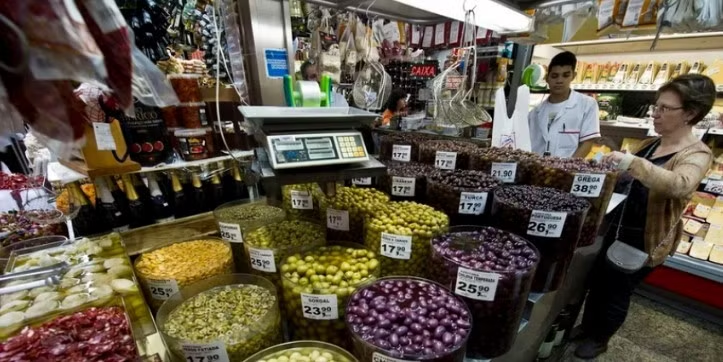
At a market in Sao Paulo, Brazil - Illustration photo by AFP/VNA

Ngo Manh Khoi, Head of the Vietnam Trade Office in Argentina, said geopolitical tensions, inflation, currency fluctuations, and disruptions in global shipping routes have increased risks for exporters.

Despite these challenges, South America remains a promising destination for Vietnamese goods. Ongoing negotiations on a free trade agreement between Vietnam and Mercosur are expected to further improve market access and competitiveness of Vietnamese goods through tariff reductions.

Khoi advised businesses to make greater use of free-trade zones and logistics hubs, diversify markets, and strengthen risk management related to exchange rates and payments.

Meanwhile, Ngo Thu Huong from the Vietnam Trade Office in Chile highlighted Chile’s role as a key gateway to South America.

Supported by the Vietnam–Chile Free Trade Agreement and the CPTPP, most import tariffs between Vietnam and Chile have been reduced to 0%, creating greater opportunities for Vietnamese exports, she said.

Chile is currently Vietnam’s fourth-largest trading partner in Latin America and serves as a key logistics gateway to the South American market. Two-way trade between Vietnam and Chile exceeded 2 billion USD in 2025, up more than 40% year-on-year.

Huong said demand in Chile is rising for high-quality rice, specialty coffee, processed seafood, furniture, and environmentally friendly products. She urged Vietnamese exporters to focus on quality, sustainability, design, and compliance with international standards to strengthen their presence in Chile and penetrate deeper into the South American market./.
VNA

See more

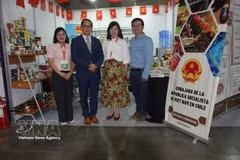
A booth at the IEAE 2026 in Ho Chi Minh City. (Photo: VNA)

Over 300 firms join Vietnam smart electronics exhibition

Vietnamese businesses have advantages in understanding domestic consumer demand, after-sales services and the ability to quickly adapt to market changes, helping them compete not only on price but also build long-term brand trust.

The Cat Linh - Ha Dong urban railway line, which began operation on November 6, 2021, is the first of its kind in Vietnam. (Photo: VNA)

Hanoi prepares to launch 1.5-billion-USD Metro 2A extension project

The Hanoi Metropolitan Railway Management Board (MRB) announced that it will organise an Early Market Engagement (EME) event for the project on June 18-19 in Hanoi to collect feedback from domestic and international businesses and consultants before the official bidding process begins.

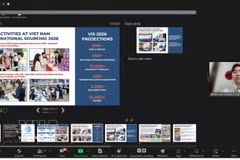
A Vietnamese representative introduces Vietnam International Sourcing 2026, scheduled to take place in Ho Chi Minh City from September 3-5, 2026, at the webinar. (Photo: VNA)

Vietnam, India eye win-win cooperation in fisheries sector

The recent upgrade of bilateral relations is set to open up more cooperation opportunities between Vietnamese and Indian businesses in the global fishery supply chain, said Vietnamese Trade Counsellor in India Bui Trung Thuong.

The dialogue forum held in Ho Chi Minh City on May 27 (Photo: VNA)

Forum seeks to connect Vietnamese startups with global capital

Alongside the rapid development of technology startups, the expansion of the digital workforce, and growing demand for innovation from businesses, open innovation collaboration models are becoming an important trend for connecting research, technology, markets, and investment capital flows.

VIFC-HCMC is positioned as a multi-functional international financial hub focusing on banking services, capital markets and international investment connectivity. (Photo: VNA)

Deputy PM urges strict risk control for VIFC rollout

Under the Government’s plan, VIFC-HCMC is positioned as a multi-functional international financial hub focusing on banking services, capital markets and international investment connectivity, while VIFC-DN is being developed into a specialised centre for fintech, digital finance and green finance.

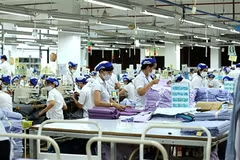
A garment and textile production line at VINATEX. (Photo: vinatex.com.vn)

Textile exports rise, but orders weaken

The latest statistics from the Vietnam Textile and Apparel Association (VITAS) show that the country’s textile and garment exports reached 14.53 billion USD in the first four months of this year, up 4.3% year-on-year.

Speakers at the event. (Photo: VNA)

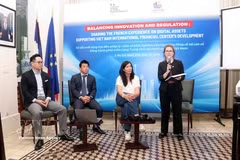
Vietnam, France share experience in building legal framework for digital assets

Digital assets are reshaping economic models, financial infrastructure, capital flows, investor confidence, cybersecurity frameworks and the competitiveness of existing international financial centres. These developments present common challenges for both France and Vietnam, making the exchange of practical lessons and regulatory experience increasingly important.

International customers are impressed by Vietnamese products for natural flavours and attractive packaging. (Photo: VNA)

Vietnamese products make strong impression at Foodservice Australia 2026

International visitors expressed positive impressions of Vietnamese products displayed at the fair. Nelma Sanjines, senior supervisor at ESP Catering in Sydney, praised the flavour of Vietnamese chilli sauce and soy sauce as well as the attractive packaging of confectionery products.