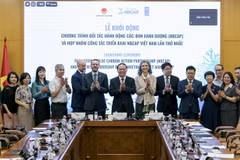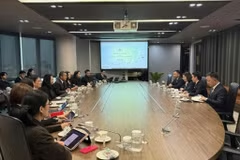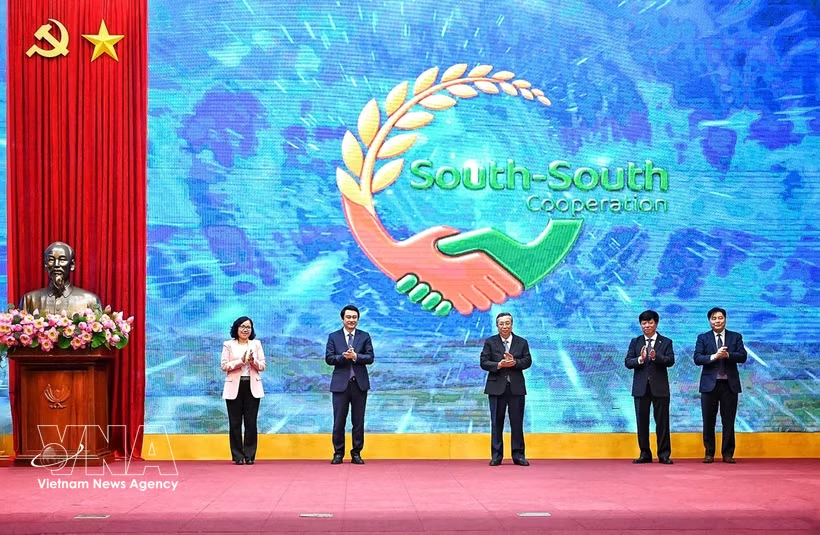
Hanoi (VNA) - Vietnam’s Ministry of Agriculture and Environment on May 29 held a meeting to promote Vietnam–Africa agricultural cooperation and officially launched the Working Group on South-South cooperation in agriculture, aiming to strengthen practical and sustainable partnerships among developing countries.
The event reflects Vietnam’s strong political determination to proactively realise the Party’s foreign policy and the State’s international integration policy, advancing international integration and deepening substantive agricultural cooperation on the basis of equality and mutual benefit.
Addressing the event, Deputy Minister of Agriculture and Environment Hoang Trung said the establishment of the working group was a timely move to create a unified coordination mechanism, strengthen inter-sectoral connectivity and mobilise resources for agricultural cooperation projects.
He stressed that the group should serve not only as a technical coordinator, but also as a platform linking policymakers, experts, businesses and international partners to accelerate concrete projects.
He outlined key tasks for the group in the coming period, including finalising an action plan, clearly defining roadmap, objectives, and coordination mechanisms; developing a list of priority cooperation initiatives in Vietnam’s areas of strength and in fields of interest; prioritising the promotion of several highly feasible pilot cooperation models for review, refinement, and scaling up; proactively working with diplomatic agencies, international organsations, and development banks to mobilise diverse financial resources; and establishing a network of experts, scientists, and domestic and international enterprises to maintain an annual information-sharing mechanism.
Deputy Minister of Foreign Affairs Le Anh Tuan described the initiative as highly meaningful, affirming that Vietnam and African countries share long-standing historical ties and common aspirations for self-reliance and development. He said agriculture remains a strategic sector receiving strong attention from leaders and people of the two sides.
He stated that the diplomatic sector will help create favourable political conditions, deepen political trust and raise awareness among localities and businesses about the potential of South-South cooperation.
The ministry will also support Vietnamese enterprises in seeking investment opportunities, technology transfer and project development in Africa, while mobilising resources to implement projects under trilateral, quadrilateral, or public–private partnership (PPP) models; and promoting the development of an open network of partners for the Working Group to seek new solutions and opportunities to support agricultural development in Africa, Tuan said.
Pham Ngoc Mau, head of the working group, said previous cooperation programmes had achieved positive results but remained fragmented and lacked a regular coordination mechanism.
Established under a decision issued by the Ministry of Agriculture and Environment in September 2025, the group is expected to shift cooperation from isolated projects to a more organised and results-oriented framework, he said.
He said the working group would focus on core functions of policy coordination, knowledge and expert networking, public-private partnership promotion and mobilisation of trilateral cooperation initiatives.
In the near future, the group aims to develop a field-based network of managers, scientists and businesses, while encouraging Vietnamese enterprises to participate more deeply in African agricultural value chains, from material supply, and seeds to logistics and processing.
Le Quoc Thanh, Director of the National Agricultural Extension Centre, stressed that training local human resources and developing simple, practical technical materials would be crucial to ensuring the long-term effectiveness of cooperation models in Africa.
He added the centre will proactively coordinate closely with the Working Group to deploy experienced field extension experts to participate in pilot models for rice cultivation, livestock production, and aquaculture in recipient countries./.