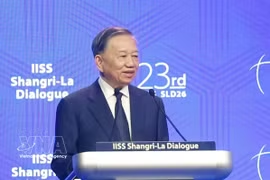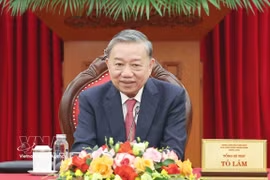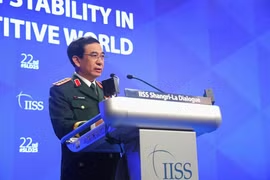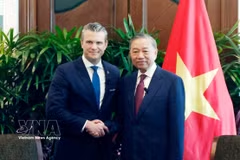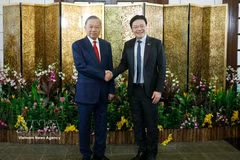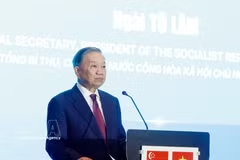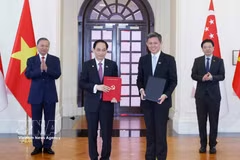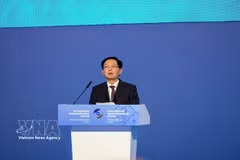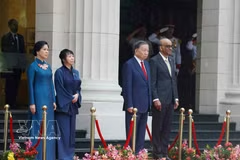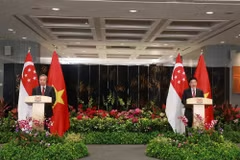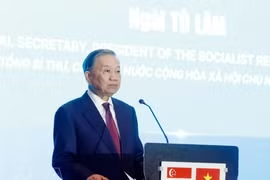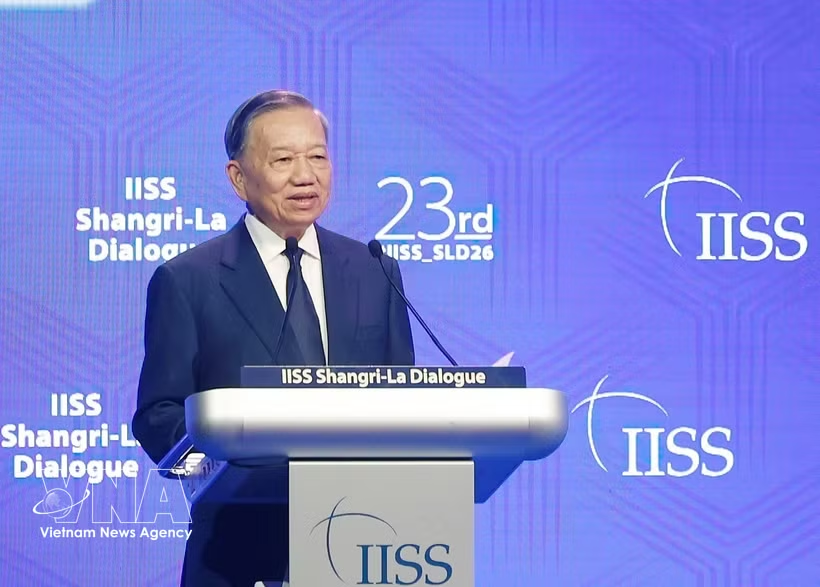
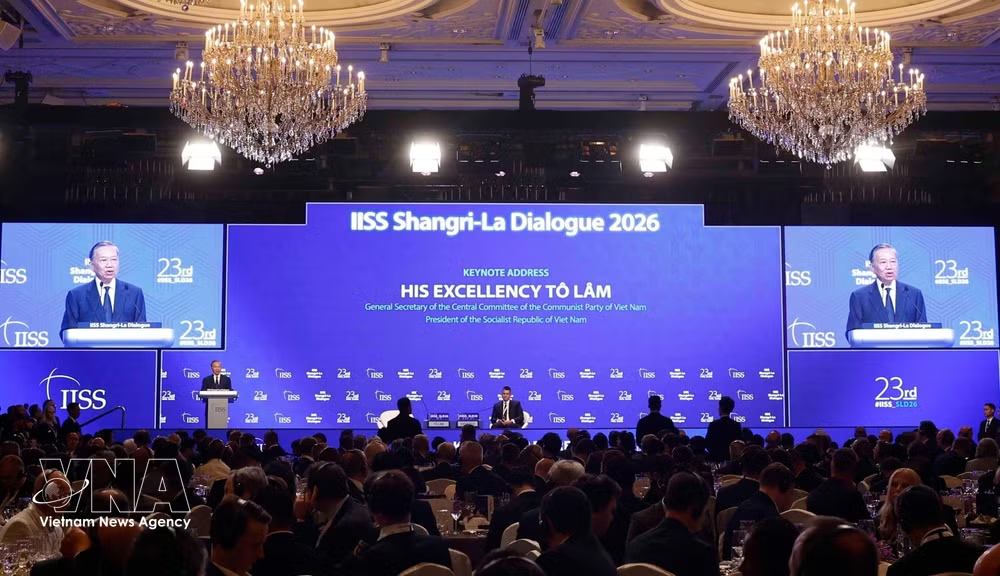
Singapore (VNA) - General Secretary of the Central Committee of the Communist Party of Vietnam and President of the Socialist Republic of Vietnam To Lam attended and delivered a keynote address at the 23rd Shangri-La Dialogue in Singapore on May 29.
The Vietnam News Agency (VNA) respectfully introduces a translation of the keynote address.
PROACTIVELY SHAPING PEACE, STABILITY AND DEVELOPMENT IN A WORLD OF TURBULENCE
Your Excellency Lawrence Wong, Prime Minister of the host country Singapore,
Dr. Bastian Giegerich, Director-General of International Institute for Strategic Studies (IISS),
Distinguished guests, Ladies and Gentlemen,
At the outset, I wish to express my sincere appreciation to the Government of Singapore and the International Institute for Strategic Studies (IISS) for the honour of addressing the opening session of this important forum. For more than two decades, the Shangri-La Dialogue has evolved into a premier platform for regional security exchange, where nations share perspectives, listen carefully to one another, and seek responsible pathways towards peace, stability and development.
We meet at a time when the world is confronted with multiple risks and uncertainties: more connected yet more vulnerable; more technologically sophisticated yet more exposed to misuse; more deeply interdependent yet increasingly susceptible to pressure and coercion. While all nations continue to speak of peace, stability and cooperation, the strategic environment is marked by a growing lack of trust, fragmentation and unchecked competition. Therefore, what we need is to reach and advance a shared vision – essential no matter how minimal it may be – to safeguard peace, trust and development for humankind in the 21st century. At the same time, we must strengthen our capacity to prevent crises early and from afar as experience repeatedly reminds us that many major crises began with misunderstandings left unresolved, signals wrongly interpreted, and preventive mechanisms not activated in time.
It is in this spirit that I wish to share some reflections on the theme: proactively shaping peace, stability and development in a world of turbulence.
Ladies and Gentlemen,
Turbulence is a constant feature of the world. Whether it is allowed to escalate into conflict or transformed into a catalyst for peace depends on the strategic choices by nations and the international community. Looking at today’s world, I believe the current instabilities reflect the convergence of three fundamental crises, unfolding simultaneously and reinforcing one another, namely a crisis of the international order, a crisis of development models, and a crisis of strategic trust.
First, the crisis of the international order. The international order is never static. A just order can evolve to reflect the changing realities of the world. Yet such adaptation must occur through rules, dialogue, mutual accommodation and self-restraint - not through coercion, unilateral imposition, threats of force, or the creation of "faits accomplis".
The crisis of the international order begins when rules are still invoked yet their binding force erodes; when commitments are repeatedly affirmed yet undermined in practice; when fundamental principles of international law are interpreted selectively, applied inconsistently, or subordinated to the logic where might makes right and the strong prey upon the weak. In such an environment, states, particularly small and medium-sized ones, face mounting pressure to choose sides and are increasingly vulnerable to coercion in the economic, technological, financial and security domains. At the same time, the very connective spaces such as seas and oceans, cyberspace, supply chains, digital infrastructure and undersea cables risk becoming arenas of strategic contestation. Recent tensions along strategic maritime routes in the Middle East remind us that conflict at a single flashpoint can rapidly disrupt trade, energy supplies, logistics and socio-economic life across the globe.
Second, the crisis of development models. For decades, globalisation, trade and investment flows, technology diffusion and supply-chain connectivity have created extraordinary development opportunities for many countries, including developing nations. Yet these very engines are now under unprecedented strain. Growth is slowing. Public debt and the cost of capital are rising. Climate change is threatening the livelihoods of millions of people. Emerging technologies create immense opportunities, but also new divides. Trade, finance, tariffs, energy, food, data and technology increasingly risk becoming tools of pressure.
For many nations, development is not secondary to security. Development is the very foundation of enduring security. When development pathways are disrupted, when opportunities for developing countries’ advancement are narrowed, economic fragility can quickly evolve into social and political instability, and even strategic uncertainty.
Third, the crisis of strategic trust. This may be a silent yet dangerous crisis, because it causes states to interpret one another’s actions through the lens of mistrust and anxiety. When trust declines, defensive measures may even be perceived as provocation; a difference of interest may escalate into confrontation; and a minor incident may trigger spirals of reactions in the absence of dialogue, communication and restraint. Strategic trust does not require eliminating differences or denying competition. Its essence lies in managing differences within a rules-based framework, ensuring that competition remains bounded, responsible and predictable. A durable regional order cannot be built upon perpetual fear and mutual mistrust.
Emerging technologies are making this challenge even more complex. Big data, artificial intelligence, cyberspace, quantum technologies, automatic systems and digital infrastructure are expanding development capacities. Yet they also have the potential to amplify suspicion, enable information manipulation, shorten decision-making time and increase the risk of miscalculation. When technological advances outpace the evolution of rules and human control, strategic stability becomes more fragile. Therefore, overcoming this crisis requires a strategic framework for trust-building, one that includes rapid communication channels in times of incidents. It also demands transparency, dialogue, substantive information-sharing to reduce misperceptions, clear codes of conduct to prevent collision, and sufficiently robust technological norms to ensure that human beings remain ultimately responsible for decisions carrying grave security consequences.
Ladies and Gentlemen,
The above-mentioned three crises are converging most visibly in the Asia-Pacific. This is the world’s most dynamic centre of growth, but also a theatre of intense strategic competition; a region defined by vital maritime routes yet fraught with risks at sea; a region that has benefited profoundly from globalisation yet now faces mounting pressure from supply-chain fragmentation, climate change, technological transition and emerging geo-economic competition. Precisely because it is where these challenges converge, the Asia-Pacific must also become where solutions emerge. This region shares a common interest in peace, connectivity and development; and possesses deep experience in multi-layered cooperation. It is where ASEAN functions as a framework for dialogue and balance. And it does have the motivation and resolve to ensure that competition does not slide into confrontation; that lines of connectivity do not become lines of division; and that one nation’s security does not become another’s insecurity.
It is from this perspective that I wish to offer several recommendations for jointly shaping an Asia-Pacific that is peaceful, stable, resilient and capable of mitigating risks early and from afar.
First, we must make rules and dialogue truly effective instruments of risk reduction. The Shangri-La Dialogue should remain a platform where nations listen carefully to one another, clarify intentions, seek common ground and manage differences, not merely one for restating positions. Dialogue must help identify risks early, facilitate information-sharing, preserve communication channels during moments of tension, and prevent disagreement from escalating into crisis. Likewise, a rules-based order does not belong to any single grouping of countries. It is the common foundation upon which large, medium and small states alike can coexist peacefully, grounded in international law and the UN Charter, with full respect for independence, sovereignty, territorial integrity, non-use or threat of force, peaceful settlement of disputes, and equality among nations. Rules acquire real meaning only when they are implemented consistently and translated into operational mechanisms such as early warning mechanisms, emergency communication channels, incident-management protocols, self-restraint and verifiable actions.
This is particularly vital for seas and oceans. The seas and oceans do not only stand for resources; but they are also the shared spaces of connection and the lifelines of global trade, energy, food and supply chains. No country benefits when these routes become theatres of coercion, confrontation or displays of power.
With regards to the East Sea, Vietnam’s position remains clear, consistent and principled. Vietnam supports the peaceful settlement of all disputes and disagreements on the basis of international law, particularly the 1982 UN Convention on the Law of the Sea. Vietnam respects the legitimate rights and interests of other states, while remaining resolute and persistent in safeguarding its own independence, sovereignty, and sovereign rights and jurisdictional rights in accordance with international law.
Second, we need to shape an open, inclusive regional architecture with ASEAN at its centre. As new mechanisms and initiatives continue to emerge, we need to build a regional architecture capable of connecting interests, reducing mistrust and reinforcing existing arrangements. All initiatives that contribute to peace, stability and development should be welcomed, provided they are transparent, respect international law, complement one another, and do not weaken ASEAN’s centrality or turn Southeast Asia into an arena of confrontation among blocs. ASEAN’s centrality is neither taken for granted nor self-sustaining. It can only be preserved through unity, strategic autonomy and the capacity to shape a common agenda. Inclusiveness must be matched by effectiveness; dialogue must generate actions; and consensus must enable timely regional responses to shared challenges. In this regard, Vietnam supports and stands ready to work closely with the Philippines as ASEAN Chair in 2026, together with all other member states, to strengthen peace and security, expand corridors of prosperity, advance connectivity, inclusive and sustainable development, and keep ASEAN’s people firmly at the centre of our common endeavour.
Third, we must place human security and societal resilience at the core of sustainable security. Instability today does not arise solely from military conflict, but also from fractures in development itself. Therefore, strengthening national defence is legitimate, but sustainable security cannot rest on military power alone. Still less can it be built through arms races or by increasing developmental insecurity for others. What we need instead is a development foundation capable of withstanding systemic shocks, one supported by open and diversified supply chains, seamless infrastructure connectivity, and cooperation in finance, technology and human capital. At the same time, we must advance practical collaboration in disaster relief, health, water security, food security, energy security, cybersecurity, critical infrastructure protection and search-and-rescue operations. When cooperation tangibly enhances safety, safeguards livelihoods and improves the people’s quality of life, strategic trust is renewed and strengthened.
Fourth, we must shape responsible norms for emerging technologies and the defence industry. Artificial intelligence, big data, quantum technologies, automatic systems, space technologies, cybersecurity and hi-tech supply chains are reshaping international security. These technologies can significantly expand our capacities for development, risk forecast and governance. Yet they can also be misused to launch cyberattacks, manipulate information, automate conflicts, enable unlawful surveillance, or create new forms of coercion. In the defence and security domain, the critical question is not how powerful technology may become, but the extent to which humanity can retain control over it. We must therefore deepen dialogue on AI in the defence and security domain; ensure human’s ultimate responsibility in decisions carrying grave consequences; develop clearer norms of responsible conduct in cyberspace; strengthen protection for undersea cables and critical data infrastructure; and promote greater transparency regarding technologies affecting strategic stability. The defence industry should serve legitimate self-defence and regional stability, not to fuel arms races.
Fifth, we must strengthen societal foundation and resilience, protect the information space and elevate public awareness. In a world of deep digital interconnection, instability no longer stems only from armed conflicts, supply-chain disruption or cyberattacks. It may begin with the erosion of trust within societies themselves. Fake news, information manipulation, extremist incitement, social polarisation and coordinated influence operations can weaken national cohesion, distort public understanding, deepen societal divisions and accelerate the spread of crises. Safeguarding peace in the new era therefore also means safeguarding truth, strengthening social trust, enhancing the capacity of strategic communications, educating digital citizens, promoting the accountability of technology platforms, and deepening international cooperation to counter false and malicious information. A society capable of discerning truth from falsehood, maintaining cohesion amid turbulence, and resisting manipulation by fear, hatred or distortion provides one of the strongest foundations for sustainable security.
Sixth, we must strengthen the capacity for preventive diplomacy, mediation and conciliation in the region. Many crises erupt not simply because of conflicting interests, but because the parties concerned lack trusted channels for communication, lack space for de-escalation, and lack mechanisms capable of steering confrontation back towards dialogue. The Asia-Pacific must therefore treat preventive diplomacy as a strategic capability, not merely as an improvised response after a crisis has already erupted. We need more diverse channels of consultation, more flexible mediation mechanisms, incident contact mechanisms, quasi-formal exchange platforms, and broader confidence-building initiatives linking defence establishments, security agencies, maritime law-enforcement bodies, scholars, businesses and social organisations. The objective is to create credible “diplomatic off-ramps” before parties become drawn into spirals of escalation that heighten the risk of conflict.
To partners with significant influence both within and beyond the region, Vietnam wishes to convey a sincere message as follows: The Asia-Pacific is an open space, and all countries with legitimate interests can have a role to play in contributing to its peace, stability and development. The region welcomes engagement that is transparent, responsible, respectful of international law, supportive of ASEAN centrality, and conducive to reducing tensions. What the region seeks is neither the mere presence nor absence of any major power. What it seeks is responsible commitment. We recognise that competition is an enduring reality of international relations, but competition must remain bounded by law, guided by transparency, and exercised with restraint.
Ladies and Gentlemen,
The three crises confronting our world today are not inevitable realities that we are bound to accept. What matters is that we confront them squarely, without allowing them to obscure opportunities for action. The crisis of the international order shows that international law and self-restraint must be reinforced. The crisis of the development models points to the need to renew growth drivers in ways that are inclusive, sustainable, and people-centered. The crisis of strategic trust calls for dialogue, transparency, responsibility, and more substantive mechanisms for cooperation.
These answers will not emerge on their own. They can only become reality if nations work together to uphold and shape rules, connect interests, strengthen trust, and build practical mechanisms that effectively reduce risks. In a world of turbulence, the challenge lies not only in external instability, but also in our insufficient preparedness to manage risks. What is needed is a shift from passive response to proactive shaping; from merely reiterating principles to operationalising mechanisms; and from managing crises after they erupt to mitigating risks before they escalate.
Therefore, the choice facing the Asia-Pacific today is not between competition and no competition, because competition is an inherent reality of international relations. The more important choice is between unchecked competition and responsible coexistence; between division and dialogue; between mistrust and coercion and an rules-based order and trust. Vietnam believes that our region possesses both the mettle and the shared stakes to choose the path of peace, cooperation, and prosperity.
Ladies and Gentlemen,
Vietnam clearly understands the value of peace through its own history, and the value of development through its own journey of Doi Moi (Renewal) and international integration. From that experience, we have come to recognise profoundly that our national interests are intertwined with the peace, stability and prosperity of the region. Contributing to regional peace is also a way of safeguarding Vietnam’s long-term interests. Expanding cooperation, reducing risks and intertwining legitimate interests are likewise how Vietnam fulfils its responsibility to the international community.
Peace, stability and development are the common denominator of all nations and peoples. But they carry meaning only when translated into concrete action: restraint in the face of disagreement; dialogue when divergences deepen; cooperation when challenges transcend borders; and the building of practical mechanisms capable of reducing risks in real terms.
Vietnam therefore stands ready to work with countries both within and beyond the region to reinforce rules, nurture trust, promote dialogue, enhance cooperation, mitigate risks, and together shape an Asia-Pacific that is safer, more resilient and more prosperous.
Thank you very much for your attention!