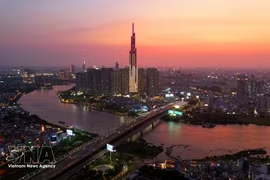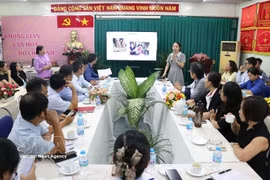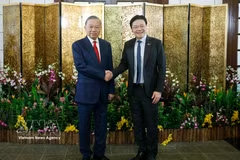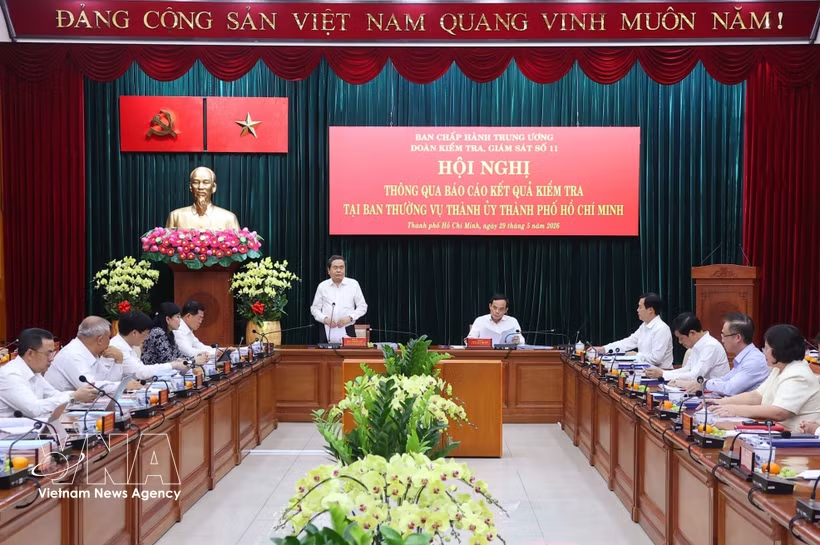
Ho Chi Minh City (VNA) – Chairman of the National Assembly (NA) Tran Thanh Man led the Politburo and Secretariat’s Inspection Team No. 11 in a May 29 conference on a draft report on the second-phase inspection of the Ho Chi Minh City Party Committee’s Standing Board.
The team praised the synchronous, methodical, and aggressive rollout of the two-tier local administration model, noting the city’s adoption of innovative governance as seen in enhanced digital administration, data management, an interconnected e-document system, paperless meetings, a cleaned-up Party member database, and grassroots task forces deployed to clear bottlenecks. The city also streamlined its organisational structures, consolidated personnel, and built a leaner and more efficient administrative apparatus.
The pursuit of the double-digit growth target, the team said, signalled a new development mindset, strategic vision, and high ambition. Ho Chi Minh City is now visibly shaping a “mega city” model anchored in knowledge, science, technology, innovation, and regional connectivity, while quantifying growth scenarios, targets, and drivers for different stages and sectors.
The team also lauded the city’s proactive identification of new growth engines such as artificial intelligence (AI), semiconductors, data centres, smart logistics, international finance, digital economy, maritime economy, and cultural industries. It acted forcefully to tackle long-stalled projects, unlock investment resources, cut red tape, and accelerate digital transformation to better serve citizens and businesses.
The rollout of Resolution No. 57-NQ/TW swung sharply from “studying and disseminating” to “translating the resolution into action”, linking delivery progress to personnel evaluations, leadership accountability, and performance outcomes.
The team specifically spotlighted several pioneering models with national reference value, including a data exchange platform, a local venture capital fund, an innovation centre model, AI-assisted public administration, the “Digital Literacy for All” drive, and a large-scale startup and innovation ecosystem. The delivery of the Politburo's Regulation No. 366-QD/TW became proactive, systematic, and reform-minded, with the city building a criteria and template system designed to shift from qualitative assessments to evaluations based on outputs, progress, work efficiency, and governance data.
In his speech, Chairman Man called Ho Chi Minh City a special metropolis, the country’s largest economic hub, a key growth engine, and a centre for science, technology, innovation, finance, and trade, contributing more than 23% of GDP and around 31% of total state budget revenues. He also noted the city’s enormous population pressure, governance demands, and development requirements.
As the city handles numerous strategic, groundbreaking, and often unprecedented tasks, he praised the Standing Board’s unity, high determination, proactiveness, dynamism, creativity, and decisiveness, as well as its adherence to the resolutions and conclusions from the Party Central Committee, Politburo, and Secretariat, along with directives from Party General Secretary and State President To Lam.
On next steps, he urged the board to continue fully implementing the Politburo’s 10 strategic resolutions and the directions laid out by General Secretary and President Lam at the municipal Party Congress and recent working sessions, especially the Politburo’s Resolution 09, dated May 19, 2026, on developing Ho Chi Minh City in the new era. He also pressed for the finalisation of the draft Law on Special Cities for submission, thus creating a new development model backed by a breakthrough institutional framework.
The city was assigned to speed up public investment disbursement, urgently clear procedural, land, compensation, and resettlement obstacles, and adopt special mechanisms under the NA’s Resolution 260/2025/QH15 that amends Resolution 98/2023/QH15. It must also improve growth quality and persistently tackle issues related to education, health care, environment, flooding, traffic congestion, drugs, and crime.
Ho Chi Minh City was tasked with continuing to refine the two-tier local administration model in a streamlined, effective, and substantive way; stepping up decentralisation and delegation of authority alongside power control and accountability; and building quantitative criteria to assess operational effectiveness, with citizens and businesses placed at the centre of service delivery.
The city must keep playing a pioneering role under Resolution 57-NQ/TW, focusing on a shared data ecosystem, strategic digital infrastructure, substantive digital transformation, and a quality workforce in AI, semiconductors, big data, core technologies, and innovation, Chairman Man said.
At the same time, it must press ahead with overhauling evaluations of Party organisations, Party members and officials, moving toward more substantive, quantitative criteria tied to outputs, performance efficiency, and leadership accountability.
The top legislator also called for tighter inspection and supervision, stricter discipline and administrative order, a resolute crackdown on the avoidance of responsibility and bureaucratic delays, and swift clearing of grassroots bottlenecks before they balloon into entrenched obstacles./.
VNA