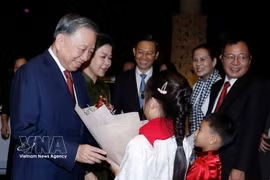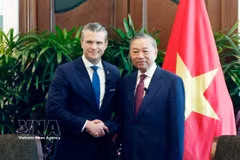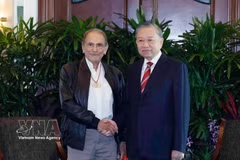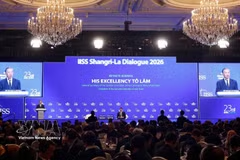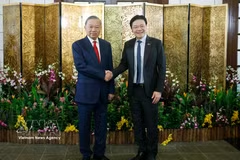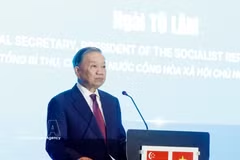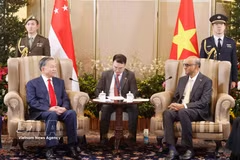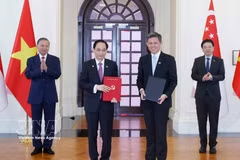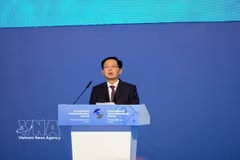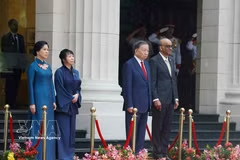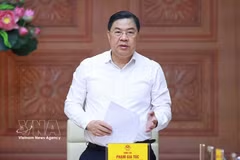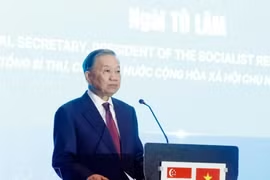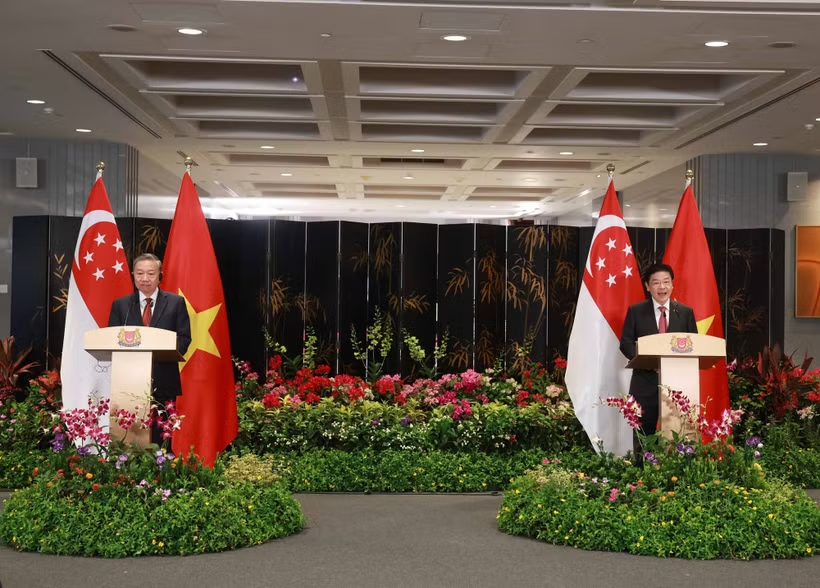
Hanoi (VNA) – General Secretary of the Communist Party of Vietnam Central Committee and State President To Lam and his spouse, along with a high-level delegation of Vietnam, are paying a state visit to Singapore from May 29 to 31, aiming to advance bilateral Comprehensive Strategic Partnership in a stronger, more substantive and effective manner.
Advancing Vietnam – Singapore cooperation
As ASEAN members located in the dynamic Asia-Pacific region, with geographical proximity, cultural similarities and many shared interests, Vietnam and Singapore have built increasingly strong, substantive and effective ties while adapting to major regional and global changes.
Looking back in history, during his arduous journey to seek a path for national salvation in the early 1930s, President Ho Chi Minh visited Singapore twice, in March 1930 and January 1933. Today, the Asian Civilisations Museum houses a memorial plaque dedicated to President Ho Chi Minh – the first monument under Singapore’s “Friends to Our Shores” programme.
Shortly after the signing of the Paris Peace Accords in January 1973, Singapore became one of the first countries to establish diplomatic relations with the Democratic Republic of Vietnam (now the Socialist Republic of Vietnam) on August 1, 1973. Singapore was also among the first ASEAN countries with which Vietnam established a Strategic Partnership, in September 2013.
Over more than five decades, particularly since the establishment of the Strategic Partnership, bilateral ties have deepened and expanded effectively across all fields. This has been reflected in the frequency of high-level exchanges and the effectiveness of bilateral cooperation mechanisms.
A notable recent milestone was Prime Minister Pham Minh Chinh’s official visit to Singapore in February 2023. During the visit, the two sides signed agreements on establishing the Green Economy – Digital Economy Partnership, along with several cooperation documents in economics, trade, investment, maritime cooperation and consular affairs.
In August 2023, then Singaporean Prime Minister Lee Hsien Loong also paid an official visit to Vietnam. The two sides signed multiple agreements on education and training, human resource development, upgrading the Framework Agreement on Vietnam – Singapore Connectivity, innovation talent exchange, skills and labour development, and sustainable infrastructure development.
Most notably, General Secretary To Lam’s official visit to Singapore from March 11 to 13, 2025 marked a major milestone in elevating bilateral ties to a new height.
During the visit, the two sides agreed to elevate bilateral relations to a Comprehensive Strategic Partnership, creating fresh momentum for cooperation across all areas. Vietnam has become the only ASEAN country with which Singapore has established such a partnership.
The two sides agreed to strengthen political trust; expand and deepen cooperation in economics, trade and investment; promote collaboration in digital transformation, innovation, green economy and clean energy; enhance cooperation in defence-security, culture, education, tourism and people-to-people exchanges; expand the Vietnam–Singapore Industrial Park (VSIP) 2.0 network toward innovation and low-carbon emissions; boost cooperation in digital transformation and emerging technologies; and promote cultural, sports and youth exchanges to strengthen mutual understanding and friendship.
The two countries also signed a range of cooperation agreements in offshore wind trade, digital transformation, transnational crime prevention and financial innovation, laying an important foundation for advancing the Vietnam–Singapore Comprehensive Strategic Partnership in the coming period.
Beyond bilateral cooperation, Vietnam and Singapore have also coordinated closely at regional and international forums. The two countries largely share common positions on regional and global issues and cooperate at multilateral forums, including the United Nations. They also work closely within ASEAN to further enhance the role and standing of both countries and uphold the bloc's ASEAN centrality in the regional security architecture.
Singaporean Prime Minister Lawrence Wong and his spouse visited Vietnam from March 25 to 26, 2025, just over a week after General Secretary To Lam’s trip to Singapore, underscoring Singapore’s strong interest in and commitment to cooperation with Vietnam. The visit also helped realise the potential of the newly upgraded Comprehensive Strategic Partnership.
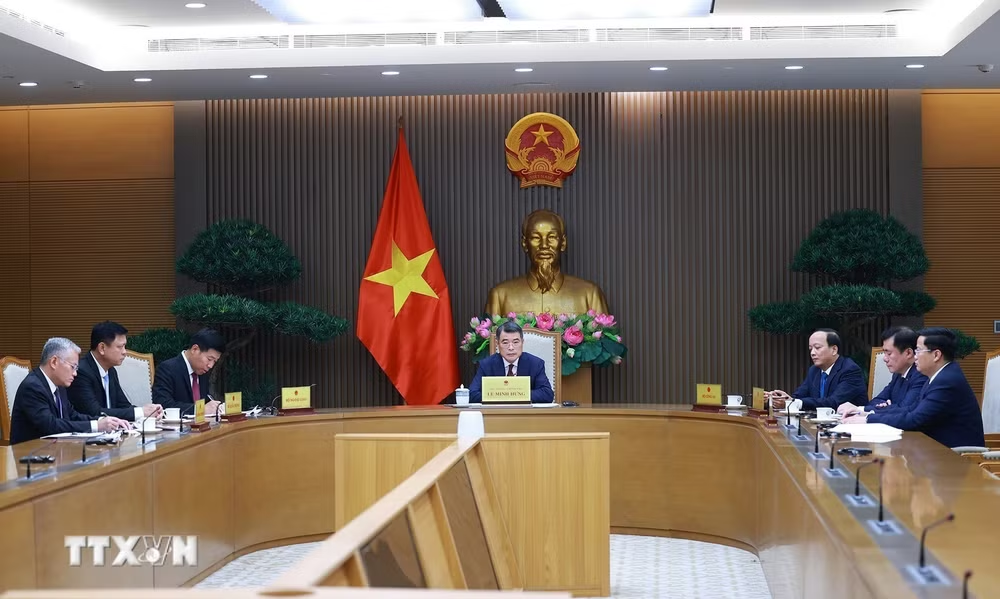
Most recently, on April 16, 2026, Prime Minister Le Minh Hung held phone talks with Prime Minister Lawrence Wong.
During the talks, Prime Minister Le Minh Hung proposed that Singapore support Vietnam in developing international financial centres and expanding and upgrading next-generation VSIPs linked to high-tech transfer.
PM Wong expressed his hope to work closely with PM Hung to further strengthen the Vietnam–Singapore Comprehensive Strategic Partnership in a substantive and effective manner.
Wong announced Singapore's plans to increase the number of VSIPs in Vietnam to 30 industrial parks in 2026, marking the 30th anniversary of the successful model in Vietnam. Singapore also pledged continued support for Vietnam in training and human resource development, especially strategic-level officials, through new training agreements and the expansion of the Singapore Cooperation Programme to Vietnamese localities.
He expressed confidence that bilateral ties would continue to flourish and voiced hopes for breakthroughs in new areas such as carbon credit exchange and food security cooperation.
The two PMs agreed to continue strengthening political trust, promoting exchanges and high-level contacts, maintaining effective existing cooperation mechanisms, including annual meetings between the two prime ministers, and soon launching a strategic dialogue mechanism between the ruling parties in 2026, alongside cooperation in energy security.
Both sides also affirmed their commitment to prioritising resources for the effective implementation of the 2025–2030 Comprehensive Strategic Partnership Action Programme. They further agreed to explore the signing of an intergovernmental agreement on cross-border low-carbon electricity trade, creating a legal framework to facilitate the successful export of offshore wind power from Vietnam to Singapore.
Economic, trade, investment ties flourish
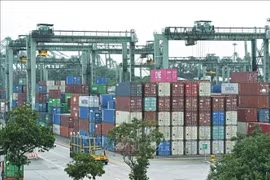
Economic, trade and investment cooperation has been one of the most successful areas in bilateral relations. Since 1996, Singapore has consistently been one of Vietnam’s biggest partners. Two-way trade has increased steadily over the years, jumping from 8.3 billion USD in 2021 to 10.3 billion USD in 2024 and 31 billion USD, and standing at nearly 14.7 billion USD in the first four months of this year.
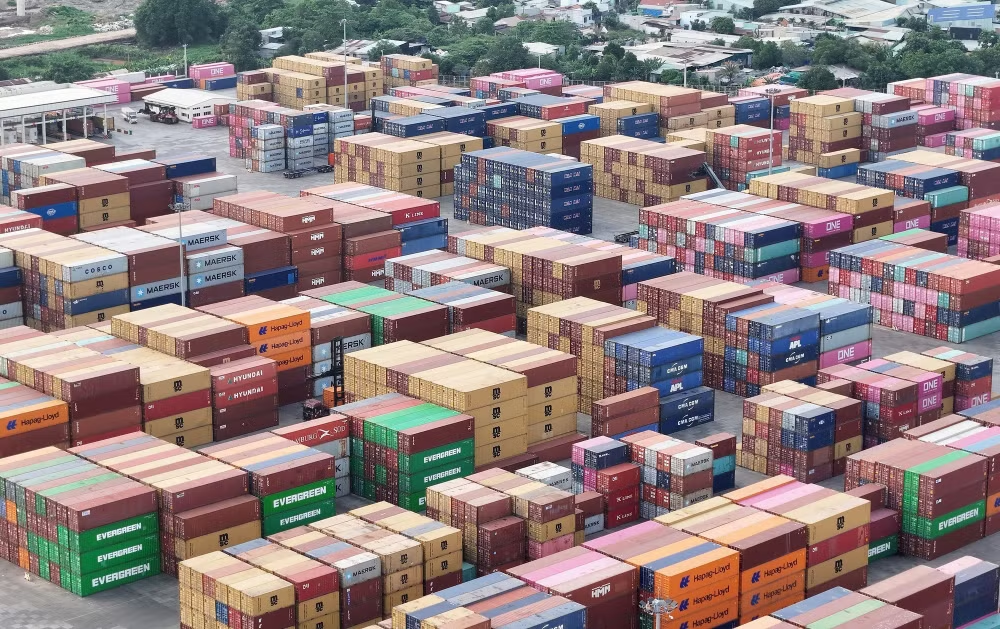
During the four-month period, Vietnam maintained its position as Singapore’s 10th largest trading partner. Singapore’s total import-export turnover with Vietnam reached 18.8 billion SGD (over 14.7 billion USD), up 43.7% compared to the same period in 2025. Singapore’s exports to Vietnam amounted to 10.2 billion SGD, an increase of 8.9%, while it spent 8.5 billion SGD on imports from Vietnam, soaring 133%.
Among Singapore’s exports, domestically manufactured products shipped to Vietnam were valued at 3.2 billion SGD, up 13.8%, while re-exported and transshipped goods to Vietnam reached 7.1 billion SGD, up 6.8%. Considering only goods originating from Vietnam and Singapore, Vietnam enjoyed a trade surplus of 5.36 billion SGD with Singapore.
Notably, three product groups — electrical machinery, equipment and parts (HS 85); mineral fuels, oils and distillation products, bituminous substances and mineral waxes (HS 27); and nuclear reactors, boilers, machinery and mechanical appliances and parts (HS 84) — continued to record strong positive growth in both exports and imports.
As two complementary economies, Vietnam and Singapore have actively implemented trade agreements to which they are parties in order to strengthen bilateral economic cooperation. As members of the Comprehensive and Progressive Agreement for Trans-Pacific Partnership (CPTPP) and the Regional Comprehensive Economic Partnership (RCEP), both countries have effectively utilised the benefits of new-generation free trade agreements, contributing to the post- COVID pandemic economic recovery in each country as well as the region.
In terms of investment, Singapore ranked first among foreign investors in Vietnam in January 2026, with 1.07 billion USD in registered capital, accounting for 41.54% of total foreign investment.
Major projects include the Bac Lieu liquefied natural gas (LNG) power plant with 4 billion USD, the Nam Hoi An Development Co., Ltd. project with 4 billion USD, and the Long An I and II LNG power plants with total investment of 3.1 billion USD.
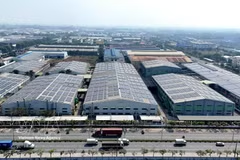
The Vietnam-Singapore Industrial Parks (VSIP) are regarded as a symbol of economic cooperation between the two countries. Since the launch of the first VSIP in Binh Duong in 1996, Vietnam has become the country with the largest number of Singapore-developed industrial parks worldwide. The VSIPs have contributed not only to Vietnam’s industrialisation and modernisation, but also to regional supply chains and economic connectivity.
Meanwhile, as of March 2025, Vietnam had 153 investment projects in Singapore worth over 690 million USD. Vietnam’s investment in Singapore mainly focuses on science and technology, information and communications, and other sectors.
The two countries have effectively maintained the Vietnam – Singapore Connectivity Ministerial Meeting (CMM) under the Framework Agreement on Vietnam-Singapore Connectivity to review and remove obstacles while discussing orientations, solutions and concrete action plans to strengthen bilateral economic and trade relations. To date, 18 meetings have been held, with the latest taking place in Singapore on September 18, 2024.
To develop new potential areas, the two governments agreed to upgrade the Framework Agreement, originally signed in 2005, during the official visit to Vietnam by Singaporean Prime Minister Lee Hsien Loong in August 2023. The upgraded framework focuses on five pillars: energy connectivity; sustainable development; infrastructure; digitalisation and innovation; and connectivity in other sectors.
Notably, Singapore was the first country with which Vietnam established a Green-Digital Economic Partnership during Prime Minister Pham Minh Chinh’s official visit to the country in February 2023.
Earlier, in October 2022, the two countries signed a memorandum of understanding (MoU) on carbon credit cooperation in line with Article 6 of the Paris Agreement on climate change. The Green-Digital Economic Partnership framework reflects the strong determination and commitment of both countries to promote innovation, reduce emissions and pursue sustainable development. It also opens up significant opportunities for enhancing economic connectivity in promising sectors such as digital economy, circular economy, innovation, clean energy and climate change response, benefiting both nations and the wider region.
The two countries are currently studying the expansion of cooperation into new sectors such as food, innovation and energy. A notable example is the Vietnam-Singapore Energy Project (VSEP), similar to the VSIP initiative launched by Singapore nearly 30 years ago. The project aims to develop Vietnam’s abundant renewable energy resources, particularly offshore wind power, enabling the country to participate in the ASEAN Power Grid. The ASEAN Power Grid is expected to ensure regional energy security, while helping the two sides achieve their shared net-zero emissions target by 2050.
Education and human resource training cooperation has also become a highlight of bilateral relations. To support Vietnam’s human resource development, the Vietnam-Singapore Training Centre (VSTC) was established in Hanoi on November 28, 2001, under a Singaporean initiative and funded by the Singaporean government, aiming to help Vietnam integrate more rapidly into the region and the world while meeting the country’s urgent personnel training needs. The two sides also signed an MoU on education cooperation in August 2023, creating a legal basis for further strengthening bilateral educational ties.
Over the past three decades, more than 21,000 Vietnamese mid- and senior-level officials and managers have participated in training programmes under the Singapore Cooperation Programme (SCP). In addition, five agreements between the two foreign ministries on training programmes for mid- and senior-level officials of the Communist Party of Vietnam for the periods 2011-2013, 2013-2015, 2017-2019, 2021-2023 and 2024-2027 have been effectively implemented, contributing to improving the quality of Vietnam’s personnel. These trained officials serve as valuable human resources and important bridges for the diverse cooperation between the two nations.
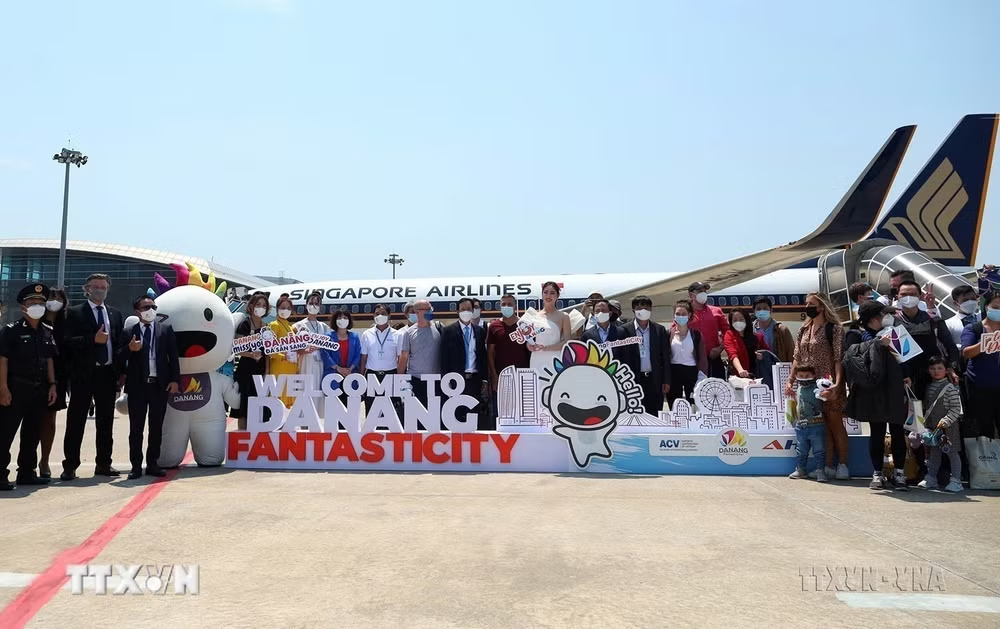
In transport and tourism cooperation, shortly after the COVID-19 pandemic was largely brought under control, Vietnam and Singapore moved quickly to lift travel restrictions and resume commercial flights from March 2022. Currently, more than 130 direct flights operate weekly from Hanoi, Ho Chi Minh City, Da Nang and Phu Quoc to Singapore.
Vietnam ranked among the top three international visitor source markets to Singapore in the first quarter of 2026. Singapore also remains one of the most popular international destinations for Vietnamese tourists in 2026, alongside Japan, the Republic of Korea and Thailand.
The Vietnamese community in Singapore currently numbers between 20,000 and 25,000 people. Overall, they are highly educated, law-abiding and closely connected to their homeland.
These achievements have made important contributions to the development accomplishments of the two countries and further advanced the Vietnam-Singapore Comprehensive Strategic Partnership in a more effective and substantive manner.
Deepening strategic coordination, political trust
Party General Secretary and President Lam’s upcoming state visit to Singapore carries special significance as the two countries continue to implement and concretise their Comprehensive Strategic Partnership framework.
According to Deputy Foreign Minister Nguyen Manh Cuong, the visit takes place at a time when bilateral ties are flourishing and both countries are facing the need to renew their growth models, enhance competitiveness, and adapt to rapid changes in the global economy.
The visit is expected to further strengthen political trust and elevate strategic coordination between the two nations. Amid growing regional and global uncertainties, the maintenance of regular high-level exchanges, the sharing of development visions, and closer coordination at multilateral forums are of importance.
Economically, both countries are seeking to deepen cooperation in investment, trade, finance and supply-chain connectivity. Singapore possesses significant strengths in technology, finance, logistics and modern governance, while Vietnam offers a dynamic market, a large workforce and strong economic growth. This complementarity provides substantial scope for expanded cooperation in the new period.
The Deputy FM said a key focus of the visit will be the promotion of deeper and more substantive collaboration in science and technology, innovation and digital transformation. Both nations are expected to broaden cooperation in artificial intelligence, big data, semiconductor technology, smart cities, digital economy, digital government and green transition initiatives. These sectors are regarded as strategically important to Vietnam's long-term development.
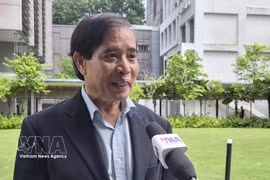
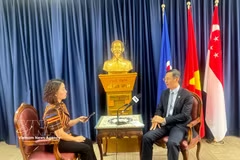
Vietnamese Ambassador to Singapore Tran Phuoc Anh said that Singapore is the first ASEAN country that General Secretary and President Lam pays an state visit following Vietnam’s recent consolidation of key leadership position. This demonstrates the importance that the Party and State of Vietnam place on Singapore, and the Vietnam – Singapore relations.
The Ambassador also pointed out that since March 2025, Vietnam’s top leader has visited Singapore twice, demonstrating the significance of the bilateral relationship at a time when both countries are pursuing strategic and long-term development goals.
For Singapore, this includes adjustments to economic policies for its next development phase, while Vietnam is pursuing a new development era with a vision to 2045.
The visit also highlights stronger Party-to-Party cooperation between the Communist Party of Vietnam and Singapore’s People’s Action Party (PAP). He said cooperation across all areas has advanced significantly since the two countries upgraded ties to a Comprehensive Strategic Partnership./.