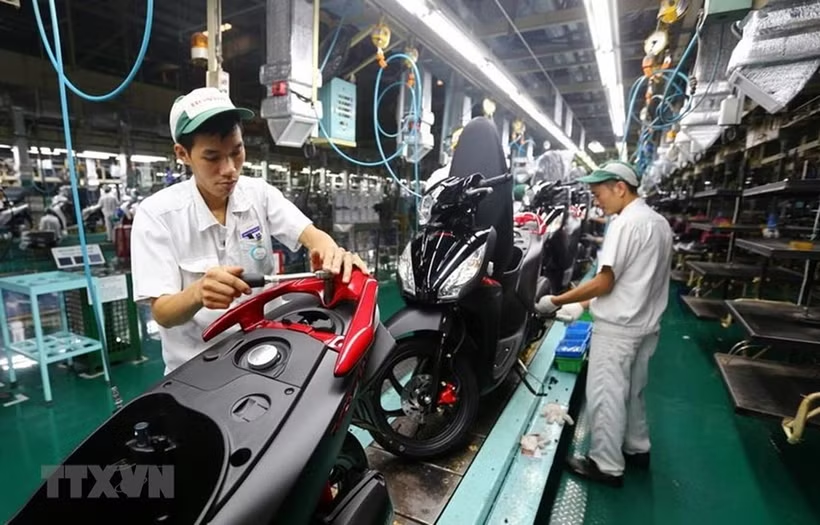
Hanoi (VNA) – Honda Vietnam (HVN) on May 29 announced its business results for fiscal year 2026 and development plans for 2027, with electrification and green mobility identified as key priorities in its next growth phase after 30 years in Vietnam.
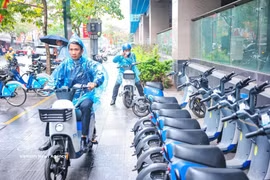
Under the plan, all newly manufactured and distributed internal combustion engine motorcycles from fiscal year 2027, starting from April 1 2026 to March 31, 2027, will meet Euro 4 emission standards in line with the Government’s emissions control roadmap. The company will expand its electric vehicle (EV) ecosystem through new electric motorcycle models, charging stations and battery-swapping services.
HVN said motorcycle sales in fiscal year 2026 reached nearly 2.3 million units, accounting for 84.7% of the market share in the Vietnam Association of Motorcycle Manufacturers (VAMM). Export turnover of completely built units and spare parts totalled 542 million USD.
During the year, the company launched 14 new motorcycle models, including both petrol-powered and electric vehicles. Upgraded versions of SH, Air Blade and Winner R were introduced, while ADV350, CT125 and Honda UC3 made their debut in Vietnam.
A major milestone in the company’s electrification strategy was the launch of two electric motorcycle models, ICON e: and CUV e:, alongside the rollout of charging and battery-swapping stations in major cities.
HVN said it will continue expanding its EV portfolio in fiscal year 2027 with modern and environmentally friendly products while improving engine technologies to optimise performance and reduce emissions.
In the automobile segment, the company sold 28,238 vehicles in fiscal year 2026, with hybrid models continuing to play a central role in its product strategy. The HR-V e and locally assembled CR-V e models recorded positive market demand amid rising consumer interest in fuel-efficient vehicles.
Alongside business activities, HVN is pursuing sustainability targets, including reducing carbon dioxide emissions by 46% by 2030 compared to 2019 levels and achieving carbon neutrality by 2050.
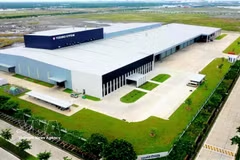
The company is currently operating rooftop solar power systems at its plants in Phu Tho and Ninh Binh provinces, with a combined capacity of 8MWp, helping cut CO2 emissions by about 21%./.