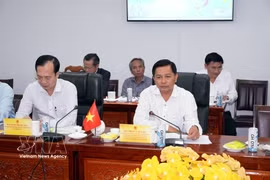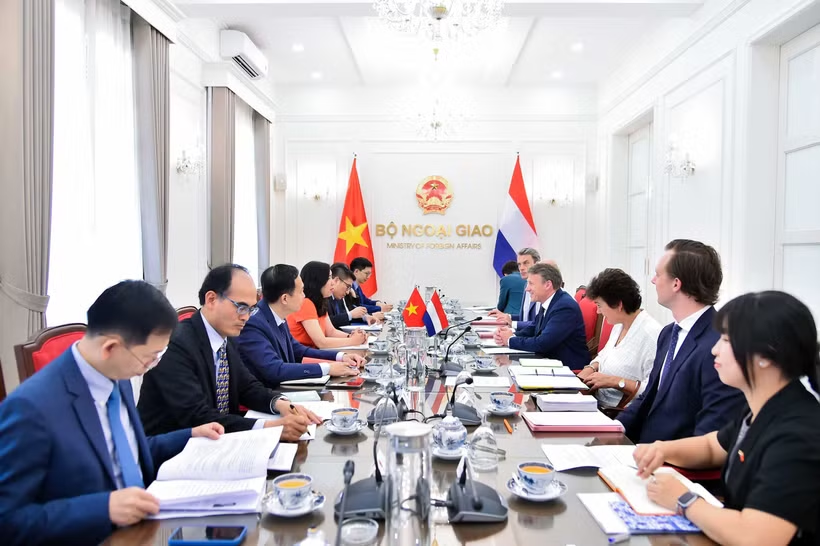
Hanoi (VNA) – Vietnamese Deputy Minister of Foreign Affairs Le Thi Thu Hang and her Dutch counterpart Marcel de Vink co-chaired the second deputy foreign ministerial-level political consultation between the two countries in Hanoi on June 1.
The two sides updated each other on developments in their respective countries and reviewed bilateral cooperation results since the previous consultation. They expressed satisfaction with the progress made so far in delegation exchanges at various levels, close coordination and mutual support for each other's initiatives and candidacy at regional and international forums, efforts to facilitate business activities, and the effective use of existing mechanisms to address issues in bilateral relations.
Sharing Vietnam’s development orientation for the new period, Hang highlighted the country’s goals of becoming a developing nation with modern industry and upper-middle-income status by 2030 and a developed, high-income country by 2045. To achieve these objectives, Vietnam will focus on maintaining fast and sustainable growth during 2026–2030, driven by science and technology, innovation, and digital transformation.
Given this, she called for deeper and more substantive implementation of the Vietnam – Netherlands Comprehensive Partnership and their sectoral strategic partnerships.
The Vietnamese deputy minister proposed that the two sides further promote trade and investment cooperation, noting the Netherlands remains one of Vietnam’s leading partners in Europe. Vietnam hopes the Netherlands will continue to be a reliable partner in sustainable agriculture, climate change adaptation, and the circular economy development while expanding collaboration Vietnam’s priority areas, including digital transformation, green transition, science – technology, and innovation.
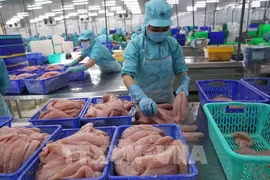
Hang also called on the Netherlands and the remaining EU member states to soon ratify the EU – Vietnam Investment Protection Agreement (EVIPA), and support the European Commission's early removal of the "yellow card" warning over IUU fishing for Vietnamese seafood exports.
For his part, the Dutch official highly valued Vietnam’s socio-economic development achievements and affirmed that his country attaches great importance to its cooperation with the Southeast Asian nation, which it regards as an important and trustworthy partner in the Asia-Pacific region.
Expressing his impression of Vietnam’s ambitious development goals, he affirmed the Netherlands’ wish to accompany Vietnam in translating those goals into reality.
Building on the positive outcomes of bilateral cooperation, Marcel de Vink agreed with his host’s proposals to enhance exchanges and dialogue at all levels and strengthen coordination at multilateral forums.
He said the Netherlands is interested in sending large-scale business delegations to Vietnam to explore cooperation and investment opportunities and will continue supporting Vietnam’s green and digital transitions as well as circular economy development. He also welcomed cooperation expansion in science – technology, high technology, the semiconductor industry, artificial intelligence, high-quality human resources training, and the implementation of joint research programmes.
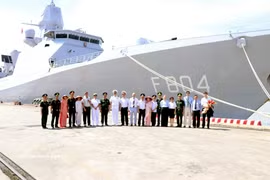
In the fields of security – defence, justice, culture, tourism, and people-to-people exchanges, the two sides agreed to continue promoting the existing effective cooperation activities, consider new cooperation agreements, and expand ties in capacity building, experience sharing, and professional training. They encouraged stronger cultural, tourism, locality-to-locality, business, and people-to-people links.
On regional and international issues of mutual concern, both sides reaffirmed their support for multilateralism and free trade, and underscored the importance of settling disputes and conflicts by peaceful means in accordance with international law and the United Nations Charter.
They also stressed the importance of maintaining peace, stability, security, safety, and freedom of navigation and overflight in line with international law, particularly the 1982 United Nations Convention on the Law of the Sea (UNCLOS)./.
VNA