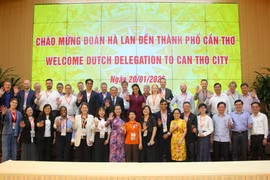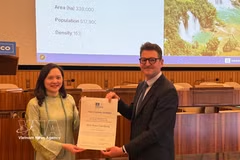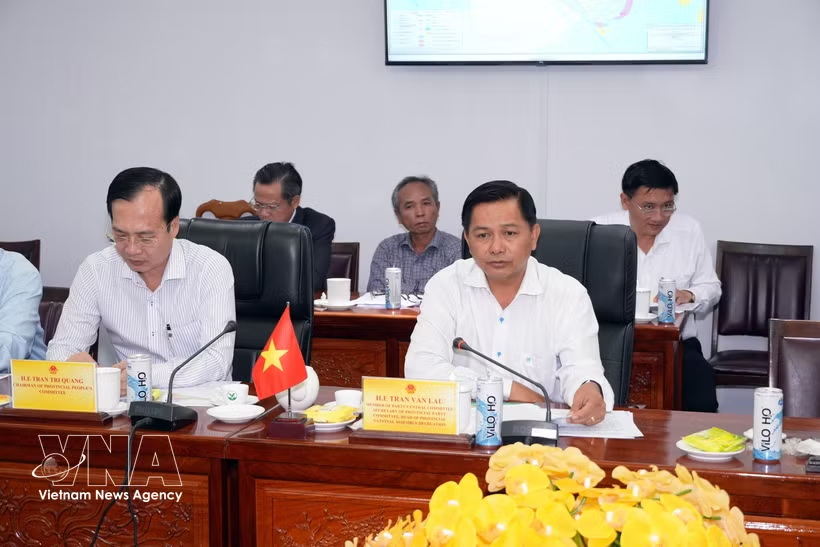
Vinh Long (VNA) – A delegation from the Embassy of the Netherlands, led by First Secretary for Water and Climate Merel van der Ven, on May 13 held a working session on sustainable offshore sand exploitation with the People’s Committee of the Mekong Delta province of Vinh Long.
Speaking at the meeting, van der Ven noted that Vietnam and the Netherlands share many similarities as delta regions heavily affected by climate change, where livelihoods and daily life are closely tied to water resources. She highlighted the Netherlands’ support for Vietnam in developing the Mekong Delta regional master planning scheme, which became the country’s first regional master planning announced in 2022.
The Dutch side also praised Vinh Long’s ongoing cooperation programmes in water management, climate adaptation and sustainable development, including the Vinh Long Urban Development and Climate Resilience Project supported by the Dutch Government and international organisations.
According to van der Ven, the Netherlands will prioritise cooperation with Vietnam in three key areas in the coming period, including sustainable groundwater management, flood response in delta regions and sustainable offshore sand exploitation. Offshore sand is seen as a potential alternative to increasingly scarce river sand, helping to meet demand for construction materials while reducing environmental pressure on the Mekong Delta ecosystem.
Notably, the Netherlands has proposed a project on establishing a strategic offshore sand reserve and supply chain management centre for the Mekong Delta. The initiative aims to develop a strategic offshore sand reserve and supply chain management hub to support infrastructure development and sustainable economic growth in the region. The project is expected to be jointly implemented by the Vietnam Department of Geology and Minerals under the Ministry of Agriculture and Environment and Dutch partners.
The Dutch side expressed interest in cooperating with Vinh Long to assess the feasibility of launching a pilot project in the province.
Chairman of the provincial People’s Committee Tran Tri Quang said Vinh Long’s 130km coastline provides significant advantages for developing marine economy, ports, logistics and renewable energy. He described offshore sand as a strategic resource for infrastructure development.
For the 2026–2030 period, the province has planned six offshore areas with estimated reserves exceeding 10 billion cubic metres. After 2030, offshore reserves are projected to reach around 15 billion cubic metres. The province has already licensed exploitation at three coastal sand mines.
Vinh Long is also drafting a sand management, reserve and distribution plan for 2026–2030 while considering investment in a sea-sand processing plant with an annual capacity of 12 million cubic metres. The move is expected to support a shift from raw extraction to deep processing, serving major infrastructure projects while protecting the environment.
Secretary of the Provincial Party Committee Tran Van Lau voiced his strong support for the proposed offshore sand reserve project, calling it a major initiative that could tackle material shortages while promoting sustainable development amid climate change.
He requested the provincial Department of Agriculture and Environment to work closely with the Dutch Embassy and the Vietnam Department of Geology and Minerals to further study the project and advise provincial leaders on implementation mechanisms and pilot programmes.
The provincial leaders pledged to create favourable conditions in terms of procedures and cooperation activities to ensure practical and effective collaboration between the two sides./.
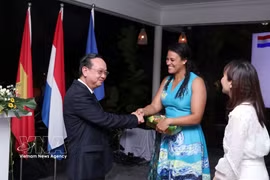
Ho Chi Minh City pledges deeper practical cooperation with Dutch partners
Speaking at a ceremony marking the Netherlands’ National Day (April 27) hosted by the Consulate General of the Netherlands in Ho Chi Minh City on April 23, Vice Chairman of the municipal People’s Committee Bui Minh Thanh reaffirmed the city’s commitment to expanding cooperation with Dutch partners across strategic sectors.