UNESCO reaffirms Non Nuoc Cao Bang as global geopark

The renewed status reflects Cao Bang’s sustained efforts to preserve and promote geological, cultural and natural heritage while linking conservation with community livelihoods.

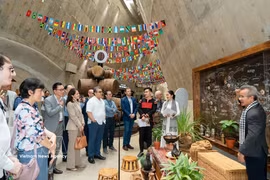
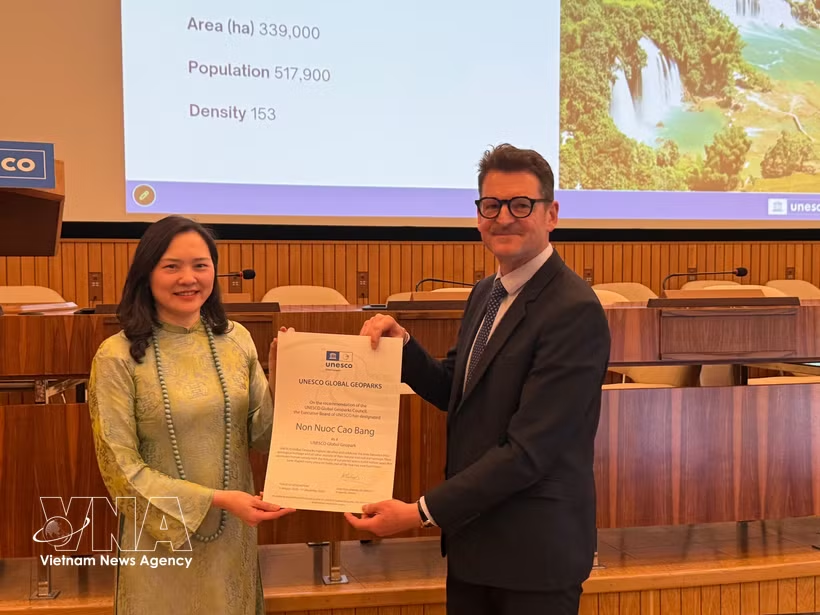
Ambassador Nguyen Thi Van Anh (L), Permanent Representative of Vietnam to UNESCO, receives the Certificate of Re-recognition for the Non Nuoc Cao Bang Global Geopark. (Photo: VNA)

Paris (VNA) – The United Nations Educational, Scientific and Cultural Organisation (UNESCO) has once again recognised Non Nuoc Cao Bang of Vietnam as a global geopark, reaffirming its status following a revalidation process.

A certificate award ceremony was held at the UNESCO headquarters in Paris on April 27 to honour 12 new global geoparks and 44 sites that passed revalidation, including Non Nuoc Cao Bang. This marks the second time UNESCO has organised such a ceremony for newly designated geoparks and, notably, the first time for revalidated sites.

Ambassador Nguyen Thi Van Anh, head of Vietnam's Permanent Delegation to UNESCO, attended the ceremony in person to receive the certificate. Representatives from northern Cao Bang province, home to the heritage, joined the event online.

This is the second time the geopark has successfully passed UNESCO’s revalidation, earning the “Green Card” – the highest rating in the periodic review process – which extends its Global Geopark status for another four years.

The recognition followed a re-evaluation mission by UNESCO experts in June 2025 and a “Green Card” recommendation by the Global Geoparks Network Council in September 2025.

The renewed status reflects Cao Bang’s sustained efforts to preserve and promote geological, cultural and natural heritage while linking conservation with community livelihoods. It also underscores the province’s commitment to implementing UNESCO recommendations, advancing sustainable development and promoting its heritage internationally.

Ambassador Anh noted that UNESCO’s decision to formally honour revalidated geoparks highlights the organisation’s growing appreciation for the determination of countries and local communities in maintaining this prestigious designation. The event is particularly meaningful as 2026 marks 50 years since Vietnam joined UNESCO and commemorates five decades of cooperation between the two sides.

Nong Thi Tuyen, Deputy Director of the Cao Bang Department of Culture, Sports and Tourism, said the continued recognition of the Non Nuoc Cao Bang Global Geopark by UNESCO following its second revalidation is clear evidence of the province’s relentless efforts in preserving and promoting diverse heritage values, while linking conservation with sustainable development and improving livelihoods for local communities.

Building on these achievements, the locality will push ahead with key tasks for the Non Nuoc Cao Bang Global Geopark in the coming period, focusing on strengthening the management, conservation and promotion of heritage values in tandem with environmental protection and sustainable development. Efforts will also be intensified to expand education and communication activities, develop sustainable tourism with equitable benefit-sharing for local communities, and invest in infrastructure, thereby advancing the geopark in line with the province’s 2025–2030 sustainable tourism development programme, said the official.

First recognised by UNESCO on April 12, 2018, the Non Nuoc Cao Bang Global Geopark spans more than 3,683 sq.km and features geological formations dating back over 500 million years. Covering 36 communes and wards, it is home to a rich collection of scenic landscapes and cultural and historical sites of national and international significance.

The latest recognition once again highlights the role of the Global Geoparks Network as an effective platform for international cooperation in promoting heritage conservation and sustainable development amid growing global environmental challenges./.

VNA

See more

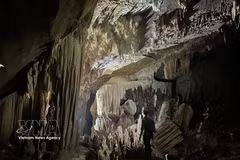
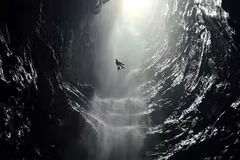
Chac Den Cave was recently discovered in Phong Nha - Ke Bang National Park in Quang Tri province. (Photo: VNA)

26 new caves discovered in Phong Nha – Ke Bang National Park

The new findings comprise several large caves with complex structures and high scientific value, including Thien Cung Cave, measuring 4,206 metres – the longest cave identified during the survey, Nuoc Lan Cave (2,721 metres), Ma Dom Cave (1,257 metres) and Cha Ngheo Cave (583 metres).

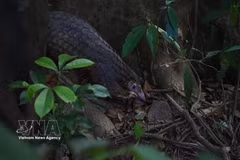
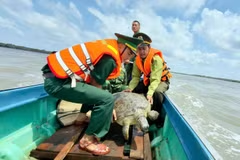
Nine Sunda pangolins (Manis javanica) have been released back into the wild at the Bach Ma National Park. (Photo: VNA)

Nine endangered Sunda pangolins returned to nature in Hue

Before their release, the animals had undergone quarantine, care, rehabilitation and close monitoring by technical staff and veterinarians to ensure they were in good health and capable of returning to their natural habitat.

Thailand ready to share experience with Vietnam in green urban development: officials

Thailand ready to share experience with Vietnam in green urban development: officials

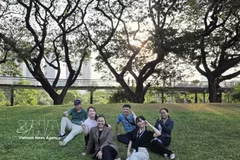
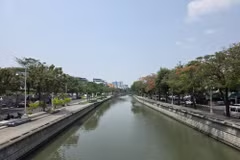
Thailand is ready to share its experience and successful models in green urban development with Vietnam, as the two countries share many similar characteristics, including rapid urbanisation, traffic congestion, flooding, canal networks and growing demand for greener public spaces, Thai officials have said in recent interviews with the Vietnam News Agency.

This May marks the third time the country’s largest wildlife bird photography competition has been held. (Photo: Vietnam BirdRace 2026 organising committee)

Vietnam BirdRace 2026 to attract hundreds of photographers worldwide

Participating teams, each comprising three to four members, are tasked with photographing as many wild bird species as possible within the official competition period. While artistic quality is not mandatory, images must be clear enough for species identification, ensuring authenticity and avoiding any disturbance to natural habitats.

Quang Tri recently received two endangered pangolins from local resident. (Photo published by VNA)

Two pangolins handed over to authorities in Quang Tri

At around 8:30 pm on April 12, Le Thanh Tung, a resident of Thuong Nghia hamlet in Cam Lo commune, and his friend spotted the two pangolins, weighing over 4 kg, while working near the Cam Lo–La Son Expressway.

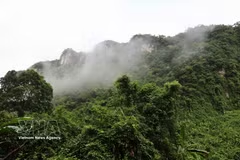
A view of Phong Nha - Ke Bang National Park in Da Nang city (Photo: VNA)

Phong Nha – Ke Bang: untapped biological treasure in Truong Son mountains

Unlike ecosystems where species inventories are largely complete, Phong Nha–Ke Bang National Park remains scientifically “open,” with each survey revealing new findings. Recent studies - from local research projects to international collaborations - have recorded additional bird species and identified the rare parasitic plant Sapria himalayana, which only survives in intact primary forests.

The interface of Vietnam Weather KTTV mobile application (Photo: baochinhphu,vn)

Application of dangerous weather warning introduced

All unusual weather events, from widespread thunderstorms, lightning strikes, landslides, flash floods, tropical depressions to strong winds at sea, are continuously updated from official data sources of the NCMHF and meteorological stations and prominently displayed on the main interface.

An overview of the kick-off meeting for the “Sustainable Management of Substances Controlled by the Montreal Protocol” project (Photo: VNA)

Vietnam launches 13 mln USD project to phase out ozone-depleting substances

Funded by the Multilateral Fund for the Implementation of the Montreal Protocol and implemented through the World Bank (WB) and the United Nations Environment Programme (UNEP), the project aims to help Vietnam meet its international commitments in managing and phasing out controlled substances. It will run from 2026 to 2031 with a total budget of over 13 million USD.