Hanoi (VNA) – Efforts to streamline the administrative apparatus have been continuously stepped up, with a focus on improving the effectiveness of grassroots governance and strengthening the capacity of commune-level officials.
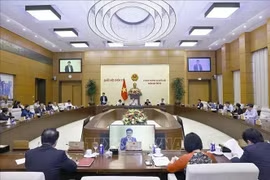
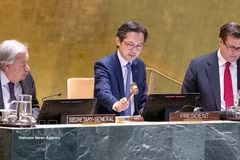
At the first session of the 16th National Assembly on April 24, legislators adopted resolutions on the 2027 supervision programme and the establishment of a thematic oversight delegation to review the implementation of policies and laws on the management and use of public office assets following organisational restructuring and administrative unit reorganisation.
In parallel, the Prime Minister issued Decision No. 706/QD-TTg dated April 21, 2026, approving a plan to review one year of implementing the reorganisation of administrative units at all levels and the operation of the two-tier local government model. Ministries, sectors and localities are required to conduct comprehensive assessments of leadership, direction, outcomes, lessons learned and proposed solutions for the 2026–2030 period, with reports to be submitted in May. A central-level review is scheduled before June 20.
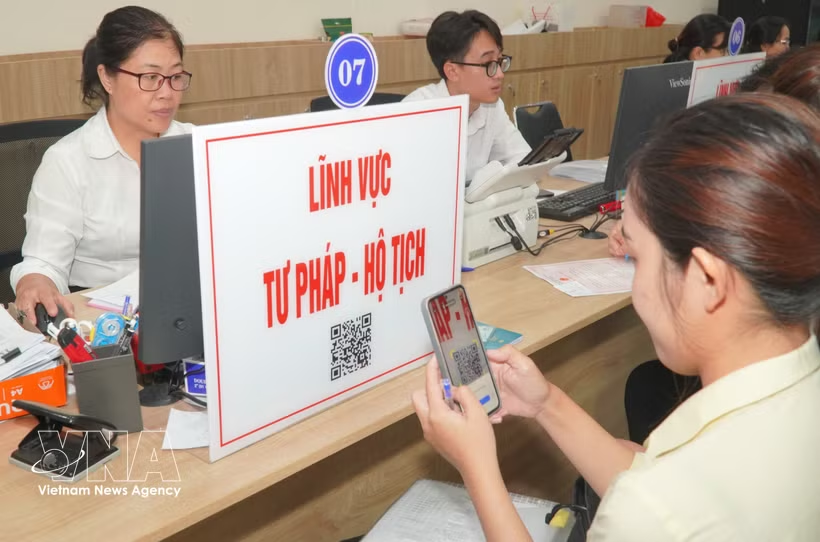
Administrative reform and digital transformation are also being stepped up. A recent Government official dispatch called for accelerating the rollout of interconnected, synchronised online public services, including the national public service portal and a centralised system for handling administrative procedures, ensuring stable and uninterrupted operations.
Enhancing capacity for communal-level officials
A key priority is the development of grassroots officials. With 2026 designated as the “Year of grassroots officials,” Politburo member and Permanent member of the Party Central Committee’s Secretariat Tran Cam Tu underscored the need to promptly address bottlenecks identified in the one-year review, thereby enhancing the effectiveness of commune- and ward-level administrations and strengthening the grassroots workforce.
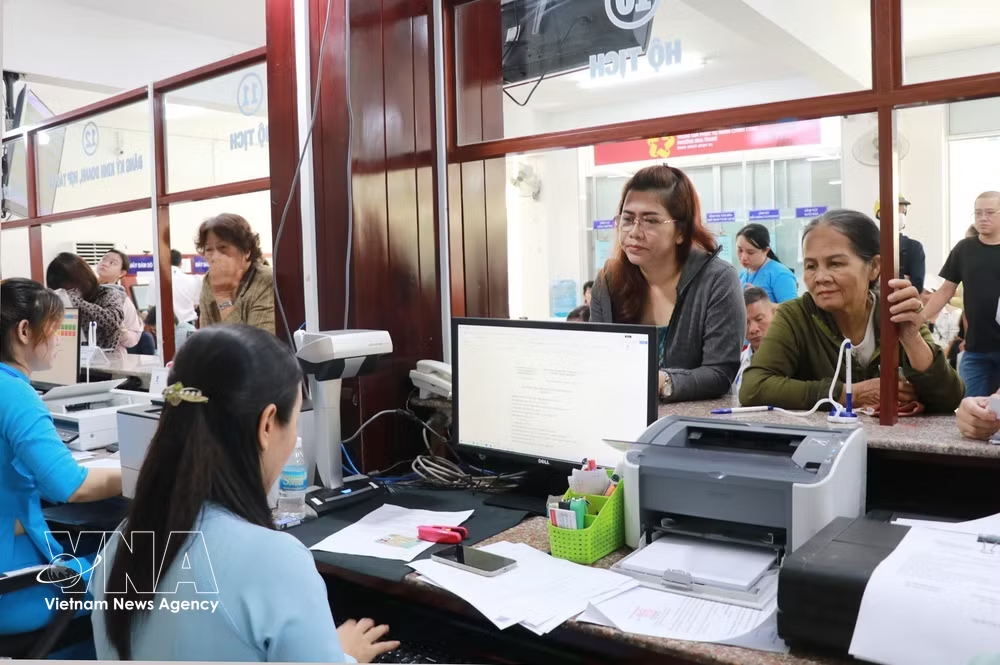
To this end, the Government has approved a project on training and capacity building for commune-, ward- and special-zone-level officials and civil servants for the 2026–2031 period.
The initiative aims to equip personnel with updated knowledge and professional skills aligned with new job positions, while fostering competencies in strategic thinking, data-driven governance, digital transformation, resource mobilisation, inter-sectoral coordination and policy responsiveness.
Alongside human resources development, structural reforms at the grassroots level are being advanced. The merger of villages and residential clusters in 2026 is identified as a key step in reorganising grassroots units nationwide, contributing to a more streamlined apparatus and more effective community governance in line with decentralisation and delegation of authority.
Boosting local governance efficiency
Localities have begun implementing these reforms. In the northern province of Quang Ninh, authorities are reviewing and restructuring multiple agencies and public service units to improve operational efficiency, while strengthening enforcement forces at the commune level.
In southern Dong Nai province, commune-level integrated service centres have been assigned additional responsibilities to manage and utilise surplus public offices and facilities following administrative restructuring, in accordance with prevailing regulations.
The provincial People’s Committee has also requested communes and wards to complete and submit reports to the provincial authorities, via the Department of Finance, by April 30, 2026. Currently, the province still has 66 surplus office facilities from former Binh Phuoc provincial departments, commune-level People’s Committees, and district-level divisions.
Meanwhile, under Decision No. 735/QD-TTg dated April 24, 2026, eight SOS Children’s Villages and their affiliated educational institutions across several provinces and centrally-run cities will be transferred to local authorities for comprehensive management by June 30, 2026. The reorganisation aims to ensure more effective governance while maintaining support policies for beneficiaries in line with legal provisions and local conditions./.