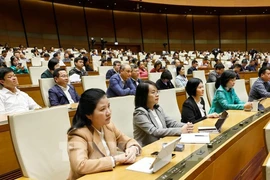
Hanoi (VNA) – The election of deputies to the 16th National Assembly (NA) and People’s Councils at all levels for the 2026–2031 tenure is set to carry special significance, marking the first time the process will take place under a new governance model with broader management scope and higher expectations for elected representatives.
The election is unfolding as Vietnam presses ahead with sweeping administrative reforms, including efforts to streamline the state apparatus and implement a two-tier local government model from the central level to grassroots authorities. Amendments to key laws are also aimed at strengthening decentralisation, improving the management of public assets and accelerating digital transformation, enabling citizens to access information more easily while fostering a leaner, more transparent governance system that better upholds people’s rights.
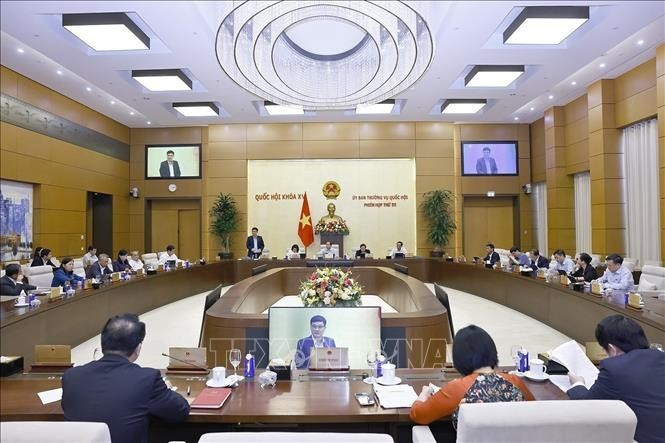
At its 55th session, the NA Standing Committee reviewed draft amendments to the Law on Notarisation, the Law on Legal Aid and the Law on Access to Information, reflecting a renewed approach to law-making. The proposed revisions go beyond technical adjustments, seeking instead to institutionalise the Party’s policy on decentralisation and the building of a socialist rule-of-law state that is transparent, open, and people-centred.
Under the draft Law on Notarisation, authority to recognise equivalent qualifications for individuals trained in notarisation abroad, along with the appointment, reappointment and dismissal of notaries, would be fully delegated to chairpersons of provincial People’s Committees. Powers previously exercised by the Minister of Justice would be transferred to local authorities. Certain provisions would replace district-level administrative units with commune-level ones in line with the two-tier governance model. Notarisation procedures are also set to be simplified, combining traditional methods with digital applications and gradually moving towards online notarisation to facilitate public access to services.
Amendments to the Law on Access to Information focus on reinforcing the responsibility of state agencies to provide information, while clearly defining categories of information citizens may access, those that are restricted, and information that can be partially disclosed. Commune-level People’s Committees would only provide information generated by their own offices, ensuring consistency with decentralisation principles and strengthening accountability among information-producing agencies.
Alongside institutional reforms, the Government is prioritising effective implementation. Official Dispatch No. 19/CD-TTg was issued to enhance the efficiency of the arrangement, management and use of public assets following the restructuring of administrative bodies and units. The directive stresses that surplus land and facilities must not be left idle, deteriorated or wasted after the reorganisation.
Procedures for the allocation, transfer and reassignment of assets must be completed in 30 days of temporary handover, while oversized premises must be reviewed and reassigned to other agencies or organisations to ensure efficient use. Inspections will also be strengthened to prevent losses and waste.
These steps reflect the broader reform drive to streamline the state apparatus that Party General Secretary To Lam has repeatedly highlighted. The objective, he stressed, is not simply to reduce organisational units or adjust their scale, but to bring about substantive improvements in operational quality.
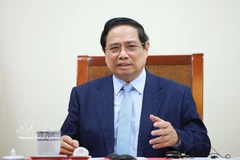
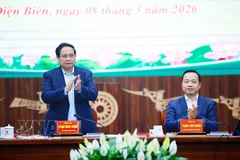
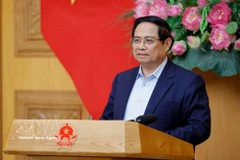
Prime Minister Pham Minh Chinh, during a working session with the National Academy of Public Administration and Governance, emphasised that public administrative governance plays a pivotal role in translating the Party’s guidelines and the State’s policies and laws into tangible development outcomes. The reform process has reshaped the national administrative structure from four tiers to three, while also restructuring and improving the quality of the cadre contingent, particularly at the grassroots level. Under the two-tier local government model, officials are required to demonstrate stronger governance and implementation capacity. Training and professional development must therefore be aligned with competency standards, digital transformation and the goal of better serving the public.
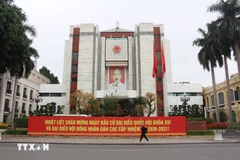
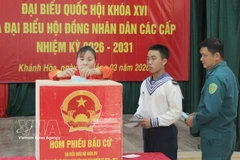
In this context, the election of deputies to the 16th NA and People’s Councils for the 2026–2031 tenure takes on added importance. It will be the first election held after administrative units have been reorganised and the two-tier local government model introduced. With broader management scope, larger populations and higher expectations, the demands placed on elected representatives will also increase. The National Election Council has issued all necessary legal documents, and more than 73 million voters have been listed at 72,195 polling stations nationwide.
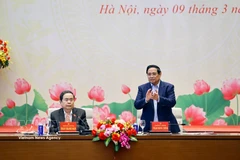
NA Chairman Tran Thanh Man, during an inspection in Hai Phong, underscored the need to carefully review special groups of voters to ensure that no one is deprived of their voting rights. Even minor tasks must be handled with caution to prevent small errors from leading to larger problems. Technological solutions such as VNeID are being deployed, but technology, he noted, is merely a tool, with human responsibility remaining the decisive factor.
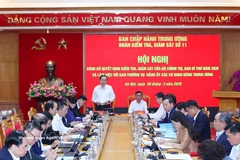
At the central level, authorities have stressed the need to strengthen Party leadership and maintain strict oversight throughout the process, avoiding complacency or negligence. At the grassroots level, election teams must receive hands-on training to standardise voting and vote-counting procedures, ensuring transparency and accountability. The election must also be organised in a way that does not disrupt economic activities or people’s daily lives.
Localities are translating these principles into concrete actions. In Hanoi, Chairman of the municipal People’s Committee Vu Dai Thang told voters that the city is determined to address five major bottlenecks, including traffic congestion, environmental pollution and urban flooding, violations of construction and land-use regulations, and food safety concerns. Hanoi is accelerating digital transformation, increasing transparency in planning, tightening budget management and improving the efficiency of public investment. Its goal of achieving double-digit growth during the 2026–2031 period goes hand in hand with building a synchronised digital government from the city to the grassroots level.
Meanwhile, in Ha Tinh, the two-tier local government model has largely stabilised after more than six months of operation following the reorganisation of 209 communes and wards into 69 administrative units. The province has assigned more than 100 provincial-level officials to grassroots positions, modernised its Public Administrative Service Centre and expanded online public services. Authorities will continue reviewing the model’s operation, clarifying decentralisation and delegation of authority, strengthening internal authorisation and shifting from traditional administrative management to modern governance centred on digital transformation.
Taken together, these measures underscore that streamlining the state apparatus is about reorganising governance in a rational manner with clear roles, clear responsibilities and clear accountablity. Laws are amended to strengthen decentralisation; public assets are rearranged to prevent waste; officials are trained to better serve the public; and elections are conducted rigorously to select representatives truly worthy of the people’s trust.
Much work remains ahead. Decentralisation must go hand in hand with stronger inspection and supervision, while digital transformation must ensure safety and security. Public asset management must remain transparent to prevent abuse or profiteering, and emerging challenges must be addressed promptly. With strong leadership from the central authorities, active participation from ministries, sectors and localities, and the support of the public, the two-tier local government model will continue to be refined. A leaner apparatus, clearer responsibilities and greater accountability will ultimately translate into better service for citizens and provide a solid foundation for Vietnam’s rapid and sustainable development in the years ahead./.