Vietnam pushes for balanced enforcement of NPT’s pillars

Vietnamese Deputy Foreign Minister Le Thi Thu Hang, head of the Vietnamese delegation to the event, reaffirmed Vietnam’s strong support for the NPT as a cornerstone of the international security architecture, and called for the full and balanced implementation of its three pillars: nuclear disarmament, non-proliferation, and the peaceful uses of nuclear energy.

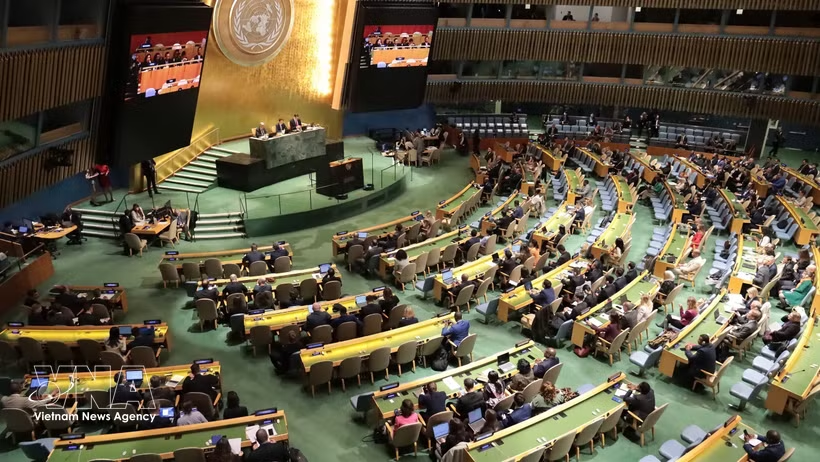
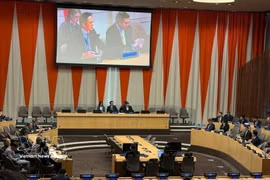
A view of the opening session of the 11th Review Conference of the Parties to the Treaty on the Non-Proliferation of Nuclear Weapons (NPT) in New York on April 27 (Photo: VNA)

New York (VNA) – Vietnam called on countries to ensure the strict and balanced implementation of all three pillars of the Treaty on the Non-Proliferation of Nuclear Weapons (NPT) during the opening day of the 11th Review Conference of the treaty in New York on April 27, underscoring the need to strengthen collective commitment to disarmament, non-proliferation and the peaceful use of nuclear energy amid growing global security challenges.

Addressing the session, Vietnamese Deputy Foreign Minister Le Thi Thu Hang, head of the Vietnamese delegation to the event, reaffirmed Vietnam’s strong support for the NPT as a cornerstone of the international security architecture, and called for the full and balanced implementation of its three pillars: nuclear disarmament, non-proliferation, and the peaceful uses of nuclear energy.

She underlined the special responsibility of nuclear-weapon states to fulfil disarmament commitments, refrain from threats or use of force, and promote confidence-building, dialogue, and international cooperation on strategic issues. Vietnam also urged stronger support for complementary international instruments, including the early entry into force of the Comprehensive Nuclear-Test-Ban Treaty (CTBT), and broader accession to and ratification of the Treaty on the Prohibition of Nuclear Weapons (TPNW).
vnanet-6.jpg
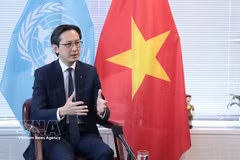
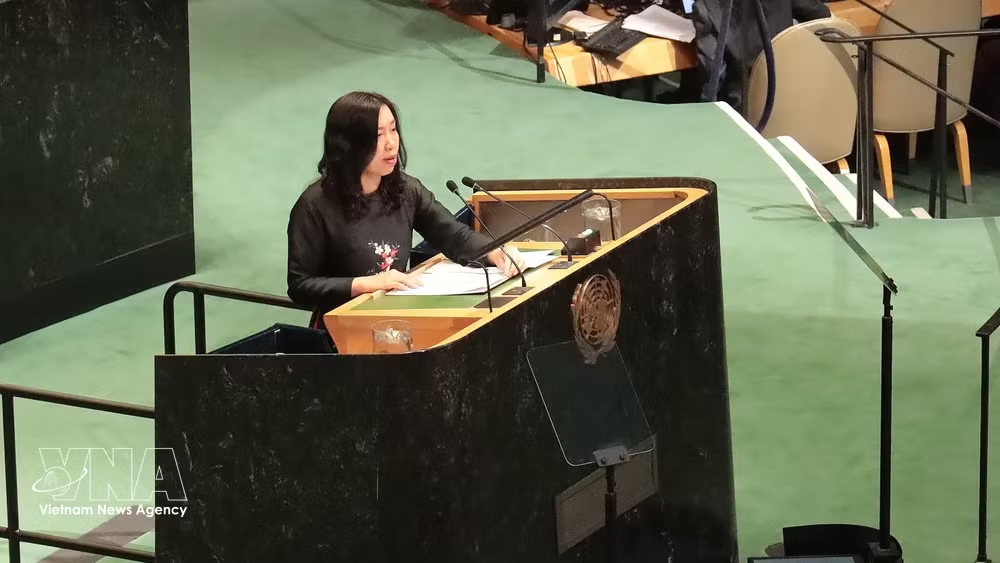
Vietnamese Deputy Foreign Minister Le Thi Thu Hang speaks at the opening day of the 11th Review Conference of the treaty in New York on April 27 (Photo: VNA)

Vietnam also stressed the importance of safeguarding the rights and interests of developing countries in the peaceful use of nuclear energy to advance development, through stronger international cooperation, broader access to technology and expertise, and ensuring sustainable financing.

Hang shared Vietnam’s own efforts to strengthen its national legal and policy framework, including the adoption of a strategy for developing and applying nuclear energy for peaceful purposes through 2035, with a vision to 2050. She said Vietnam is promoting scientific research and technological applications in nuclear energy, particularly in healthcare, agriculture, environmental protection and energy security.

Against a backdrop of mounting global uncertainty, she called on the international community to reaffirm support for the NPT through stronger collective efforts and by adopting a balanced and substantive outcome document to guide the treaty’s next review cycle.

The 11th NPT Review Conference, chaired by Vietnam, runs from April 27 to May 22 and includes intensive thematic discussions among member states of the treaty.

Representatives from many countries expressed concern that the global security and political environment is facing its most serious and complex challenges in decades, particularly in conflict hotspots, and rising nuclear risks. They underscored the urgency of reaffirming strong commitment to the objectives of the NPT to prevent a nuclear catastrophe./.
VNA

See more

Vietnamese Ambassador to the RoK Vu Ho speaks at the event. (Photo: VNA)

President Ho Chi Minh honoured in RoK on 136th birth anniversary

With Vietnam–Korea ties expanding across multiple fields, he noted that honouring President Ho Chi Minh in the RoK carries significance beyond the overseas Vietnamese. It offers a chance to raise mutual understanding, empathy, and bonds between the Vietnamese and Korean people built on shared values of peace, cooperation, and development.

President Ho Chi Minh works at the Presidential Palace in Hanoi. (File photo: VNA)

Ho Chi Minh Thought guides development path: Top leader

In an article written on the occasion of President Ho Chi Minh’s 136th birth anniversary (May 19, 1890 – 2026), the top Vietnamese leader affirmed that “Ho Chi Minh Thought serves as a guiding light along our development path.”

Vietnamese Ambassador to Venezuela Vu Trung My speaks at the event (Photo: VNA)

President Ho Chi Minh’s enduring legacy highlighted at Venezuela commemoration

Vice President of the United Socialist Party of Venezuela (PSUV) Jesús Faria expressed deep admiration for President Ho Chi Minh and Vietnam’s indomitable struggle for national independence. He described President Ho Chi Minh as an immortal symbol of 20th-century national liberation movements, whose legacy continues to inspire leftist parties, progressive movements, and peoples across Latin America, including Venezuela.

Standing Vice Chairman of the municipal People’s Committee Nguyen Loc Ha (R) and EU Ambassador to Vietnam Julien Guerrier. (Photo: VNA)

Ho Chi Minh City, EU boast ample room for sustainable development cooperation

Since the establishment of their diplomatic ties in 1990, Vietnam and the EU have deepened the bilateral ties into one of the bloc’s most dynamic and in-depth partnerships with an ASEAN member, Ha noted, adding that the relationship entered a new chapter in January when the President of European Council’s visit upgraded it to a Comprehensive Strategic Partnership.

Deputy Minister of Foreign Affairs Nguyen Minh Hang speaks at a discussion session on reforming multilateral systems and global governance, held on May 15, 2026, as part of the expanded BRICS Foreign Ministers’ Meeting in India. (Photo: VNA)

Vietnam ready to strengthen BRICS connection with Asia-Pacific

Hang called on countries to act responsibly in accordance with international law and the UN Charter; respect the independence, sovereignty and territorial integrity of states; refrain from using or threatening to use force; and settle disputes peacefully through dialogue. She also underscored the importance of ensuring security, safety and freedom of navigation through straits in line with international law, including the 1982 United Nations Convention on the Law of the Sea (UNCLOS).

Vietnamese Minister of Foreign Affairs Le Hoai Trung (centre), DPRK Vice Minister Pak of Foreign Affairs Sang Gil (left), and Vietnamese Ambassador to the DPRK Le Ba Vinh cut the ribbon to open the exhibition. (Photo: VNA)

Photo exhibition highlights Vietnam–DPRK relations

Visitors at the exhibition were moved by historical photographs dating back nearly 70 years, including images of the founding leader of the DPRK Kim Il Sung personally welcoming President Ho Chi Minh and a CPV delegation at Pyongyang’s Sunan International Airport during their visit to the DPRK from July 8–12, 1957. In return, the DPRK leader paid an official visit to Vietnam from November 27 to December 3, 1958.

Illustrative image (Photo: VNA)

Deputy PM calls for substantive assessment of two-tier local administration operations

Chairing a meeting on the development of a scheme to review the first-year operations of the political system’s organisational apparatus and the two-tier local administration model, Tra emphasised that the review must comprehensively and objectively evaluate the nationwide implementation of administrative unit restructuring and the operation of the new local administration model.

Vietnamese Ambassador to Russia Dang Minh Khoi (right) and First Deputy Chairman of the Federation Council of Russia Andrey Yatskin at their meeting in Moscow on May 14. (Photo: VNA)

Key directions for Vietnam–Russia cooperation in 2026

Vietnamese Ambassador to Russia Dang Minh Khoi had a working session with a delegation from the Russian Federation Council led by First Deputy Chairman Andrey Yatskin, in Moscow on May 14, discussing the expansion of multifaceted cooperation in 2026.

Officials from Cao Bang province of Vietnam and Baise city in the Guangxi Zhuang Autonomous Region of China hold talks on May 15. (Photo: VNA)

Cao Bang, China’s Baise city eye to boost all-around cooperation

Cao Bang province of Vietnam and Baise city in the Guangxi Zhuang Autonomous Region of China are exploring a “red tourism” route linking Pac Bo and Meng Mo (China) to promote revolutionary tradition education and strengthen bilateral friendship. They are also stepping up cooperation in human resource development through training exchanges and efforts to improve workforce quality.

Atsaphangthong Siphandone (centre), Secretary of the Vientiane Party Committee and Chairman of the municipal People’s Council, speaks at the working session. (Photo: VNA)

Ho Chi Minh City, Vientiane strengthen cooperation for 2026–2030

Under the MoU, the two sides will strengthen cooperation in politics – diplomacy, security – defence, legal and judicial affairs, economic affairs, education, culture and society, cooperation among mass organisations and socio-political organisations, and development support.