Central Vietnam braces for peak heat as forecasters warn of worsening conditions

Looking further ahead, April is expected to bring above-average temperatures nationwide, with the north and central provinces forecast to run around 1.5 to 2.5 degrees higher than seasonal norms. Other regions are likely to be between 0.5 and 1.5 degrees warmer than usual.

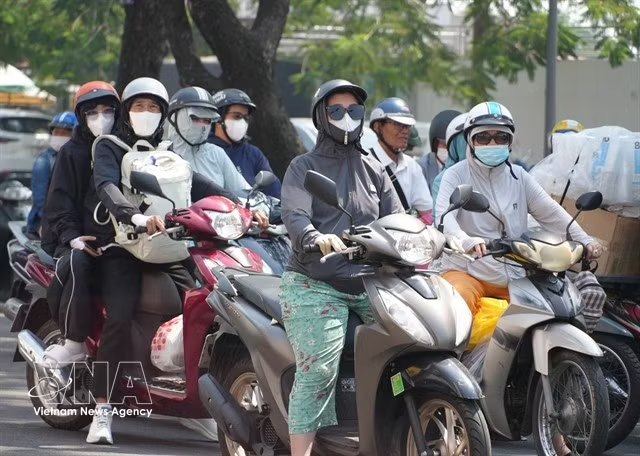
Motorbike riders in Huế City wear sun-protective gear as they travel along Trần Hưng Đạo Street amid the intense heatwave. (Photo: VNA)

Hanoi (VNS/VNA) - A prolonged spell of extreme heat is sweeping across much of Vietnam, with temperatures climbing above 40 degrees Celsius in parts of the central region and forecasters warning of heightened risks to public health, energy demand and wildfire outbreaks.

The heatwave has been driven by a persistent low-pressure system over the country’s west, combined with a strong foehn wind effect that has intensified conditions across the central provinces and cities in recent days, according to the National Centre for Hydro-Meteorological Forecasting.

From April 6 to 8, temperatures from Nghe An to Quang Tri surged to around 40 degrees, with some localities exceeding 41 degrees. Tay Hieu ward in Nghe An recorded 41.9 degrees, while Con Cuong commune reached 41.3 degrees.

The heat has not been confined to the central belt. In the north-western region, temperatures have hovered between 36 and 38 degrees, with peaks above 39 degrees recorded in areas such as Muong Te in Lai Chau and Phu Yen in Son La.

Meanwhile, the Central Highlands and southern regions have seen widespread heat of between 35 to 37 degrees.

Forecasters say the current pattern is unlikely to ease immediately. The western low-pressure system remains active, while a subtropical high-pressure ridge continues to dominate the south, locking in stable, hot conditions.

From April 9 to 13, the north-west is expected to endure another stretch of intense heat, with temperatures ranging from 36 to 39 degrees and locally higher.

In the Red River Delta, hot conditions are forecast to expand from April 10, with daytime highs of between 35 to 37 degrees.
The central region is set to bear the brunt. From Thanh Hoa to Da Nang, and parts of Quang Ngai and Gia Lai, temperatures of between 36 to 39 degrees are expected through April 14.

In the corridor from Nghe An to Hue, conditions may become particularly severe, with highs of approximately 40 degrees and isolated areas exceeding 41 degrees.

The Central Highlands and the south are also expected to remain under widespread heat, with temperatures holding steady at between 35 to 37 degrees over the same period.

Forecasters have classified the heat risk at level 1 across most regions, rising to level 2 in central provinces and cities from Nghe An to Hue – a threshold reached when temperatures exceed 37 degrees for several consecutive days across a broad area.

At this level, forecasters say, heat begins to have clear impacts on public health and daily economic activity.

“The assessment also takes into account low humidity, the foehn wind effect and the duration of the heatwave,” said Mai Van Khiem, Director of the centre.

“After April 14, temperatures are expected to gradually ease.”

Looking further ahead, April is expected to bring above-average temperatures nationwide, with the north and central provinces forecast to run around 1.5 to 2.5 degrees higher than seasonal norms. Other regions are likely to be between 0.5 and 1.5 degrees warmer than usual.

Heatwaves are projected to intensify from May, particularly in the north and central regions, peaking during the summer months through August before easing from September.

Overall, 2026 is expected to see more frequent and more severe heat events than in 2025.

Experts warn that prolonged high temperatures, coupled with dry winds, could sharply increase electricity demand, raising the risk of fires in residential areas and forests.

“Extended exposure to extreme heat also heightens the danger of dehydration and heat exhaustion, particularly among vulnerable groups”, an expert said./.

VNA

See more

The clouded monitor (Varanus nebulosus) weighs approximately two kilograms and measures around 70 centimetres in length. (Photo: VNA)

Quang Tri hands over rare clouded monitor to rescue centre

The animal was identified as a clouded monitor (Varanus nebulosus), weighing approximately two kilograms and measuring around 70 centimetres in length. The species belongs to Group IB — a category of endangered and rare forest wildlife species given the highest level of protection in Vietnam, with all forms of commercial exploitation and use strictly prohibited.

The female stump-tailed macaque undergoes a health check by authorities before being released back into the wild. (Photo published VNA)

Rare stump-tailed macaque released into the wild

The stump-tailed macaque, scientifically known as Macaca arctoides, is classified as a rare and endangered species under Group IIB in Vietnam’s regulations on endangered wildlife management.

A graphic image of the Nui Thoong high-tech waste treatment and waste-to-energy plant project. (Photo: hanoimoi.vn)

Hanoi breaks ground on 200-million-USD waste-to-energy plant

Designed to process 2,000 tonnes of waste per day and generate 45MW of electricity for the national grid, the project is the first high-tech waste-to-energy plant in southwestern Hanoi, where large-scale solid waste treatment facilities have long been lacking.

After undergoing health checks, all three sea turtles are released back into their natural habitat in the presence of authorities, local residents and tourists. (Photo: VNA)

Quang Tri authorities release three endangered sea turtles back to the wild

The three turtles, each weighing around 1.5 kilogrammes with shells measuring about 25 centimetres long and 20 centimetres wide, are green sea turtles. They were accidentally caught in fishing nets and found drifting at sea near Con Co waters on May 16 by fisherman Bui Dinh Thuy in Cua Viet commune during a fishing trip.

A rare turtle is transported to Cuc Phuong National Park for care and rehabilitation ahead of its eventual release back into the wild. (Photo published by VNA)

Rare turtles returned to Vietnam under CITES

The shipment includes several endangered Vietnamese species such as the Indochinese box turtle (Cuora galbinifrons), Bourret’s box turtle (Cuora bourreti), keeled box turtle (Cuora mouhotii), and black-breasted leaf turtle (Geoemyda spengleri), all considered highly endangered and increasingly threatened in the wild by habitat destruction, poaching, and illegal trade.

Representatives of the Ngoc Lam Border Guard Station under the Nghe An Border Guard Command and Son Lam commune's police hand over a pangolin voluntarily surrendered by a local resident to the wildlife conservation centre at Pu Mat National Park. (Photo: VNA)

Nghe An residents voluntarily hand over rare pangolins for conservation

On May 11, the Quy Chau Forest Protection Department, along with local police and authorities, took in a critically endangered pangolin, handed over by a resident. The animal was discovered a day earlier by Thai Doan Tuan, from Viet Huong village in Quy Chau commune, after it wandered into his garden. Recognising it as a protected Sunda pangolin, he contacted authorities for assistance.

A 2kg pangolin is released back into the wild at the Pu Huong Nature Reserve on May 6, 2026. (Photo published by VNA)

Nghe An releases rare pangolin back to the wild

Pangolins, scaly mammals capable of curling into a ball for self-defence, are classified as critically endangered and are strictly protected under both Vietnamese and international law.

At the working session (Photo: Vietnam Meteorological and Hydrological Administration)

Vietnam, Sri Lanka share experience in hydrometeorology

Both sides expressed confidence that continued dialogue and knowledge-sharing will deepen cooperation in hydrometeorology, helping enhance disaster response capacity and climate change adaptation in the years ahead.