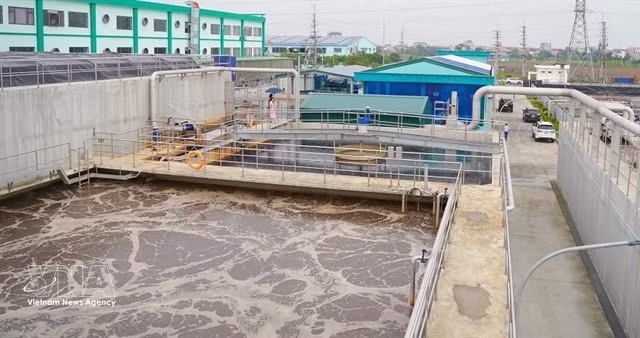
Hanoi (VNS/VNA) - Authorities in the Mekong Delta province of Dong Thap are strengthening environmental oversight at industrial zones and clusters, focusing on upgrading centralised wastewater treatment systems, to support sustainable development goals.
Under a newly issued directive, the provincial People’s Committee requires relevant agencies to classify industrial clusters into specific groups, enabling tailored management approaches and appropriate investment in wastewater treatment infrastructure.
In the case of clusters that already have centralised wastewater treatment systems, the Department of Agriculture and Environment has been tasked with coordinating with local authorities and relevant units to guide secondary investors in connecting their wastewater to shared systems in line with environmental regulations.
Authorities will also help communes and infrastructure operators regularly inspect and evaluate the systems to ensure they can receive and treat wastewater from secondary projects.
Where enterprises expand production beyond treatment capacity, infrastructure investors must propose timely upgrades or expansions.
In the case of specialised industrial clusters not required to install centralised wastewater treatment systems, the province will conduct comprehensive environmental assessments before granting exemptions.
These clusters include Trung An, Binh Thanh, Cai Tau Ha–An Nhon, Tan My Chanh, My Hiep and Bac Song Xang.
They were established before January 1, 2022, have occupancy rates above 805 and house enterprises that have already invested in individual wastewater treatment systems that meet regulatory standards.
Relevant departments have been assigned to conduct detailed evaluations of each cluster and advise on exemption decisions.
Clusters required to build wastewater treatment systems under a defined roadmap, such as Truong Xuan, Tan Duong, An Binh, and Quang Khanh, have been urged to speed up work on them.
Truong Xuan authorities have been instructed to review land-use planning, identify suitable land, prepare investment lists and propose funding for centralised wastewater treatment systems, prioritised in the 2026-30 public investment plan with implementation targeted from 2026.
At inactive clusters such as An Binh and Tan Duong, local authorities will continue monitoring and require plans for compliant treatment systems once operations resume or new projects emerge. Infrastructure operators at Quang Khanh are asked to accelerate construction in line with approved planning.
Where land for centralised systems is lacking, the Department of Agriculture and Environment will review conditions and propose exemptions under the Law on Environmental Protection, while still requiring enterprises to review discharge sources, complete environmental procedures and meet technical standards.
For industrial zones, the provincial Economic Zone Authority will ensure all secondary projects connect to centralised systems and comply with regulations, while investors must upgrade and expand treatment capacity and complete environmental documentation.
Developers at Tan Huong, Long Giang, Sa Dec and Tran Quoc Toan industrial zones have been urged to improve technologies, expand capacity and prepare upgrades to meet future discharge requirements.
According to Vo Phuong Thuy, Director of the Department of Industry and Trade, Dong Thap has 26 approved industrial zones, including six operational with 180 projects, three under development and two completing procedures, while the rest are in planning or seeking investors.
The province also has 23 industrial clusters covering over 797ha, with 18 in operation hosting 129 projects, including 17 FDI ventures./.
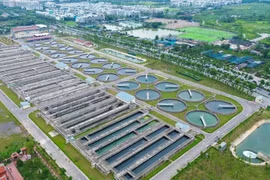
Largest wastewater treatment plant in Northern Vietnam
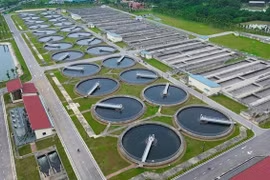
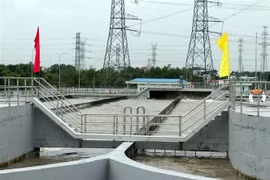
The Yen Xa Wastewater Treatment Plant, located in Thanh Liet ward (Hanoi), is the largest of its kind in northern Vietnam. With an investment of 16 trillion VND (nearly 610 million USD), the plant is expected to improve living conditions, the natural ecosystem and sanitation in central urban areas of Hanoi within the basin of To Lich River, Lu River and the left bank of the Nhue River. The project is a landmark work to celebrate the 80th anniversary of the August Revolution and National Day (September 2).