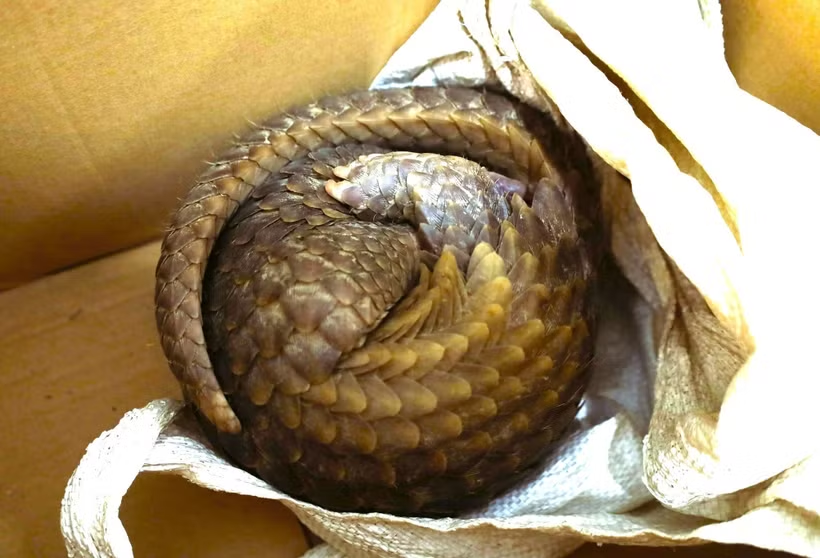
Nghe An releases rare pangolin back to the wild

Pangolins, scaly mammals capable of curling into a ball for self-defence, are classified as critically endangered and are strictly protected under both Vietnamese and international law.

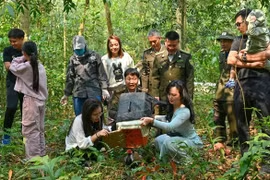
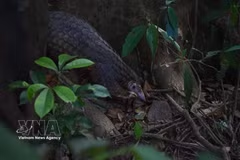
A 2kg pangolin is released back into the wild at the Pu Huong Nature Reserve on May 6, 2026. (Photo published by VNA)

Nghe An (VNA) – An adult pangolin weighing around 2 kg was released into the wild at the Pu Huong Nature Reserve on May 6, following coordinated efforts by the Quy Chau Forest Protection Unit, Hung Chan commune authorities and local police.

At about 8 pm on May 4, a family in Hung Chan commune discovered the animal wandering into their garden. Recognising it as a strictly protected wild species, they voluntarily handed it over to local authorities the following day for proper handling in line with regulations.

After receiving the pangolin, local authorities directed police and forest rangers to provide care and monitoring. Initial health checks showed the animal was in stable condition with no signs of injury or weakness, allowing it to be safely returned to its natural habitat within the reserve, an area known for its rich forest ecosystem and high biodiversity under strict protection.

Pangolins, scaly mammals capable of curling into a ball for self-defence, are classified as critically endangered and are strictly protected under both Vietnamese and international law.

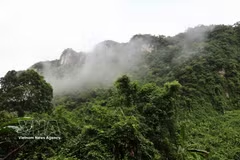
​The Pu Huong Nature Reserve, covering nearly 46,500 ha, is part of the core zone of the UNESCO-recognised Western Nghe An Biosphere Reserve. It forms a vital ecological corridor linking with the Pu Mat National Park and Pu Hoat Nature Reserve, ensuring habitat connectivity.

​Pu Huong is a biodiversity hotspot, home to nearly 570 animal species, many listed in Vietnam’s Red Data Book, the International Union for Conservation of Nature (IUCN) Red List and the Convention on International Trade in Endangered Species of Wild Fauna and Flora (CITES), along with over 1,800 plant species, including numerous rare and endemic varieties. Camera trap surveys in recent years have also recorded the presence of pangolins in the area.

​Authorities said the voluntary handover of the animal reflects growing public awareness and sense of responsibility towards wildlife protection, contributing to broader efforts to conserve forests and biodiversity in buffer-zone communities./.
VNA

See more

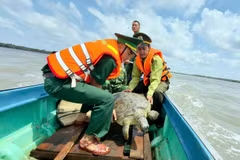
After undergoing health checks, all three sea turtles are released back into their natural habitat in the presence of authorities, local residents and tourists. (Photo: VNA)

Quang Tri authorities release three endangered sea turtles back to the wild

The three turtles, each weighing around 1.5 kilogrammes with shells measuring about 25 centimetres long and 20 centimetres wide, are green sea turtles. They were accidentally caught in fishing nets and found drifting at sea near Con Co waters on May 16 by fisherman Bui Dinh Thuy in Cua Viet commune during a fishing trip.

A rare turtle is transported to Cuc Phuong National Park for care and rehabilitation ahead of its eventual release back into the wild. (Photo published by VNA)

Rare turtles returned to Vietnam under CITES

The shipment includes several endangered Vietnamese species such as the Indochinese box turtle (Cuora galbinifrons), Bourret’s box turtle (Cuora bourreti), keeled box turtle (Cuora mouhotii), and black-breasted leaf turtle (Geoemyda spengleri), all considered highly endangered and increasingly threatened in the wild by habitat destruction, poaching, and illegal trade.

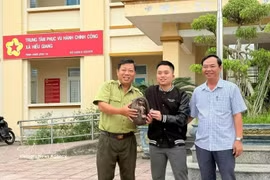
Representatives of the Ngoc Lam Border Guard Station under the Nghe An Border Guard Command and Son Lam commune's police hand over a pangolin voluntarily surrendered by a local resident to the wildlife conservation centre at Pu Mat National Park. (Photo: VNA)

Nghe An residents voluntarily hand over rare pangolins for conservation

On May 11, the Quy Chau Forest Protection Department, along with local police and authorities, took in a critically endangered pangolin, handed over by a resident. The animal was discovered a day earlier by Thai Doan Tuan, from Viet Huong village in Quy Chau commune, after it wandered into his garden. Recognising it as a protected Sunda pangolin, he contacted authorities for assistance.

At the working session (Photo: Vietnam Meteorological and Hydrological Administration)

Vietnam, Sri Lanka share experience in hydrometeorology

Both sides expressed confidence that continued dialogue and knowledge-sharing will deepen cooperation in hydrometeorology, helping enhance disaster response capacity and climate change adaptation in the years ahead.

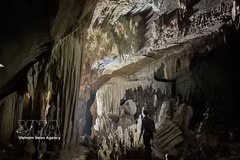
Chac Den Cave was recently discovered in Phong Nha - Ke Bang National Park in Quang Tri province. (Photo: VNA)

26 new caves discovered in Phong Nha – Ke Bang National Park

The new findings comprise several large caves with complex structures and high scientific value, including Thien Cung Cave, measuring 4,206 metres – the longest cave identified during the survey, Nuoc Lan Cave (2,721 metres), Ma Dom Cave (1,257 metres) and Cha Ngheo Cave (583 metres).

Nine Sunda pangolins (Manis javanica) have been released back into the wild at the Bach Ma National Park. (Photo: VNA)

Nine endangered Sunda pangolins returned to nature in Hue

Before their release, the animals had undergone quarantine, care, rehabilitation and close monitoring by technical staff and veterinarians to ensure they were in good health and capable of returning to their natural habitat.