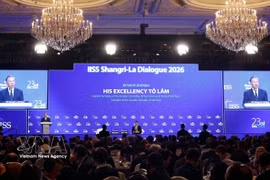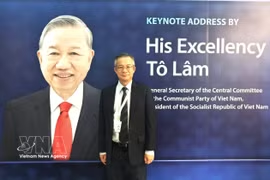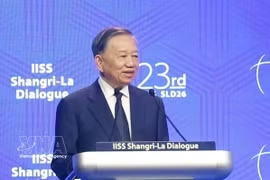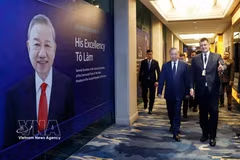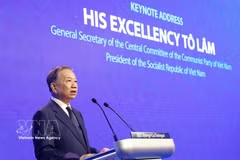
Beijing (VNA) – The keynote address by General Secretary of the Communist Party of Vietnam (CPV) Central Committee and State President To Lam at the opening session of the 23rd Shangri-La Dialogue on May 29 was among the most influential speeches delivered at the forum and generated strong resonance, a Chinese scholar has said.
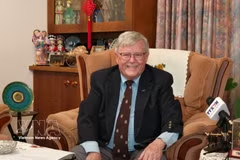
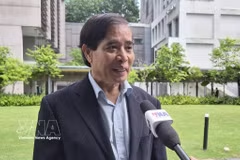
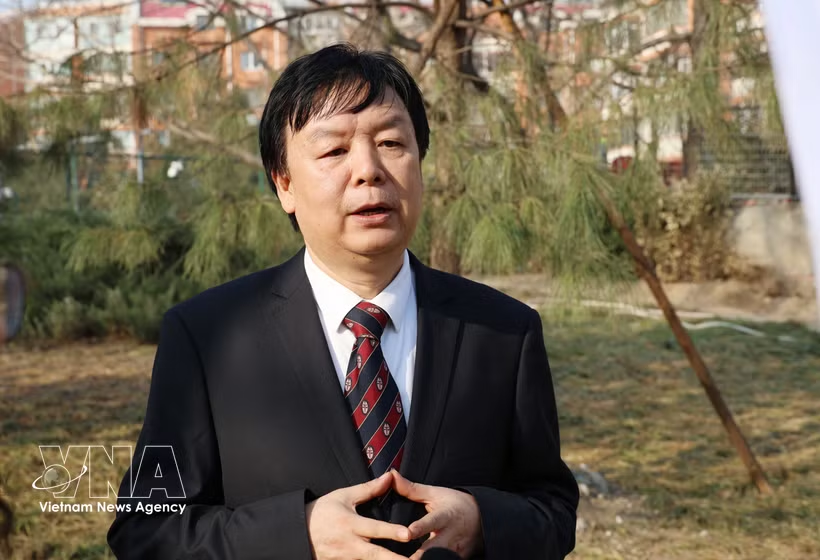
In an interview granted to the Vietnamese News Agency’s correspondents in China, Prof. Mi Liang, Director of the Centre for Southeast Asian Studies at the Beijing Foreign Studies University of China, said the speech was positive and constructive, broadly reflecting the perspectives of most Southeast Asian countries.
His assessment of the world’s current challenges was objective, he said, noting that the international community is facing crises related to international order, development models, and strategic trust. These challenges, marked by selective application of international rules, growing unilateralism, the weaponisation of economic tools, the widening gap between development and security, and increasing mistrust among nations, have become root causes of current global instability, with particularly serious consequences for small- and medium-sized countries.
The top Vietnamese leader’s call for reconstructing the international order based on the UN Charter and international law closely aligns with the perceptions of many countries in the Global South and reflects the aspirations of most Southeast Asian and Asian nations, he noted.
According to the Chinese scholar, in his speech, Party General Secretary and State President To Lam reaffirmed and emphasised the central role played by ASEAN, stating clearly that Vietnam regards ASEAN as the most important strategic space, and that the Asia-Pacific regional security architecture should be led by ASEAN rather than becoming an arena for rivalry among major powers, the Chinese scholar said. The Vietnamese leader also called for inclusive regional security cooperation to prevent the region from “militarization”.
As a researcher, Mi highly valued the views expressed by General Secretary and State President To Lam. He said that as a regional intergovernmental organisation, ASEAN must remain independent and self-reliant, be respected, and be free from interference by any external power. Under international law, he noted, this is absolutely not a problem.
The expert noted that in his address, Party General Secretary and State President To Lam also elaborated on Vietnam’s “Four No's” defence policy, emphasising that sustainable security must be built on development and mutual trust rather than an arms race.
He said the policy is consistent with the positions of most peace-loving nations, the UN Charter, and the “Five Principles of Peaceful Coexistence,” affirming that this principle stands on the right side of history.
He added that top leader To Lam also outlined Vietnam’s balanced diplomatic approach of “not taking sides while adhering to fundamental principles,” advocating common security through preventive diplomacy, emerging technology governance, and greater resilience in food, energy and data security.
Mi described the address as positive, constructive, independent and consistent with international law and reality, in line with Vietnam's interests, and reflected the aspirations of most Southeast Asian countries. He showed his belief that the speech is likely to shape directions for Vietnam’s foreign policy in the time to come.
Notably, the scholar also pointed to the Vietnamese leader’s response to a question from a Chinese delegate on the sidelines of the event, related to the Vietnam – China “3+3” strategic dialogue mechanism, which brings together officials responsible for foreign affairs, defence and public security. According to him, the mechanism carries significant practical value in strengthening bilateral ties while contributing to regional peace, stability, and cooperation. It reflects Vietnam’s policy of self-reliance and resilience, its commitment to international law, peace, and mutually beneficial cooperation, and underscores the importance Vietnam attaches to coordination and dialogue channels with China.
In the scholar’s view, the keynote address – the first presented by the Vietnamese leader at the Shangri-La Dialogue in his capacity as Vietnamese Party and State leader, signaled Vietnam’s evolution from a country that primarily follows established rules to one that actively contributes to shaping the regional agenda, using multilateral platforms to uphold “ASEAN’s centrality” and rally regional voices against unilateral pressure.
Assessing the potential contributions of Vietnam’s proposals to building an inclusive and sustainable regional security architecture, Mi said that the initiatives put forward by the Vietnamese leader at the 23rd Shangri-La Dialogue will help reinforce ASEAN’s central role while promoting preventive diplomacy and the “3+3” mechanism. These proposals, he noted, offer a rules-based and non-confrontational approach that integrates development and security, providing a pathway toward a comprehensive and sustainable regional security architecture.
He observed that the Vietnamese leader’s vision at the dialogue covers non-traditional security areas such as rule reform, emerging technology governance, and societal resilience capacity. By linking security with sustainable development, climate change, and digital economy, his approach transcends the limitations of conventional military security and aligns with the holistic and systemic governance requirements of a sustainable security architecture.
The Chinese expert further emphasised that Vietnam’s policy of “non-alignment, not taking sides, and being autonomous yet responsible", together with its diplomatic practice, helps prevent the formation of rival blocs while fostering stability through institutional dialogue and multilateral platforms. In his view, this approach offers a practical pathway for the regional security architecture to evolve from a model of “balance of power” toward “rule-based collective governance.”/.
See more
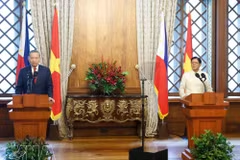
Vietnam's top leader holds talks with Philippine President
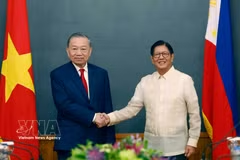
Vietnam always values and wishes to further deepen its friendly neighbourly relations with the Philippines in all areas on the basis of a shared commitment to peace, stability and respect for international law, affirmed General Secretary of the Communist Party of Vietnam (CPV) Central Committee and State President To Lam.
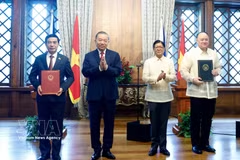
Vietnam, Philippines issue Joint Statement on Enhanced Strategic Partnership
Vietnam, Philippines upgrade bilateral ties to Enhanced Strategic Partnership
Both sides emphasised the importance of international law and the United Nations Charter, the ASEAN Charter, and the principles of equality, cooperation, and mutual benefit; reaffirmed peace, stability, security, safety, and freedom of navigation and overflight in the East Sea; and stressed the need to resolve disputes peacefully on the basis of international law, including the 1982 United Nations Convention on the Law of the Sea (UNCLOS).
Vietnam's strategic autonomy earns praise from Australian expert
Vietnam has an opportunity to further entrench its leadership position within ASEAN, collaborate with like-minded partners, and demonstrate that Hanoi is, and will continue to be, a friend, a reliable partner, and an active and responsible member of the international community, said Professor Carl Thayer from the Australian Defence Force Academy at the University of New South Wales.
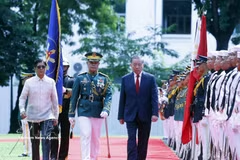
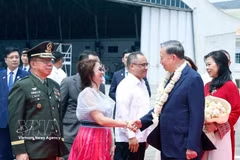
Philippine President hosts official welcome ceremony for Vietnam’s top leader
The trip marks the Vietnamese leader’s first visit to the Philippines as Party General Secretary and State President. It takes place as the two countries are preparing to celebrate the 50th anniversary of diplomatic relations and as the Philippines assumes the ASEAN Chairmanship in 2026.
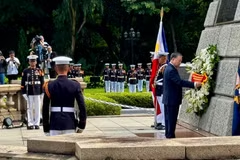
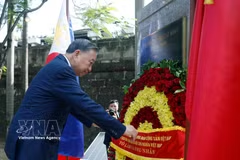
Top Vietnamese leader pays tribute to Philippine national hero Jose Rizal
The Rizal Monument is one of the Philippines’ most significant historical landmarks. Located in the capital city of Manila, it was erected in honour of Dr. Jose Rizal, a physician, writer, and national hero who played a pivotal role in the country's struggle for independence.
☀️ Morning digest on June 1
The following is a list of selected news summaries reported last weekend by the Vietnam News Agency.
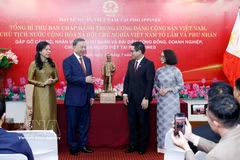
Vietnam’s top leader receives Philippines-based organisations, businesses
Talking to President of the Asian Development Bank (ADB) Masato Kanda, General Secretary and President To Lam affirmed that Vietnam attaches importance to its cooperation with the bank and wishes to further deepen this partnership in the new development phase.
Party and State leader meets Vietnamese community in Philippines
General Secretary and President To Lam encouraged the Vietnamese in the Philippines to remain united, abide by local laws, contribute practically to the homeland and continue fostering friendship and cooperation between the two countries.
Top leader’s visit boosts Vietnam – Singapore ties, ASEAN’s global standing: experts
Looking ahead to 2045, when Vietnam aims to become a developed economy, the two countries are expected to be linked by one of the world's most advanced strategic partnerships, Professor Vu Minh Khuong noted, describing this as a distinctive feature of General Secretary and President Lam’s visit.
Vietnam – “Architect” of regional peace, security
By moving from crisis response to proactive risk reduction, Vietnam has positioned itself as a responsible and mature “architect” of regional peace, said a Malaysia-based expert.
Top Vietnamese leader pays tribute to President Ho Chi Minh in Manila
The President Ho Chi Minh monument in the ASEAN Garden holds profound historical, cultural, and diplomatic significance, reflecting the friendship between Vietnam and the Philippines, as well as the solidarity within the ASEAN community.
General Secretary and President To Lam arrives in Manila for state visit to Philippines
The trip demonstrates Vietnam's high regard for its friendship and cooperation with the Philippines, as well as with ASEAN and the Southeast Asian region.
Top leader of Vietnam pays state visit to Philippines
Party General Secretary and State President To Lam and his spouse are paying state visit to the Philippines from May 31 to June 1 at the invitation of President Ferdinand Romualdez Marcos Jr. and his spouse.
Malaysian scholar highlights Vietnam’s growing role in the region
Referring to Vietnam’s presence at this year’s Shangri-La Dialogue, the scholar said the country has stepped onto the regional stage with a renewed posture, positioning itself as a constructive diplomatic player committed to promoting peace and stability.
Top leader’s spouse visits Vietnamese language class in Singapore
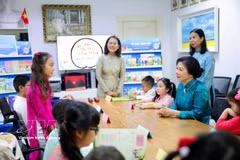
Ngo Phuong Ly, spouse of General Secretary of the Communist Party of Vietnam Central Committee and State President To Lam, on May 30 visited the Lac Hong Vietnamese language class in Singapore.
Vietnam-Singapore ties: a cooperation model in ASEAN
The two sides agreed that, amid an increasingly complex and volatile global environment, Vietnam and Singapore should further strengthen coordination, for the development of each country, as well as for peace, stability and cooperation in Southeast Asia.
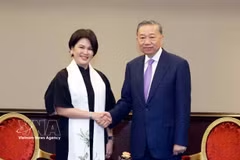
Vice Chairwoman of China’s Guangxi Zhuang Autonomous Region welcomed in Hanoi
Guangxi is ready to increase imports of Vietnamese agricultural and aquatic products, coordinate in upgrading border gates and facilitating customs clearance, promote cross-border tourism cooperation, and enhance people-to-people exchanges and friendship between localities on both sides
Vietnam, Australia foster Comprehensive Strategic Partnership
Vietnam and Australia have agreed to further deepen the economic cooperation pillar and work toward the early realisation of the goal of raising bilateral trade turnover to 20 billion USD.
Indonesian media praise top leader’s message on ASEAN centrality
Against the backdrop of an increasingly complex geopolitical environment, the top Vietnamese leader's messages of ASEAN unity, strategic autonomy, and trust-building have been widely regarded as timely and practical. They also underscore Vietnam’s increasingly active role in regional and international affairs.