Shangri-la Dialogue underscores Vietnam’s growing role in regional, global security architecture

Vietnam’s presence at the 23rd Shangri-la Dialogue met the international community’s expectations for balanced, constructive and bridge-building contributions from a country that consistently pursues a non-aligned foreign policy.

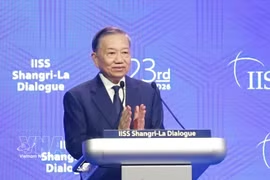
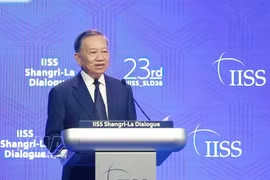
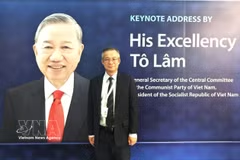
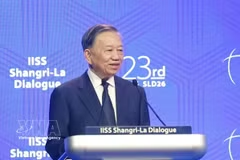
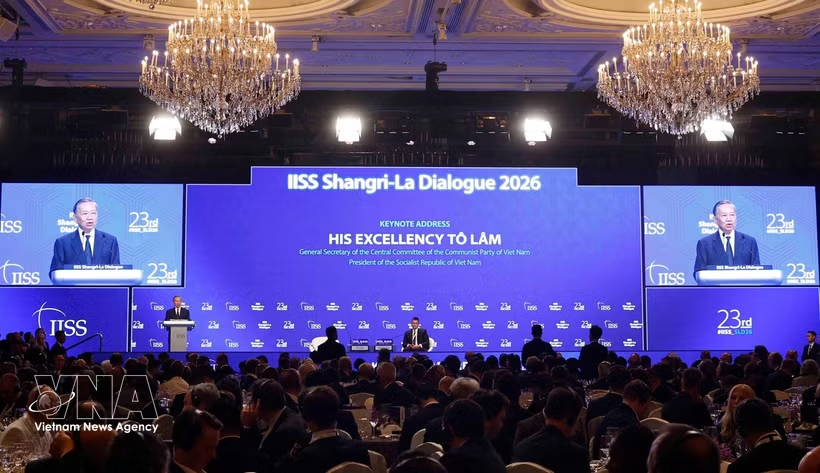
Party General Secretary and State President To Lam delivers the keynote address at the 23rd Shangri-la Dialogue in Singapore. (Photo: VNA)

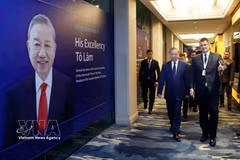
Hanoi (VNA) – General Secretary of the Communist Party of Vietnam Central Committee and State President To Lam’s participation in and keynote address at the 23rd Shangri-la Dialogue in Singapore has reaffirmed Vietnam’s rising stature in regional and global affairs, while demonstrating the country’s proactive approach to shaping a stable and cooperative security environment amid growing international uncertainties.

During his tour to three ASEAN countries from May 27 to June 1, the Vietnamese leader’s appearance at Asia’s premier security forum attracted considerable attention from observers.

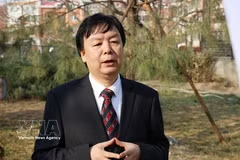
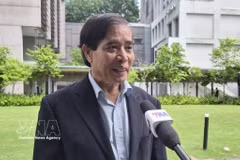
According to Ambassador Pham Quang Vinh, former Deputy Minister of Foreign Affairs, the invitation extended to Vietnam’s top leader reflected the confidence of the international community in Vietnam’s role and contributions.

This confidence is underpinned by Vietnam’s extensive network of international partnerships, Vinh said, given that the country currently maintains diplomatic frameworks ranging from Comprehensive Partnerships to Comprehensive Strategic Partnerships with more than 40 countries, including 15 Comprehensive Strategic Partners, among them all five permanent members of the United Nations Security Council.

Vinh further noted that the organisers’ decision to invite the Party and State leader as a keynote speaker reflected their strong interest in Vietnam’s perspectives on the pressing challenges facing regional peace, security and development.

Dr. Dao Ngoc Bau, Director of the Institute of Politics and International Relations under the Ho Chi Minh National Academy of Politics, described the invitation as recognition of Vietnam’s international credibility accumulated through four decades of renewal and integration. He stressed that Vietnam is increasingly transitioning from being an object of geopolitical strategies to becoming an active participant in shaping the regional security order.

Vietnam’s presence at the forum met the international community’s expectations for balanced, constructive and bridge-building contributions from a country that consistently pursues a non-aligned foreign policy, he assessed.

The speech identified three interconnected challenges facing the international community: the crisis of the international order, the crisis of development models, and the crisis of strategic trust among nations. By highlighting the links between these challenges, the Vietnamese leader offered a comprehensive assessment of the factors affecting global stability.

Importantly, the address went beyond diagnosis and proposed practical solutions. The six directions outlined by the leader included strengthening a rules-based international order, promoting dialogue and cooperation, enhancing human security, improving societal resilience, ensuring responsible governance of emerging technologies, and reinforcing preventive diplomacy.

Observers viewed these proposals as a coherent framework aimed at fostering sustainable peace. In particular, the emphasis on international law, trust-building, dialogue and cooperation was seen as a balanced and constructive approach to addressing security challenges.

The speech also highlighted the importance of building an open, inclusive and ASEAN-centred regional architecture. According to Dr. Bau, this reflects Vietnam’s exercise of “structural soft power” – the ability to shape norms, institutions and frameworks for cooperation rather than impose its will on others.

Beyond traditional security issues, the leader drew attention to emerging challenges arising from artificial intelligence, big data and cyberspace. Ambassador Vinh noted that while these technologies offer tremendous opportunities for development, they also require responsible governance and international cooperation to prevent misuse.

Experts agreed that the strong interest generated by the speech demonstrates growing confidence in both Vietnam’s role and the strategic vision of its leadership. They described the address as a significant intellectual contribution to regional security discussions and further evidence of Vietnam’s increasingly active role in promoting peace, stability and sustainable development in the region and beyond./.


VNA
See more

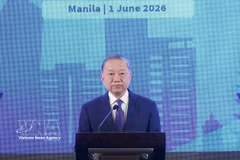
General Secretary of the Communist Party of Vietnam (CPV) Central Committee and State President To Lam speaks at the Vietnam-Philippines Business Forum in Manila on June 1. (Photo: VNA)

Vietnam-Philippines economic ties should be elevated to new height: Top Vietnamese leader

The Vietnamese leader urged the two sides to further promote two-way investment in highly complementary and long-term value-adding sectors, such as modern agriculture, food processing, clean energy, logistics, supporting industries, digital economy, and innovation. He stressed the need to move from mere trade exchange to co-investment, co-production, and deeper participation in regional value chains.

Prof. Mi Liang, Director of the Centre for Southeast Asian Studies at the Beijing Foreign Studies University of China. (Photo: VNA)

Top Vietnamese leader’s Shangri-La address makes strong impact: Chinese scholar

Party General Secretary and State President To Lam reaffirmed and emphasised the central role played by ASEAN, stating clearly that Vietnam regards ASEAN as the most important strategic space, and that the Asia-Pacific regional security architecture should be led by ASEAN rather than becoming an arena for rivalry among major powers.

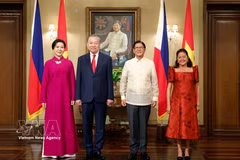
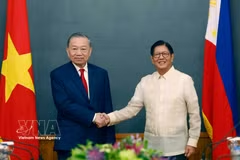
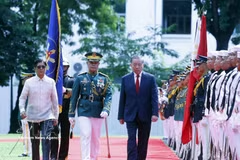
General Secretary of the Communist Party of Vietnam (CPV) Central Committee and State President To Lam (L) and Philippine President Ferdinand Romualdez Marcos Jr. before their talks in Manila on June 1. (Photo: VNA)

Vietnam's top leader holds talks with Philippine President

Vietnam always values and wishes to further deepen its friendly neighbourly relations with the Philippines in all areas on the basis of a shared commitment to peace, stability and respect for international law, affirmed General Secretary of the Communist Party of Vietnam (CPV) Central Committee and State President To Lam.

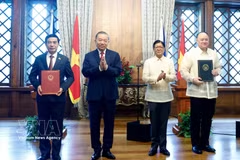
General Secretary of the Communist Party of Vietnam Central Committee and State President To Lam (second, left), and Philippine President Ferdinand Romualdez Marcos Jr. (second, right) witness the exchange of a Memorandum of Understanding (MoU) on defence cooperation between the Ministry of National Defence of Vietnam and the Ministry of Defence of the Philippines. (Photo: VNA)

Vietnam, Philippines upgrade bilateral ties to Enhanced Strategic Partnership

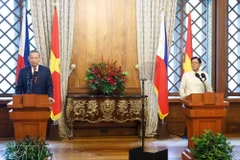
Both sides emphasised the importance of international law and the United Nations Charter, the ASEAN Charter, and the principles of equality, cooperation, and mutual benefit; reaffirmed peace, stability, security, safety, and freedom of navigation and overflight in the East Sea; and stressed the need to resolve disputes peacefully on the basis of international law, including the 1982 United Nations Convention on the Law of the Sea (UNCLOS).

The Cambodian scholar is impressed by Party Genereral Secretary and State President To Lam's keynote address. (Photo: VNA)

Vietnam’s hallmark at 23rd Shangri-La Dialogue: Active peace builder in volatile world

Vietnam called for an open, inclusive regional architecture with ASEAN at its core, insisting that all new initiatives be transparent, respect international law, complement one another, and avoid undermining ASEAN centrality or turning Southeast Asia into an arena for great power rivalry. It expressed full support for and readiness to cooperate with the Philippines - ASEAN Chair 2026.

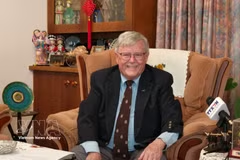
Professor Carl Thayer from the Australian Defence Force Academy at the University of New South Wales. (Photo: VNA)

Vietnam's strategic autonomy earns praise from Australian expert

Vietnam has an opportunity to further entrench its leadership position within ASEAN, collaborate with like-minded partners, and demonstrate that Hanoi is, and will continue to be, a friend, a reliable partner, and an active and responsible member of the international community, said Professor Carl Thayer from the Australian Defence Force Academy at the University of New South Wales.

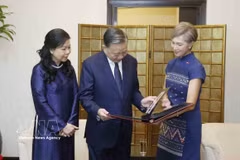
Seeing off the Vietnamese delegation at Changi International Airport on May 31 morning, Singapore's Minister for Digital Development and Information Josephine Teo (right) presents Party General Secretary and State President To Lam and his wife with an album of photographs documenting their activities in Singapore. (Photo: VNA)

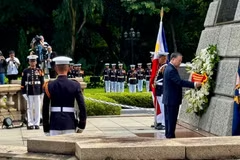
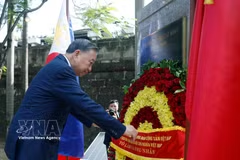
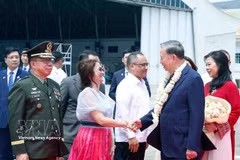
Top leader of Vietnam pays state visit to Philippines

Party General Secretary and State President To Lam and his spouse are paying state visit to the Philippines from May 31 to June 1 at the invitation of President Ferdinand Romualdez Marcos Jr. and his spouse.