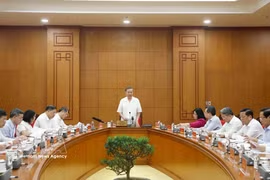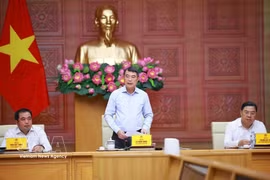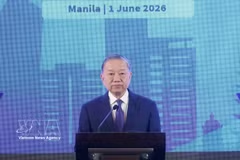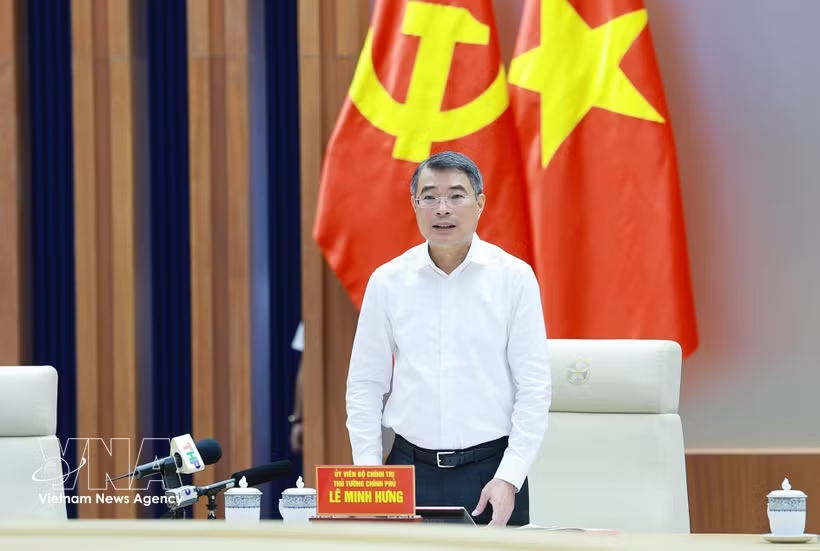
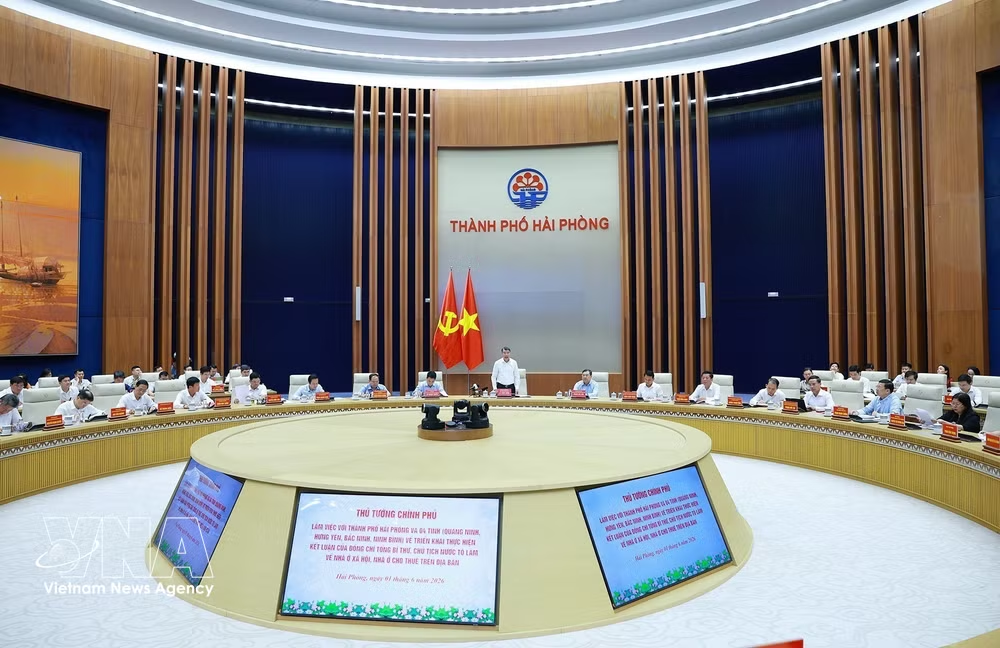
Hai Phong (VNA) -Prime Minister Le Minh Hung on June 1 chaired a working session in Hai Phong with leaders of five localities in the Northern Key Economic Region - Hai Phong, Quang Ninh, Bac Ninh, Ninh Binh and Hung Yen - to implement the direction on the development of rental housing from Party General Secretary and State President To Lam.
The session aimed to implement Conclusion No. 64-TB/VPTW dated May 22, 2026, on the Party leader’s guidance regarding the implementation of Directive No. 34-CT/TW on social housing and future housing development orientations.
The conclusion emphasised that, alongside housing for sale, priority should be given to rental housing, particularly apartment rental models in major urban centres, industrial parks, economic zones, growth poles and key economic corridors.
Participants reviewed rental housing demand in each area, considering different market segments and target groups. They also examined the gap between supply and demand, and pinpointed issues in policy frameworks.
Drawing on practical experience, particularly Hai Phong’s model, they discussed suitable approaches for each locality, procedures, resource mobilisation mechanisms and preferential credit schemes, including those linked to the National Housing Fund.
They also examined the roles of national and local housing funds and proposed amendments to relevant legislation to establish a more coherent and stable legal framework.
Concluding the meeting, PM Hung stressed that rental housing development is a major policy direction clearly defined by the Party and State through recent directives of the Secretariat and conclusions of the Party General Secretary and State President.
He urged ministries, sectors and localities to regard the task as an important, urgent and long-term political mission.
He underlined that rental housing is not merely a housing issue but also one of social welfare, workforce quality, investment competitiveness and sustainable development across the Northern Key Economic Region.
The leader praised Hai Phong for pioneering efforts to strengthen its local housing fund and for achieving notable progress in social housing development. He also acknowledged the proactive preparations undertaken by Quang Ninh, Bac Ninh, Ninh Binh and Hung Yen to implement rental housing initiatives.
However, PM Hung noted that the current supply of rental housing remains far below actual demand. Most workers still rely on informal rental accommodation that often lacks adequate living conditions, fire safety standards and social infrastructure. He also pointed to the underutilisation of public housing assets, insufficient financial and credit incentives for investors, and the slow and uneven operation of local housing funds.
Calling for a fundamental shift in housing development thinking, the PM said that while previous efforts focused mainly on housing for sale, localities must now develop both commercial housing and rental housing. Rental housing, he stressed, should become a strategic and long-term segment, particularly in areas with large industrial parks, economic zones and migrant worker populations.
He affirmed that while the State does not subsidise housing directly, it cannot leave the market entirely to self-regulate. The State must play a facilitating role through planning, institutions, policies and financial instruments to guide healthy market development. Under this approach, businesses should be encouraged to invest and earn reasonable returns, while residents gain access to stable, long-term and safe housing. Rental housing development, he added, must be closely integrated with industrial park planning, economic zones, transport corridors and population management.
PM Hung urged localities to act immediately rather than wait for additional guidance. Matters falling within the local authority should be addressed, while ministries and sectors must promptly resolve issues under their jurisdiction. Recommendations requiring legislative amendments should be fully consolidated for inclusion in upcoming revisions to the Housing Law and the Law on Real Estate Business.
As immediate tasks, the PM instructed Hai Phong, Quang Ninh, Bac Ninh, Ninh Binh and Hung Yen to urgently review and adjust rental housing planning, clearly identifying locations and scales of rental housing projects linked to key industrial parks and strategic development zones.
The five localities were also directed to assess rental housing demand by industrial park and target group, and formulate detailed development plans with specific targets, priority project lists, investment resources and implementation roadmaps.
These plans must be completed by this June to serve as the basis for allocating rental housing development targets nationwide.
The Government leader particularly stressed the need to move swiftly from planning to implementation. Each locality, he said, should strive to commence at least one rental housing project in this month and continue launching larger-scale projects in the third and fourth quarters of the year. He cautioned against delays caused by excessive focus on planning and proposal preparation without concrete action.
Regarding policy mechanisms, localities were asked to submit proposals based on practical experience to the Ministry of Construction for consolidation and inclusion in the revised Housing Law and Law on Real Estate Business, with completion targeted for July.
PM Hung tasked the Ministry of Construction with refining the legal framework for rental housing and issuing technical standards for small- and medium-scale rental housing, including family-operated rental accommodation, with particular attention to fire safety requirements. The ministry was also instructed to consolidate rental housing development plans through 2030 for the five localities and report policy recommendations to the PM in July.
In addition, the ministry will work with the localities to develop a rental housing demand map by segment, particularly for industrial workers, to support planning and resource allocation. The task is scheduled for completion by July. The ministry will also coordinate with the Ministry of Finance to examine mechanisms allowing enterprises and cooperatives to purchase commercial or social housing solely for rental purposes.
Meanwhile, the Ministry of Finance was directed to study financial, tax and capital incentives to attract businesses, investment funds and long-term capital into the rental housing sector. The State Bank of Vietnam was tasked with developing preferential credit policies and suitable interest rates for projects with long investment recovery periods.
Emphasising that the Northern Key Economic Region remains one of Vietnam’s most important growth engines, PM Hung said that effectively addressing workers’ housing needs would help retain human resources, strengthen investment competitiveness, ensure social welfare and lay a solid foundation for rapid and sustainable economic development in the years ahead./.