Vietnam, China foster cooperation in theory research, official training

The two sides shared the view that both sides should strengthen cooperation to translate high-level common understandings into practical outcomes. Cooperation, they agreed, should focus on two key pillars: theory research and the training and capacity building of officials.

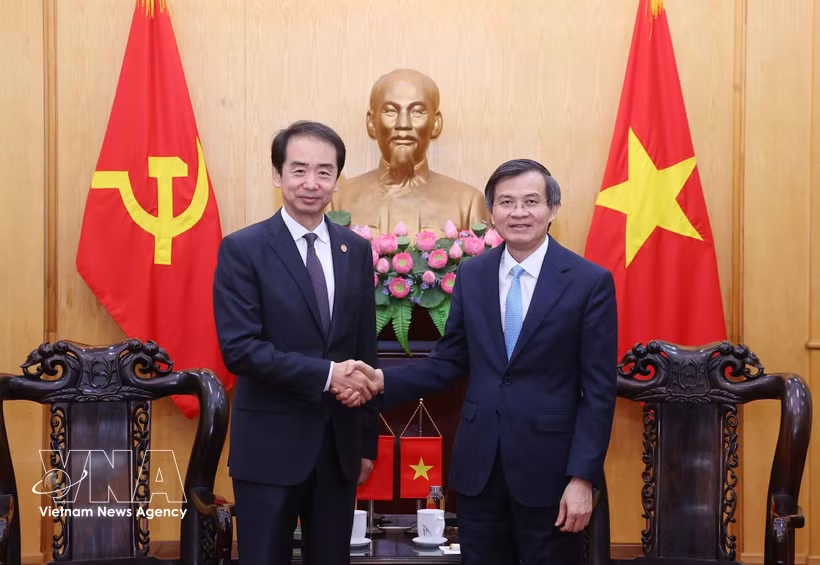
Politburo member and Director of the Ho Chi Minh National Academy of Politics (HCMA) Doan Minh Huan (R) receives Chinese Ambassador to Vietnam He Wei in Hanoi on June 1 (Photo: VNA)

Hanoi (VNA) - Politburo member and Director of the Ho Chi Minh National Academy of Politics (HCMA) Doan Minh Huan had a working session with Chinese Ambassador to Vietnam He Wei at the academy on June 1.

The two sides discussed measures to implement the agreements and common perceptions reached by the top leaders of the two countries during Party General Secretary and State President To Lam’s recent visit to China.

Huan and He shared the view that both sides should strengthen cooperation to translate high-level common understandings into practical outcomes. Cooperation, they agreed, should focus on two key pillars: theory research and the training and capacity building of officials.

Regarding theory work, both sides underscored the importance of joint research efforts to enrich the theoretical foundations underpinning the development of the two countries. As the two socialist nations enter a crucial stage of development, they agreed to intensify studies on key issues, including the transitional period towards socialism, the development of new productive forces and ecological civilisation.

They also highlighted the significance of theoretical exchanges between the two Parties, agreeing on the need to enhance their quality and renew their formats to create a more open platform for substantive and in-depth discussions among experts from both countries.

On official training and development, Huan stressed that cooperation should be based on mutual exchange and interaction to enhance the capacity of officials on both sides, thereby meeting the development requirements of each country in the new context.

The HCMA is interested in expanding access to training curricula offered by the Central Party School of China and other leading Chinese institutions specialising in political and theoretical education. The Vietnamese side also showed interest in applying experiential learning models at revolutionary heritage sites to strengthen Party spirit and ideological training.

In addition, the academy proposed organising specialised training courses for Vietnamese officials in areas where China has considerable expertise, including urban governance, science and technology development, talent attraction and heritage-based economic development.

He expressed his support for the proposals put forward by the academy. He affirmed his commitment to serving as a bridge between the two sides by promoting exchange mechanisms between the academy and the Chinese Embassy, with a view to establishing joint research groups in the future.

The Chinese ambassador also pledged that the embassy will support efforts to advance cooperation agreements between the academy and its Chinese partners, helping ensure that collaboration delivers tangible results and contributes to the broader development of bilateral relations./.

VNA
See more

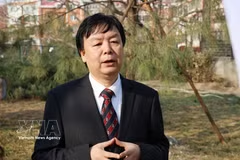
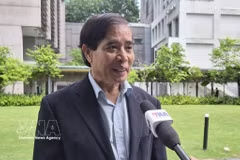
Prof. Mi Liang, Director of the Centre for Southeast Asian Studies at the Beijing Foreign Studies University of China. (Photo: VNA)

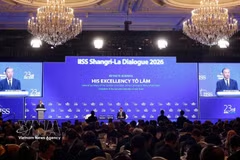
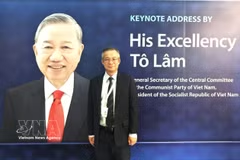
Top Vietnamese leader’s Shangri-La address makes strong impact: Chinese scholar

Party General Secretary and State President To Lam reaffirmed and emphasised the central role played by ASEAN, stating clearly that Vietnam regards ASEAN as the most important strategic space, and that the Asia-Pacific regional security architecture should be led by ASEAN rather than becoming an arena for rivalry among major powers.

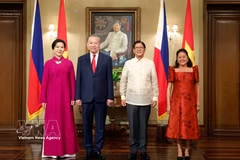
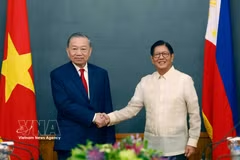
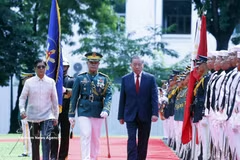
General Secretary of the Communist Party of Vietnam Central Committee and State President To Lam (L) and Philippine President Ferdinand Romualdez Marcos Jr. before their talks in Manila on June 1. (Photo: VNA)

Vietnam's top leader holds talks with Philippine President

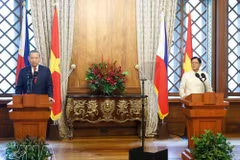
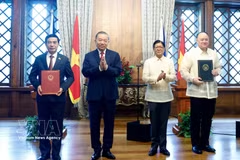
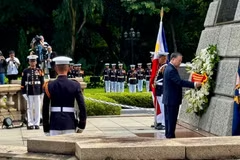
Vietnam always values and wishes to further deepen its friendly neighbourly relations with the Philippines in all areas on the basis of a shared commitment to peace, stability and respect for international law, affirmed General Secretary of the Communist Party of Vietnam (CPV) Central Committee and State President To Lam.

The Cambodian scholar is impressed by Party Genereral Secretary and State President To Lam's keynote address. (Photo: VNA)

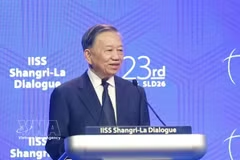
Vietnam’s hallmark at 23rd Shangri-La Dialogue: Active peace builder in volatile world

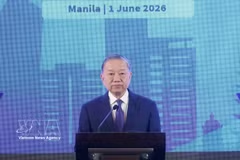
Vietnam called for an open, inclusive regional architecture with ASEAN at its core, insisting that all new initiatives be transparent, respect international law, complement one another, and avoid undermining ASEAN centrality or turning Southeast Asia into an arena for great power rivalry. It expressed full support for and readiness to cooperate with the Philippines - ASEAN Chair 2026.

Professor Carl Thayer from the Australian Defence Force Academy at the University of New South Wales. (Photo: VNA)

Vietnam's strategic autonomy earns praise from Australian expert

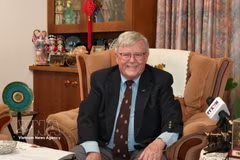
Vietnam has an opportunity to further entrench its leadership position within ASEAN, collaborate with like-minded partners, and demonstrate that Hanoi is, and will continue to be, a friend, a reliable partner, and an active and responsible member of the international community, said Professor Carl Thayer from the Australian Defence Force Academy at the University of New South Wales.