IP enforcement actions triple as government tightens oversight

Since the Prime Minister issued Directive 38, which directs ministries and agencies to strengthen efforts against IP violations, 1,438 cases had been detected and processed as of May 27.

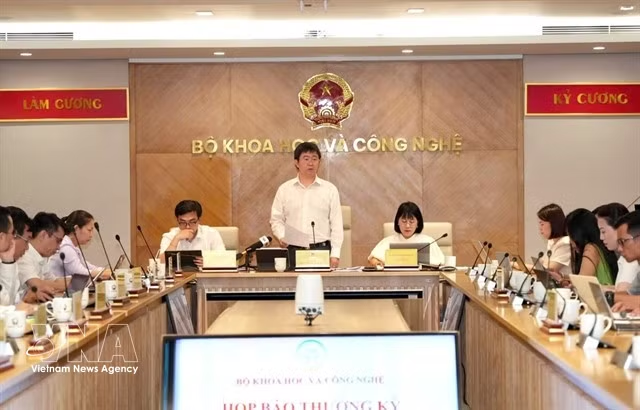
The Ministry of Science and Technology holds its monthly press briefing on June 1. (Photo: VNA)

Hanoi (VNS/VNA) – More than 1,400 intellectual property (IP) violations have been uncovered in less than a month under a nationwide enforcement campaign, the Ministry of Science and Technology said on June 1, highlighting a sharp increase in action against infringement.

Since the Prime Minister issued Directive 38 on May 5 this year, which directs ministries and agencies to strengthen efforts against IP violations, 1,438 cases had been detected and processed as of May 27.

Of those, 1,146 were handled through administrative penalties and 28 were referred for criminal investigation. Total fines exceeded 12.6 billion VND (roughly 480,000 USD), while the estimated value of seized infringing goods reached approximately 35.7 billion VND (about 1.4 million USD).

The pace of enforcement has accelerated significantly. Tran Le Hong, deputy director of the National Office of Intellectual Property, said that within just three weeks, the number of administrative cases processed was running at around three times the monthly average recorded throughout 2025.

The number of IP-related criminal cases referred for prosecution had already reached about 60% of the total recorded in all of 2025. Enforcement actions by the market surveillance force also increased by about 210% compared with May 2025.

On the regulatory front, the ministry has submitted a draft decree to Prime Minister Le Minh Hung that would allow authorities to block access to domain names found to infringe industrial property rights.

The proposed measure is intended to speed up enforcement and address a longstanding challenge, as international domain registrars without a legal presence in Vietnam have often proved difficult to compel into compliance.

Hong also said his office had held working sessions with C03, the Ministry of Public Security's agency responsible for investigating corruption, economic crimes and smuggling, as well as market surveillance officials in the Mekong Delta city of Can Tho, to coordinate enforcement efforts under Directive 38.

The office also issued eight formal notices to agencies nationwide regarding 37 suspected trademark infringement cases.

The ministry announced plans to establish a national IP enforcement database this year. The system would consolidate enforcement records and case histories, providing agencies with a shared platform to retrieve and cross-reference information more efficiently.

"It will be a powerful tool for statistics, forecasting trends in IP infringement and informing policy," Hong said.

The briefing also highlighted a number of developments in innovation and digital transformation.

Vietnam climbed five places to rank 50th globally in StartupBlink's 2026 Global Startup Ecosystem Index, its highest position to date.

The country's innovation ecosystem now includes 963 science and technology enterprises, 20 technology exchange platforms and 37 innovation centres across 26 of Vietnam's 34 provinces and centrally administered cities.

In digital transformation, the digital economy contributed an estimated 14.02% of GDP in 2025, equivalent to around 72.1 billion USD.

Vietnam ranked 11th globally for telecommunications infrastructure, with average mobile broadband speeds of 207.3 Mbps and fixed broadband speeds of 287.33 Mbps.

The country has 110.5 million mobile broadband subscribers, including 24.29 million 5G users, and 25.62 million fixed broadband subscribers. Postal service revenue in May was estimated at 8.5 trillion VND (323 million USD), up 30% year-on-year.

May also saw significant international engagement. Party General Secretary and State President To Lam attended the Vietnam – India Innovation Forum in New Delhi. The ministry held bilateral talks with Sri Lanka on cooperation in 6G, drones and satellite technology, and participated in international forums on artificial intelligence, semiconductors and digital infrastructure in Singapore, the US, Thailand and the Philippines.

Domestically, the ministry organised a series of events to mark Science, Technology and Innovation Day on May 18, including a science book fair themed Knowledge – Building a Digital Nation and a technology marketplace focused on AI applications.

Looking ahead, the ministry said it would focus on implementing Resolution 57, a key directive on science and technology development, by refining the legal framework governing science and technology, digital transformation and telecommunications.

It also plans to advance strategic technologies, restructure national science and technology programmes and submit a national digital architecture framework to the Prime Minister as a foundation for comprehensive digital transformation in the years ahead./.

VNA

See more

Illustrative image

Proactive cybersecurity essential in age of AI-powered crime: experts

According to Dr. Le Minh Nghia, Chairman of the Vietnam Financial Consulting Association (VFCA), AI has become a key driver reshaping the global financial industry. In Vietnam, the technology is already widely used in banking and finance for credit analysis, electronic customer identification (eKYC), risk management, service personalisation and real-time transaction processing.

Dr Nguyen Huu Ha, Deputy Director of the Gia Lai Department of Science and Technology, speaks at the scientific workshop on recent advances in the study of strongly correlated electron systems opened in the central province on June 1, 2026. (Photo: VNA)

Global physicists discuss strongly correlated electron materials advances

The workshop aims to achieve three key objectives providing a platform for academic exchange and strengthening collaboration between leading international scientists and young researchers, including doctoral students; promoting multidimensional scientific dialogue on major open questions in the field; and initiating new directions for international research cooperation with the active participation of Vietnam's physics community.

Tra Vinh University attracts a growing number of students and interns from Vietnam and abroad for study and research programmes. (Photo: VNA)

Fostering skilled workforce for innovation era: experts

Experts said close coordination among State management agencies, research institutes, universities, and businesses will improve training quality and serve the dual goals of quality education and practical research application.

Manufacturing cameras at the Sunny Opotech Vietnam Co., Ltd. in the Yen Binh Industrial Park, Thai Nguyen province. (Illustrative photo: VNA)

OV intellectuals pin hopes on stronger Vietnam – Singapore technology ties

OVs hope the two countries can establish an interconnected cooperation mechanism in the technology supply chain, from sharing research, testing, and development infrastructure to training human resources, thereby forming a technology alliance able to compete with others in the ASEAN region and the world.

Deputy Prime Minister Nguyen Van Thang talks with technology enterprises on the sidelines of the event. (Photo: VNA)

Vietnam launches first national AI-native hackathon

Part of the Vietnam Innovation Challenge 2026, the programme goes beyond conventional coding competitions by requiring participants to develop AI-driven solutions to business challenges in real time.

Ho Chi Minh City: Rising hub for science, technology, innovation

Ho Chi Minh City: Rising hub for science, technology, innovation

Ho Chi Minh City currently hosts 143 science and technology enterprises, accounting for around 20% of the national total. Total factor productivity (TFP) contributes 59% to the city’s GRDP growth, with science and technology responsible for 74% of TFP growth.

A view of the talks in Bangkok on May 28. (Photo: VNA)

Vietnam, Thailand step up cooperation in science, technology, innovation

Over recent years, NSTDA has built strong partnerships with Vietnamese research institutes and organisations in agriculture, biotechnology, energy and sustainable development. Notable examples include joint projects on cassava value chains, salt-tolerant rice, biotechnology products and an initiative on green energy cooperation and development in the Mekong basin.

Targeting full integration of all individual and organisational documents on VNeID by 2028 in accordance with regulations on electronic identification and authentication. (Photo: VNA)

VNeID set to become Vietnam’s all-in-one digital super app

The project aims to transform VNeID into a modern, secure and highly scalable national digital platform capable of effectively serving citizens, businesses, agencies and organisations in handling administrative procedures, accessing online public services, conducting electronic transactions and using digital utilities.

Thai Binh Seed Group Joint Stock Company has applied science and technology in research and production to develop numerous high-yield, high-quality crop varieties. (Photo: VNA)

Localities aim for higher growth through science, technology

Experiences from localities nationwide show that Resolution 57 is fostering a marked transformation in development mindset. Science and technology, innovation and digital transformation are increasingly becoming foundational drivers of economic growth and opening new development space for localities in the years ahead.