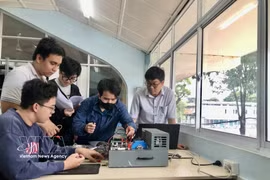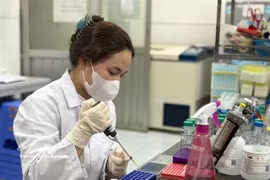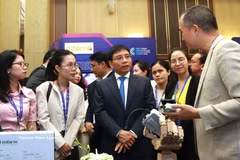
Hanoi (VNA) – Human resources are seen as the decisive factor in driving breakthroughs in science, technology and innovation, prompting the Party and State to roll out policies aimed at training, attracting and effectively utilising intellectuals, experts and highly skilled workers amid the current transformation era.
Progress on the ground
Conclusion No. 18-KL/TW of the second plenum of the 14th Party Central Committee noted that Vietnam made notable progress in developing human resources for science, technology, innovation, and digital transformation during the 2021–2025 period.
In recent years, government agencies, research institutes, universities, and businesses have adopted a wide range of solutions to develop scientific, technological, and innovation-related personnel.
During the 2021–2025 period, Vietnam National University, Ha Noi (VNU–Hanoi) introduced 10 sets of mechanisms to encourage the development of science, technology, and innovation.
The university also implemented a scheme to attract outstanding scientists and high-performing research groups, offering support packages of up to 150 million VND (5,600 USD) for papers published in journals ranked among the world’s top 1%.
In 2025, it allocated around 100 billion VND (3.8 million USD) to priority research areas, support for strong research groups, investment in facilities and equipment, and incentives for the establishment of new research institutes.
Assoc. Prof. Pham Bao Son, Vice President of VNU–Hanoi, said that over the past four years the university had attracted nearly 500 PhD holders and established 50 leading research groups.
A number of globally renowned scientists have been invited to lead research in fields such as semiconductor materials, quantum technology, artificial intelligence, data mining, and social network analysis.
Notably, VNU–Hanoi has signed strategic cooperation agreements with domestic and international corporations, in line with the Politburo's Resolution 57 on breakthroughs in the development of science, technology, innovation, and national digital transformation.
The cooperation focuses on scientific research, innovation, technology transfer, training of high-quality personnel, and addressing practical, market-driven business challenges.
Meanwhile, the Vietnam Academy of Science and Technology (VAST) has identified the University of Science and Technology of Hanoi as playing a central role in building an internationally recognised research university model.
The university has implemented numerous programmes collaborating with nearly 100 Vietnamese scientists based in France, the US, Hungary, and Japan.
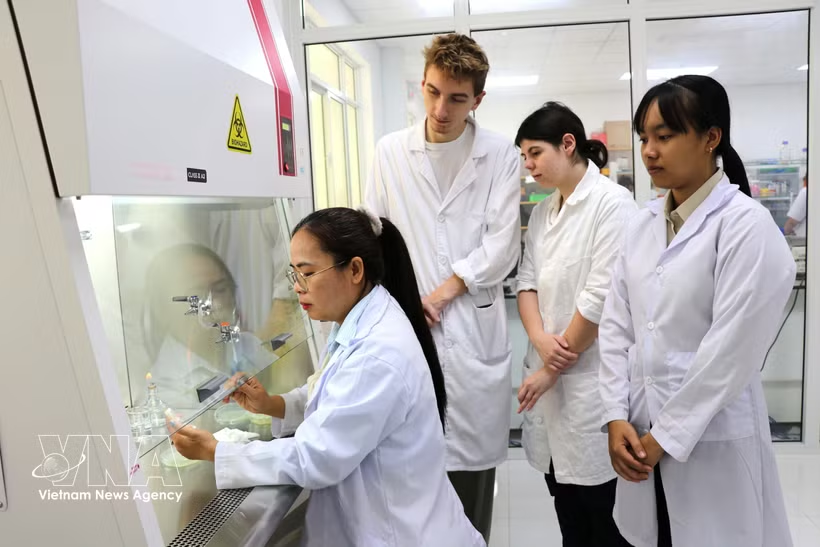
It has also attracted foreign experts, established joint research groups, co-supervised doctoral candidates, shared databases and laboratories, and recruited and supported promising young scientists with outstanding research achievements.
According to Nguyen Thi Van Nga, Director of the Centre for Scientific Data and Information under VAST, in 2025 the academy published 2,437 research papers, including 1,699 in international publications.
It carried out 527 research projects at various levels, obtained 105 patents and utility solution certificates, and signed 836 contracts for research, technology transfer, and scientific services, helping to address major challenges faced by ministries, agencies, and businesses.
The remarkable transformation in the development of scientific, technological, and innovation-related human resources has helped lay a solid foundation for socio-economic development.
According to the Ministry of Science and Technology, a workforce of more than 2.3 million people, combined with an expanding culture of entrepreneurship and innovation, has turned science, technology, and innovation into a direct productive force contributing to the State budget and macroeconomic stability.
Key challenges remain
Conclusion No. 18-KL/TW acknowledged that science, technology, innovation, and digital transformation have not yet contributed substantially to growth, while mechanisms and policies in these fields still face numerous bottlenecks.
Therefore, it is necessary to strengthen public-private cooperation in attracting, training, and effectively utilising high-quality scientific and technological personnel; to build, connect, and develop networks of experts and scientists at home and abroad; and to substantially improve mechanisms and policies for attracting talented individuals and specialists from both the domestic and international talent pools.
According to Assoc. Prof. Dang Hoai Bac, President of the Posts and Telecommunications Institute of Technology, developing scientific, technological, and innovation-related human resources requires a major overhaul of cooperation mechanisms among universities, research institutes, and businesses to facilitate technology transfer and expand the practical application of research outputs among businesses and government agencies.
Assoc. Prof. Son said that instead of universities and research institutes driving the research agenda, businesses should proactively commission major research projects.
At the same time, policies aimed at attracting international scientists need to be reformed to ensure a favourable working environment and competitive remuneration.
Prof. Tran Hong Thai, President of VAST, stressed the need for clearer regulatory provisions in forthcoming policy documents on mechanisms for the co-supervision of doctoral candidates, as part of broader efforts to train, attract, and effectively utilise scientific and technological personnel.
Doctoral candidates should be embedded in the strategic projects of research institutes, with a focus on areas where the country holds comparative advantages and has genuine development needs.
Experts said close coordination among State management agencies, research institutes, universities, and businesses will improve training quality and serve the dual goals of quality education and practical research application.
In addition, research activities require reforms to project management mechanisms as well as financial and investment policies in order to drive the development of scientific, technological, and innovation-related human resources commensurate with the demands of national transformation./.