Vietnam launches first national AI-native hackathon

Part of the Vietnam Innovation Challenge 2026, the programme goes beyond conventional coding competitions by requiring participants to develop AI-driven solutions to business challenges in real time.

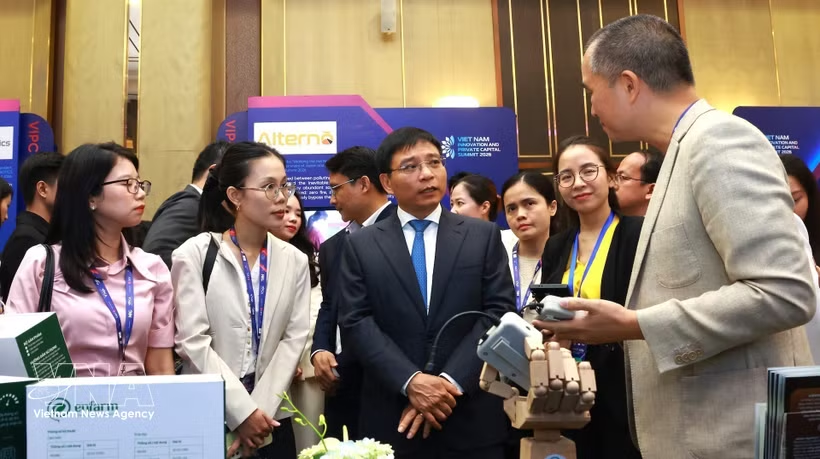
Deputy Prime Minister Nguyen Van Thang talks with technology enterprises on the sidelines of the event. (Photo: VNA)

Hanoi (VNA) – The National Innovation Centre (NIC) on May 28 officially unveiled Vietnam AI Hacks, marking the launch of the country’s first AI-native hackathon at a nationwide scale.

Part of the Vietnam Innovation Challenge 2026, the programme goes beyond conventional coding competitions by requiring participants to develop AI-driven solutions to business challenges in real time.

At the launch ceremony, Tran Viet Hung, founder and CEO of the AI for Vietnam Foundation, said the AI era will favour those capable of creating with AI rather than merely applying existing tools.

According to Hung, the programme gives young Vietnamese developers a platform to engage directly with practical business problems, build functional AI products within 48 hours, and gain access to development opportunities spanning domestic, regional and international markets.

Nguyen Khanh Linh, who oversees investment promotion and strategic technology at the NIC, said the initiative will invite the AI community to tackle issues in sectors such as manufacturing, logistics, healthcare, education, public administration and smart urban development through practical and scalable solutions.

Scheduled to take place in Da Nang from July 17-19, the hackathon is expected to attract between 2,000 and 3,000 developers and young engineers competing intensively over 48 hours.

Ahead of the event, participants will join a five-week series of training sessions and workshops, while post-event activities will focus on investment connections, business partnerships and international growth opportunities.

Thao Griffiths, Public Policy Director for Vietnam, Laos, Cambodia and Myanmar at Meta, said Vietnam has one of the region’s most vibrant technology developer communities.

She noted that the Vietnam Innovation Challenge 2026 seeks to channel this momentum into impactful products capable of addressing pressing business and social issues, while contributing to the growth of both Vietnam’s and Southeast Asia’s digital ecosystems.

Assoc. Prof. Dr Nguyen Gia Nhu, Rector of the School of Computer Science and AI at Duy Tan University, described the initiative as a significant step in preparing a new generation of AI professionals for Vietnam.

As AI increasingly shapes national competitiveness, programmes offering hands-on experience will enable young people not only to study AI, but also to apply it in creating products, solving practical challenges and engaging with businesses, investors and international experts, he added.

The Vietnam Innovation Challenge is jointly organised by the NIC under the Ministry of Finance and Meta, aiming to mobilise innovative solutions from organisations and individuals worldwide to address key national challenges./.​

VNA

See more

Manufacturing cameras at the Sunny Opotech Vietnam Co., Ltd. in the Yen Binh Industrial Park, Thai Nguyen province. (Illustrative photo: VNA)

OV intellectuals pin hopes on stronger Vietnam – Singapore technology ties

OVs hope the two countries can establish an interconnected cooperation mechanism in the technology supply chain, from sharing research, testing, and development infrastructure to training human resources, thereby forming a technology alliance able to compete with others in the ASEAN region and the world.

Ho Chi Minh City: Rising hub for science, technology, innovation

Ho Chi Minh City: Rising hub for science, technology, innovation

Ho Chi Minh City currently hosts 143 science and technology enterprises, accounting for around 20% of the national total. Total factor productivity (TFP) contributes 59% to the city’s GRDP growth, with science and technology responsible for 74% of TFP growth.

A view of the talks in Bangkok on May 28. (Photo: VNA)

Vietnam, Thailand step up cooperation in science, technology, innovation

Over recent years, NSTDA has built strong partnerships with Vietnamese research institutes and organisations in agriculture, biotechnology, energy and sustainable development. Notable examples include joint projects on cassava value chains, salt-tolerant rice, biotechnology products and an initiative on green energy cooperation and development in the Mekong basin.

Targeting full integration of all individual and organisational documents on VNeID by 2028 in accordance with regulations on electronic identification and authentication. (Photo: VNA)

VNeID set to become Vietnam’s all-in-one digital super app

The project aims to transform VNeID into a modern, secure and highly scalable national digital platform capable of effectively serving citizens, businesses, agencies and organisations in handling administrative procedures, accessing online public services, conducting electronic transactions and using digital utilities.

Thai Binh Seed Group Joint Stock Company has applied science and technology in research and production to develop numerous high-yield, high-quality crop varieties. (Photo: VNA)

Localities aim for higher growth through science, technology

Experiences from localities nationwide show that Resolution 57 is fostering a marked transformation in development mindset. Science and technology, innovation and digital transformation are increasingly becoming foundational drivers of economic growth and opening new development space for localities in the years ahead.

Lieutenant Colonel Nguyen Dinh Do Thi of the Department of Cybersecurity and High-Tech Crime Prevention under the Ministry of Public Security speaks at a discussion session. (Photo: VNA)

Experts recommend ‘five don’ts’ to protect personal data

Vietnamese authorities handled more than 30 cases involving the illegal sale and theft of personal data between 2023 and 2025, affecting over 160 million data records across sectors including health, education, finance, banking and telecommunications.

Deputy Prime Minister Ho Quoc Dung speaks at the meeting. (Photo: VNA)

Deputy PM demands full disbursement for sci-tech in 2026

As of May 12, total disbursed capital reached 7.95 trillion VND, equivalent to 14.78% of the Prime Minister’s plan. Of this, central budget disbursement hit 4.06 trillion VND, or 14.8% of the target, while local budget disbursement exceeded 3.88 trillion VND, or 14.75%.